v2026 - Production Ready

White Label Yacht Marketplace - Listings, Broker Lead Pipeline & Marine Services

Buyer-to-Broker Yacht Marketplace, Charters & Marine Services

A white label yacht marketplace published under your brand: buyers filter by real vessel specs, brokers work a staged lead pipeline instead of an inbox, and eight marine service lines earn beside every listing.

Launch within 6 Days using

  • 60 Days Platform Guidance
  • Complete Source Codes
  • Complete Rebranding
  • Complete Whitelabeling
  • App Publishing Support
  • Free 1 Year Updates
MXYacht console · Fleet deskLive
Open enquiries38
Listings online1,284
Marine offerings8

Marina-wide activity ticker

  • Moderator approves a listingAwaiting-approval list
  • Enquiry received on a 52 ft sloopEnquiry pipeline
  • Lead advanced to ViewingKanban board
  • Haulage quote askedService desks
  • Listing complaint filedTickets & disputes
  • Featured placement switched onPlacement boosts
  • Asking price cut loggedAsking-price timeline
  • Watchlist notice dispatchedWatch notices
App in action
Structured leads, not loose emailseach enquiry logged with its source, stage and first-reply time

The Build at a Glance

6
Earning Drivers

dealer plans, upgrades, lead fees, shows, tools, licensing

8
Marine Offerings List

charter, insurance, transport, finance, survey and more

0
Fleet Partner Payout Split

the source is yours outright, no per-seat fee

5
User Roles

guest, buyer, seller, broker and admin dashboards

Every Lead Has a Clock

Each enquiry is logged with its source, stage and first-reply time, so a slow broker shows up on the dashboard.

Specs Deep Enough for a Yacht

Over forty vessel fields from beam and draft to engine hours and rig, plus video and a full price history.

Ready to put a yacht marketplace under your own name?Talk to Product Expert

Worldwide, more than 6,000+ companies place their trust in us

MediaCube is the best managed IT service provider in New York City by Expertise.comMiraQs as an official member of Forbes Business Council Miracuves is a verified agency with design rush. MiraQs is ranked as a trustworthy service provider with Trustpilot. Miracuves is one of the top managed service providers, companies by themanifest. Miracuves ranked as a top software development company by Design Rush. Miracuves is recognized as top software developed company by goodfirms. Miracuves Ranked among top 1000 companies globally by ClutchMiracuves is a top-minus service provider in the United States by Clutch

01See it live

Try Every Role

Live Demo - Buyer App, Broker Desk, Operator Console & Android

Every role has a live login and needs no setup. Search the stock as a buyer and send an enquiry, then switch to the broker desk to stage it, and open the operator console to see the same lead from above. That round trip is the quickest way to judge the platform.

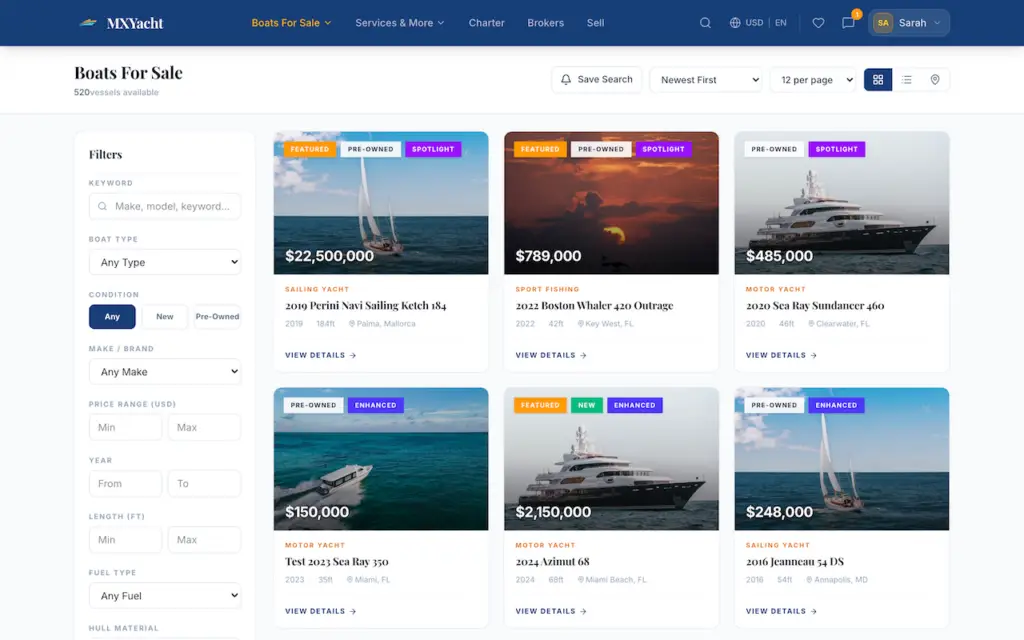
mxyacht.mimeld.comDesktop boats for sale results with filters, listing grid, prices and badges
Live demo
BOATER WEB PORTAL

The Buyer Side - Search, Compare & Enquire

What your buyers use, across 46 routes: favorites, side-by-side compare, enquiry forms, a signed-in message inbox, full-screen video galleries, saved searches with a chosen alert cadence, and technical and map-radius search.

  1. 1Start the web app in a browser of your choice
  2. 2Use one of the demo accounts listed underneath
  3. 3Explore: Search, Compare, Favorites, Inquiries, Inbox
Try:buyer@yacht.mimeld.com | password
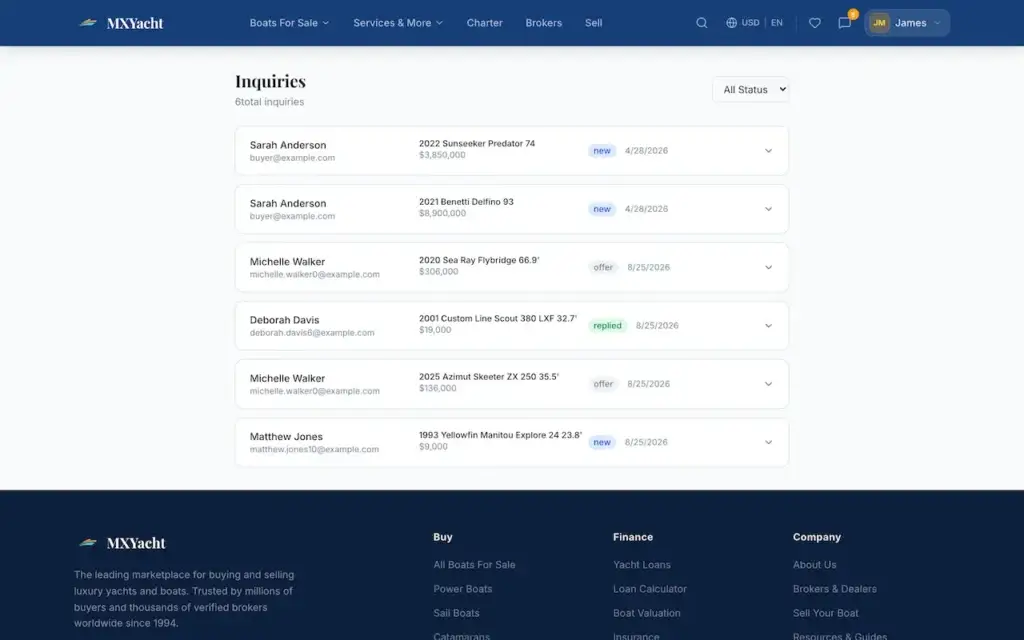
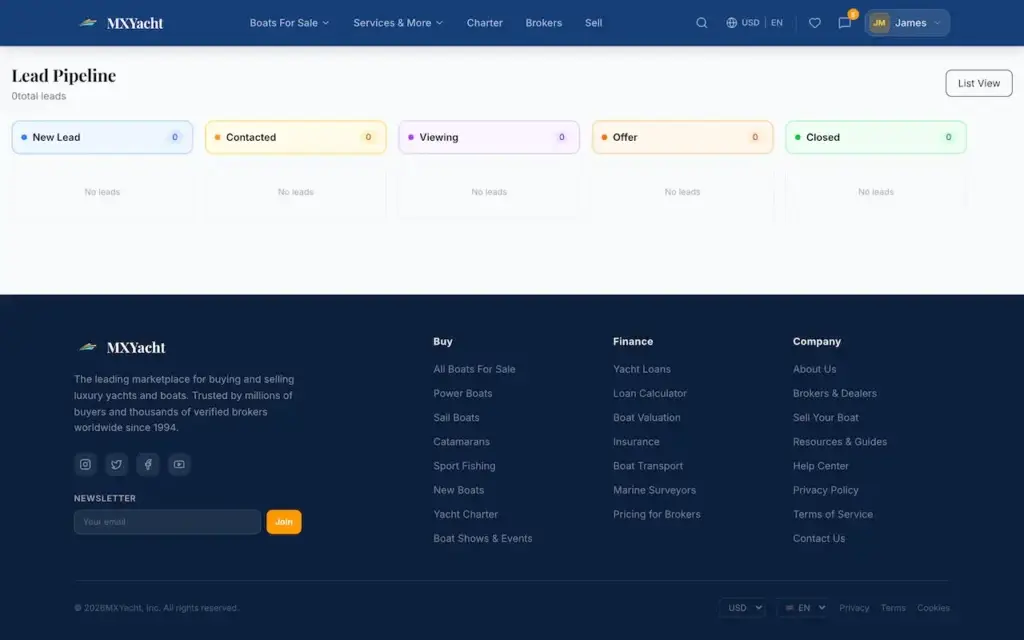
mxyacht.mimeld.comDealer lead pipeline with New Lead, Contacted, Viewing, Offer and Closed stages
Live demo
AGENT DESK

Stock, Lead Pipeline, Clients & Market Data

The broker's working day: a listing manager with photo and upgrade control, a kanban enquiry board with stages and notes, replies scoped to each enquiry, client records with budgets and shortlists, LeadSmart answers, the listing optimizer and response-time reports.

  1. 1Open the broker workspace
  2. 2Use the dealer credentials shown below to log in
  3. 3Explore: Listings, Pipeline, Clients, Broker Tools
Try:dealer@yacht.mimeld.com | password
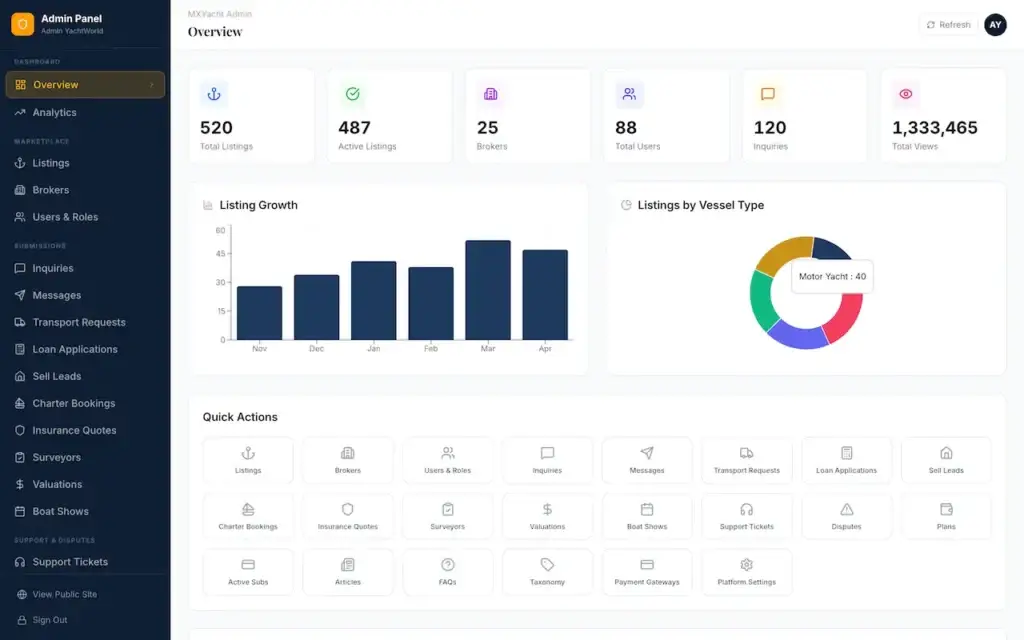
mxyacht.mimeld.comAdmin overview dashboard showing listing, dealer, user, inquiry and revenue metrics
Live demo
HARBOR MASTER BACKEND

Moderation, Plans, Service Desks & Reporting

Where the platform is governed: users and brokerages, listing moderation, plan editing with activate switches and subscriber counts, taxonomy and settings, the eight marine service desks, articles and FAQs, tickets, disputes and the analytics dashboard.

  1. 1Open the operator console
  2. 2Log in with the admin credentials given below
  3. 3Explore: Moderation, Plans, Service Queues, Analytics
Try:admin@yacht.mimeld.com | password
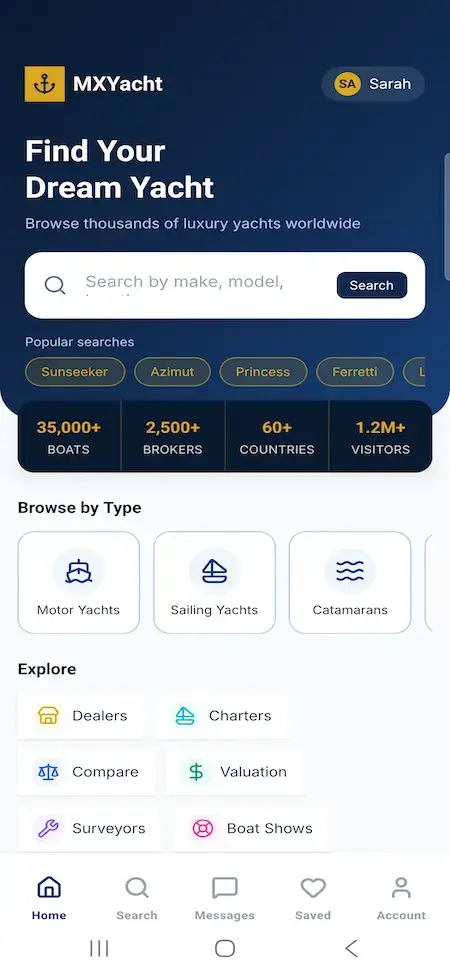
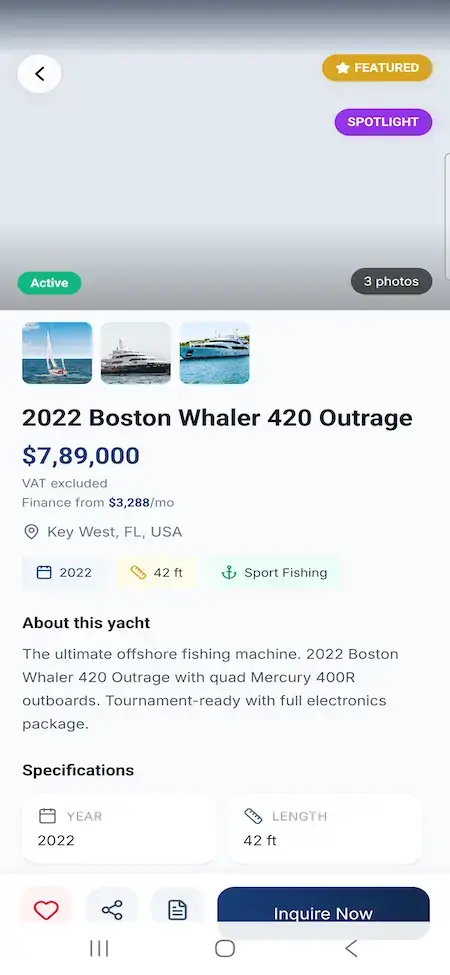
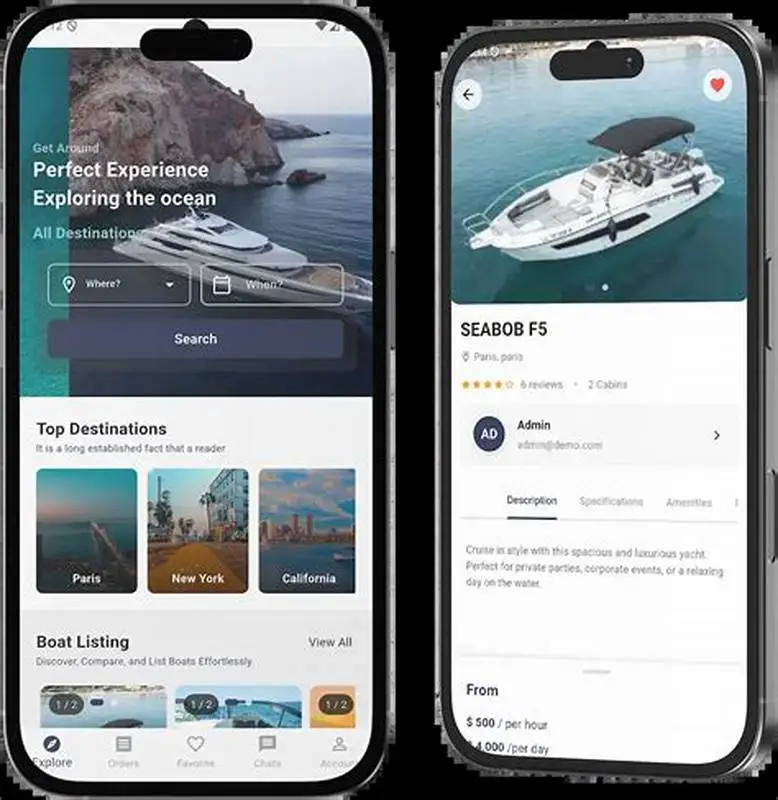
Buyer mobile home with yacht search, vessel categories, dealers, charters and servicesMobile yacht detail page with gallery, price, specifications, broker contact and inquiry actions
Live demo
ANDROID APP

Expo Build - The Same Marketplace in Your Pocket

The Expo React Native app, with tabs for Home, Search, Favorites, Messages and Account and screens for listings, brokers, charter, boat shows, surveyors, valuations, compare and each role's dashboard, all calling the same API as the web app.

  1. 1Download the Android build
  2. 2Enter the seller credentials below to sign in
  3. 3Explore: Search, Favorites, Messages, Account
Try:seller@yacht.mimeld.com | password

Watch It Sail

Video Walkthrough - From a Search to a Staged Lead

One ordinary lead from start to finish, rather than a feature reel. A search narrows by length, draft and price, a listing opens to its gallery, spec sections and price history, and the buyer saves the search with a weekly alert before sending an enquiry. That enquiry lands on the broker’s kanban board, where it gets a stage, a threaded reply and a curated shortlist on the client record. The operator console closes it out: a listing held for moderation, a plan being edited, and fresh intake in the insurance and transport desks.

Book a Live Walkthrough

The Full Interface

Screens & Flows - Buyer, Broker and Operator Journeys

Screens from every side of the marketplace: faceted results with range filters, the listing page with gallery, specs, price history and broker details, compare, the saved-search and alert manager, the buyer inbox, the broker’s listing manager and kanban board, client records with shortlists, LeadSmart review, market evaluation and reports, and the operator console with moderation, plans, taxonomy and the eight service desks.

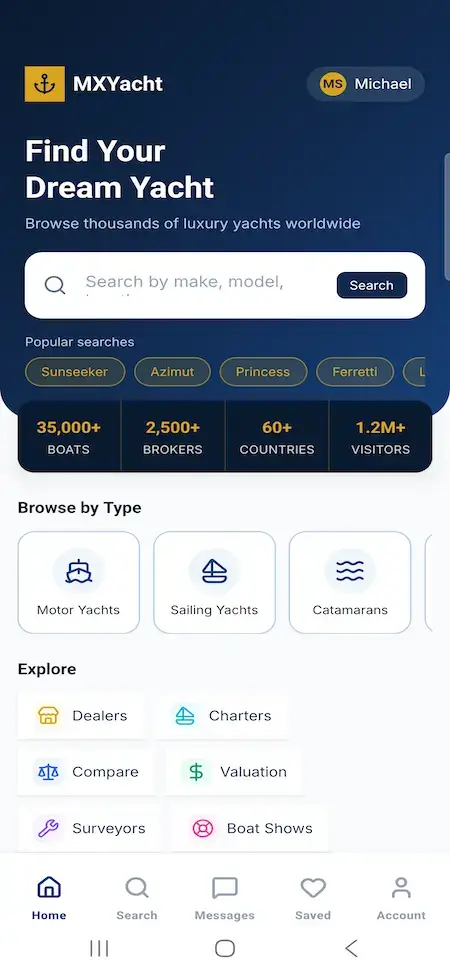
Buyer mobile home with yacht search, vessel categories, dealers, charters and services
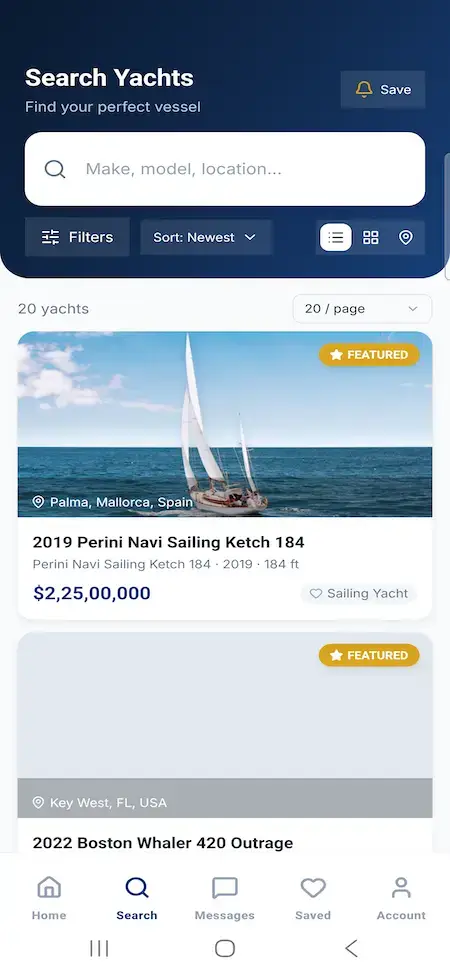
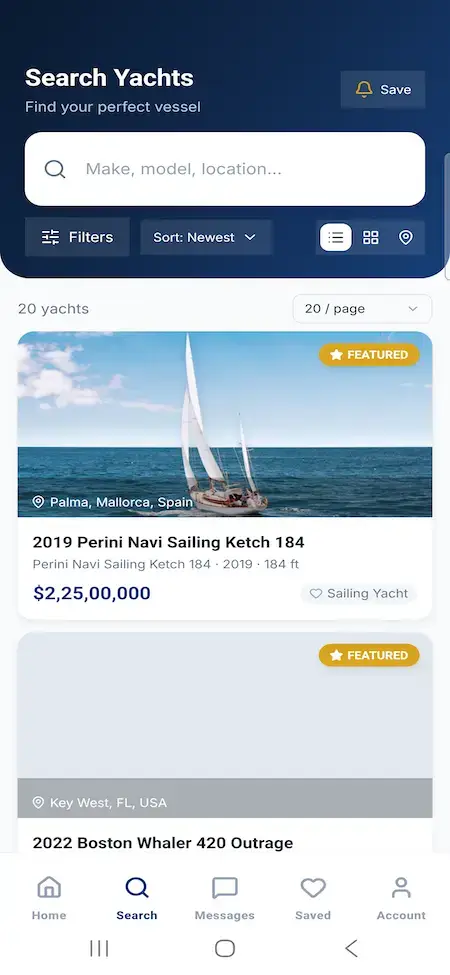
Buyer mobile search results with filters, yacht cards, prices and status badges
Mobile yacht detail page with gallery, price, specifications, broker contact and inquiry actions
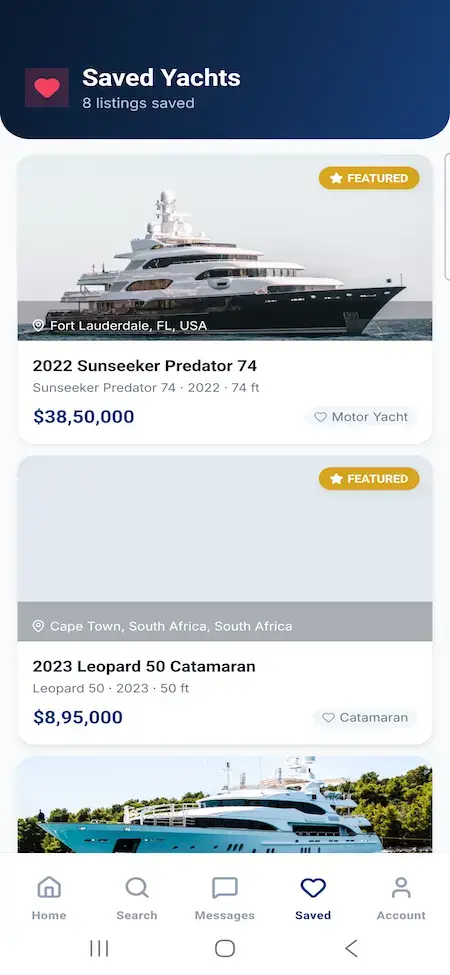
Buyer mobile saved yachts screen with bookmarked vessel cards
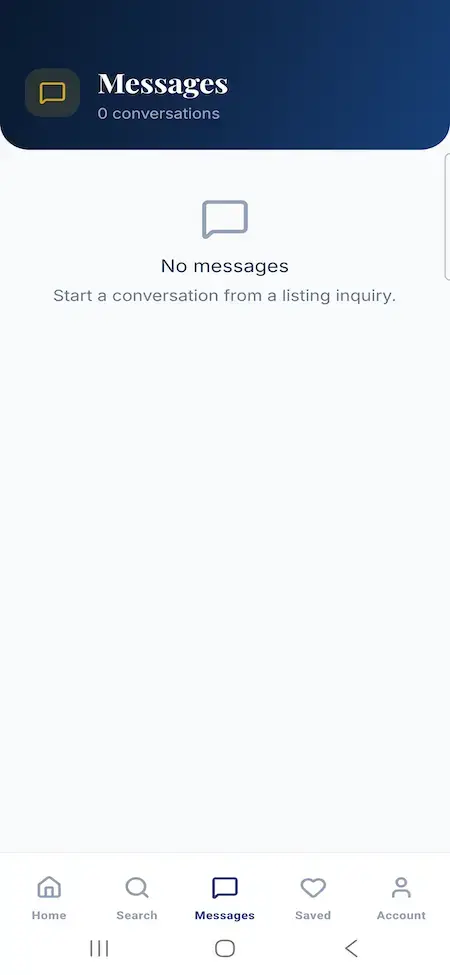
Buyer mobile messages empty state for dealer and broker conversations
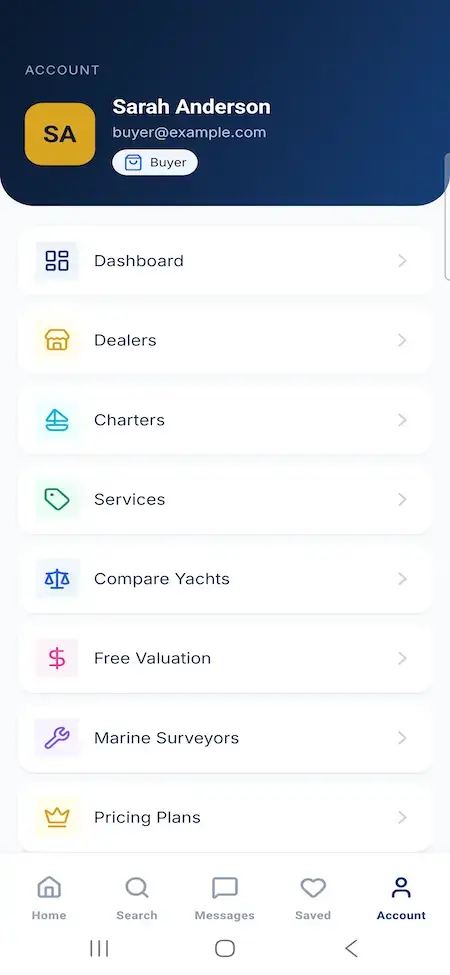
Buyer mobile account menu with dashboard, dealers, charters, comparison and valuation services
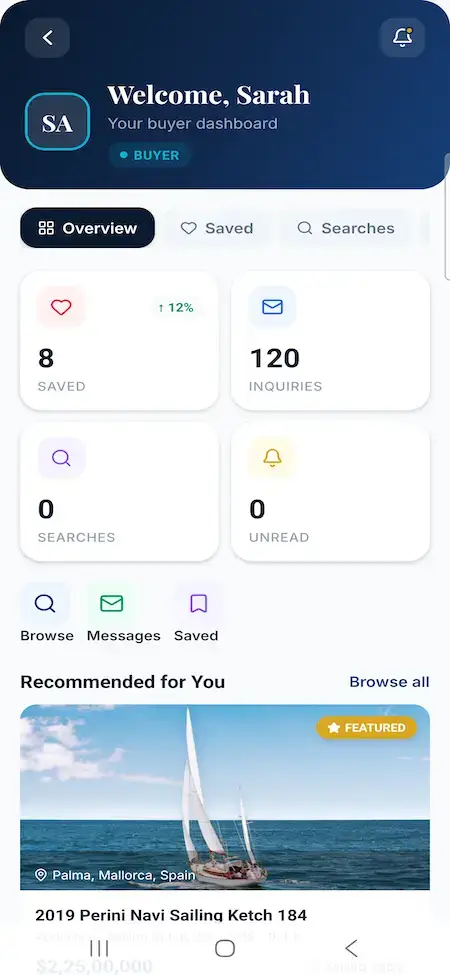
Buyer mobile dashboard showing saved yachts, searches, unread messages and recommendations
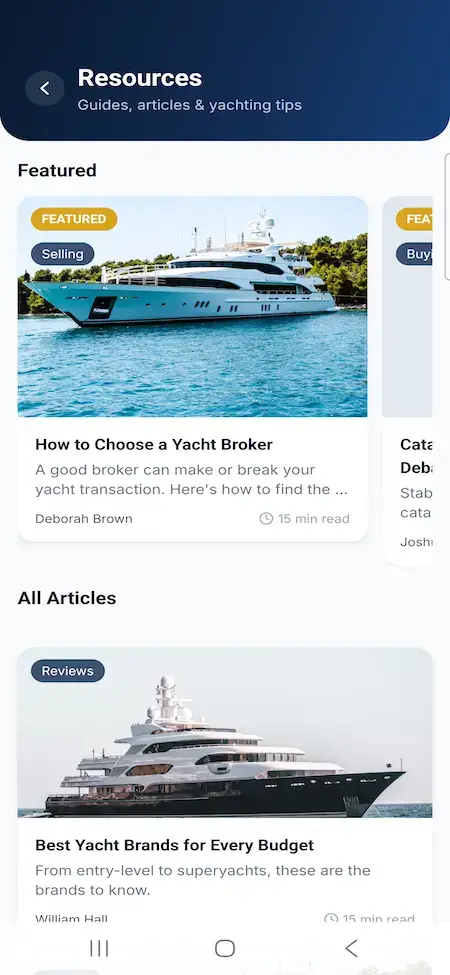
Buyer mobile resources screen with boating articles and guides
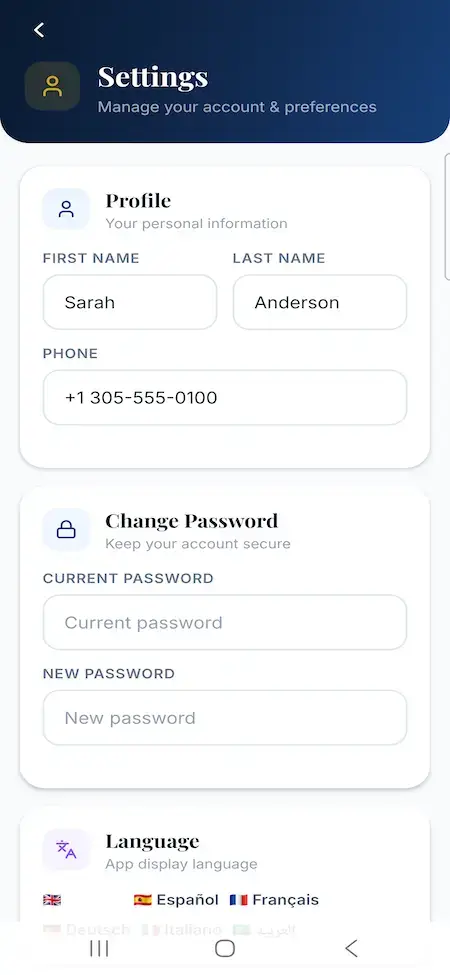
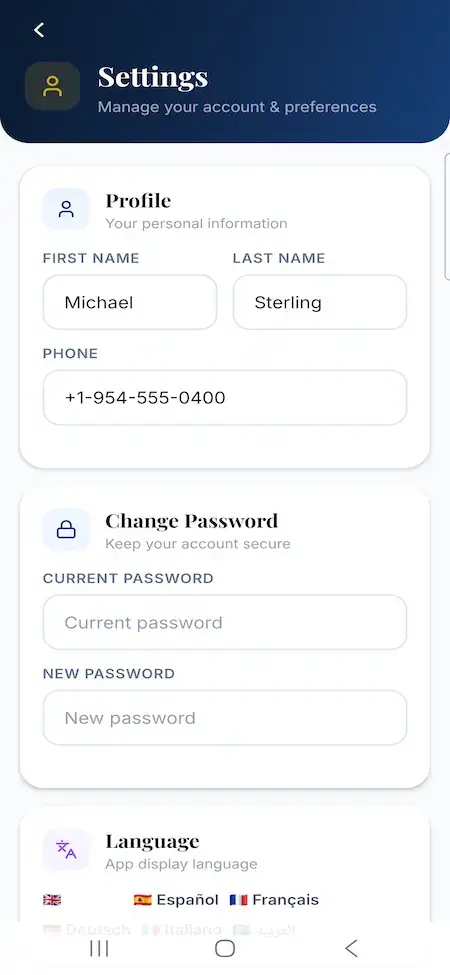
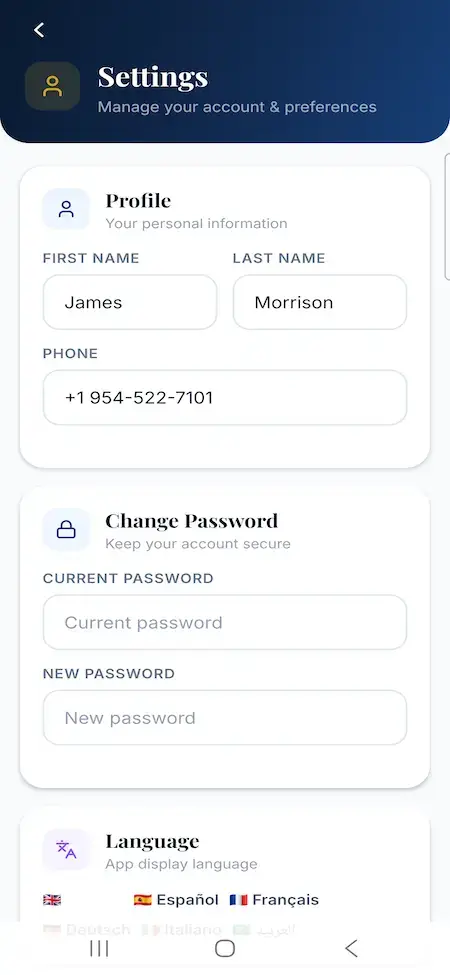
Buyer mobile settings for profile, password and language
9 screens · scroll →
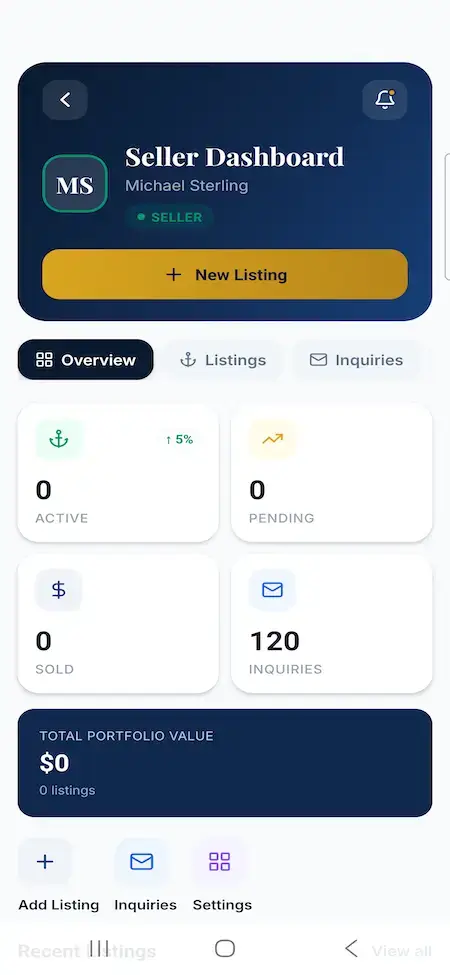
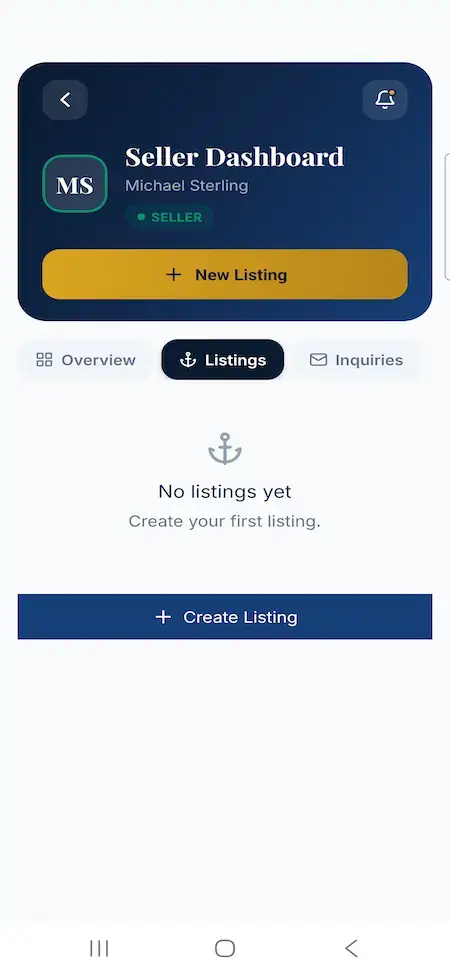
Seller mobile dashboard showing active, pending and sold listings, inquiries and portfolio value
Seller mobile listings empty state with a create listing action
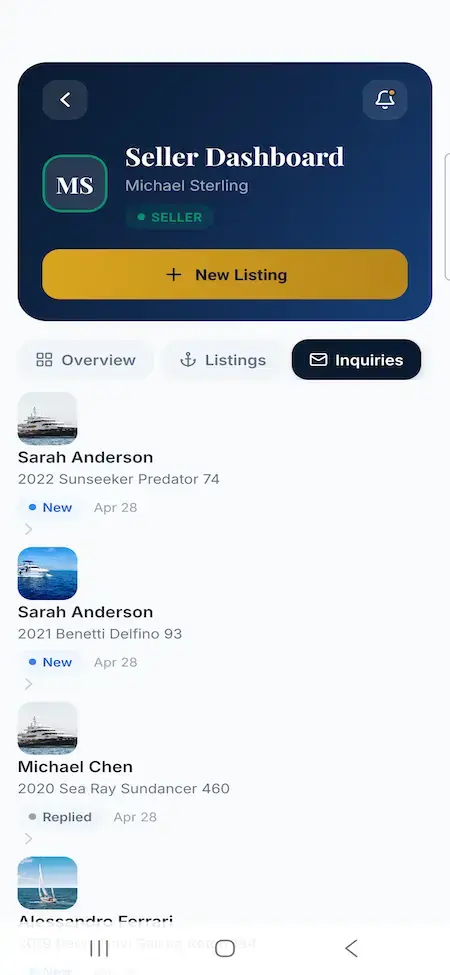
Seller mobile inquiry list showing buyers, yachts and response status
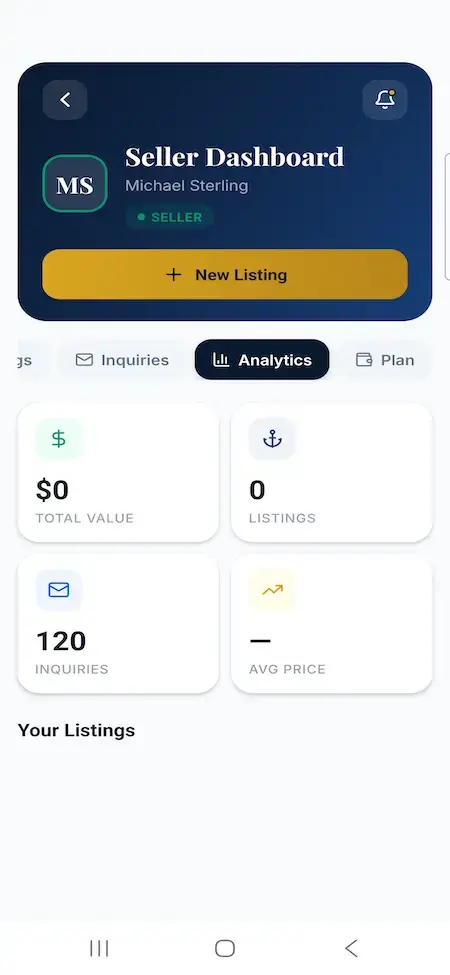
Seller mobile analytics showing listing views, inquiries and performance metrics
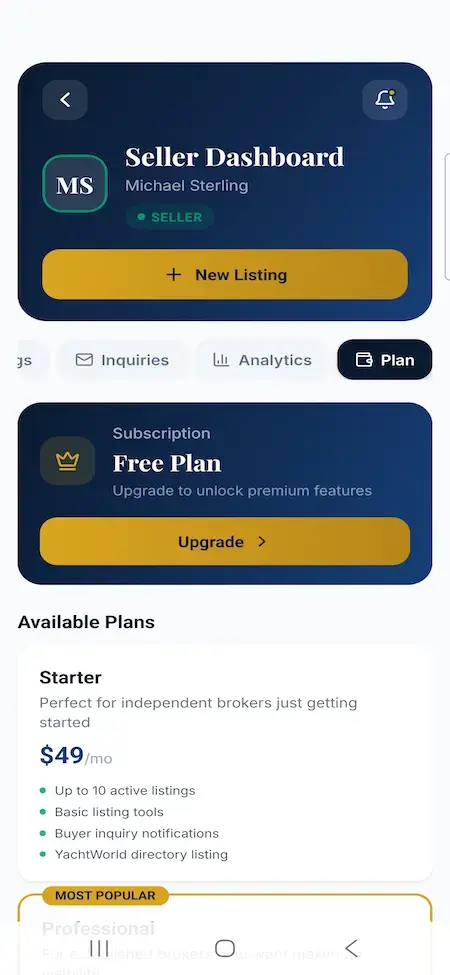
Seller mobile subscription screen with pricing plans and benefits
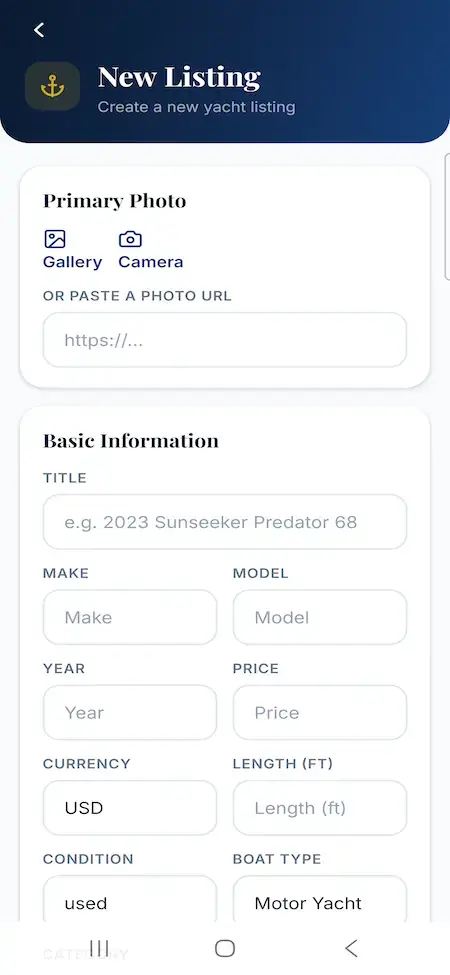
Seller mobile form for yacht photos, specifications, condition and price
Seller mobile marketplace home with yacht search and vessel categories
Seller mobile yacht search results with filters, listing cards and prices
Seller mobile settings for profile, password and language
9 screens · scroll →
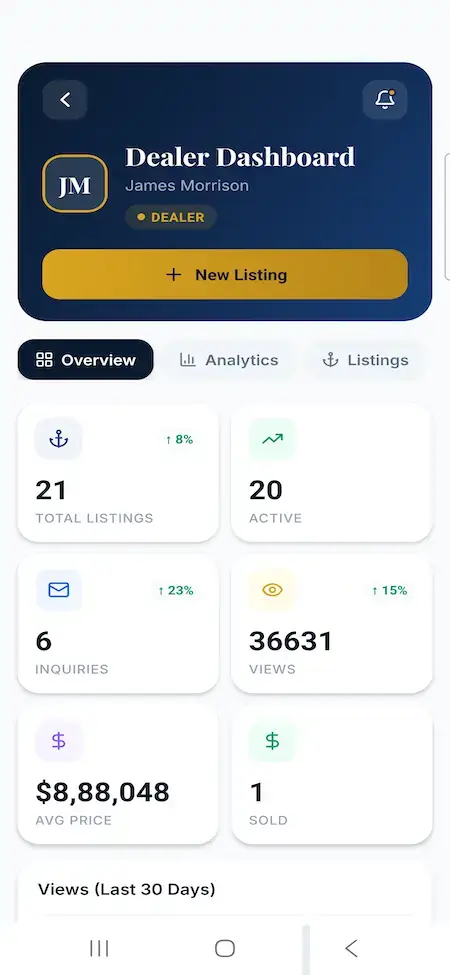
Dealer mobile dashboard showing listings, inquiries, views, revenue and sold boats
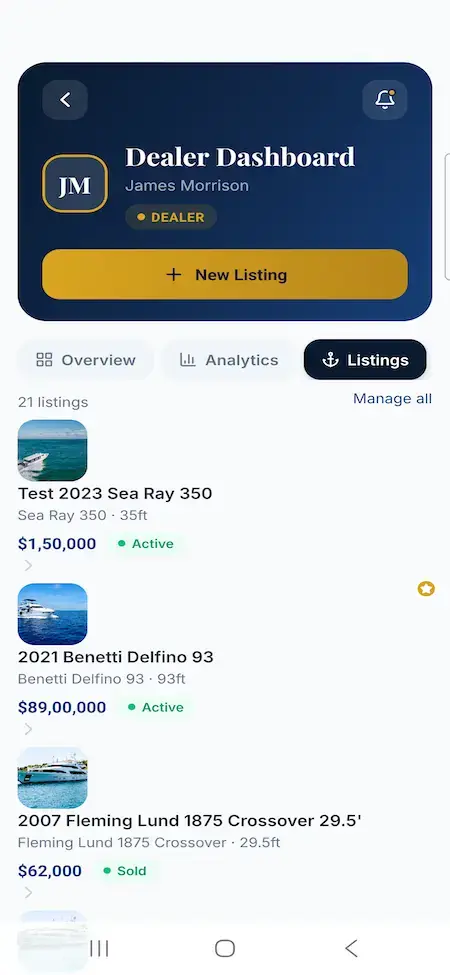
Dealer mobile listings screen with yacht cards, prices and listing status
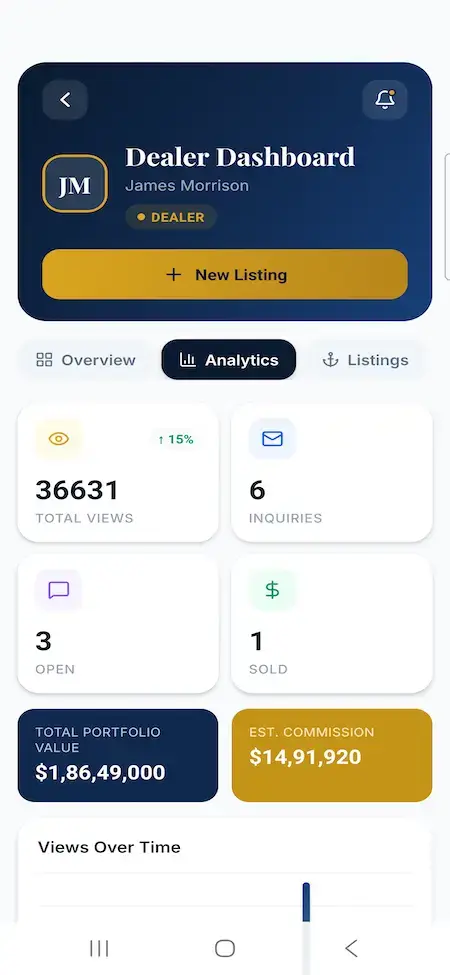
Dealer mobile analytics showing views, inquiries, sold boats, portfolio value and commission
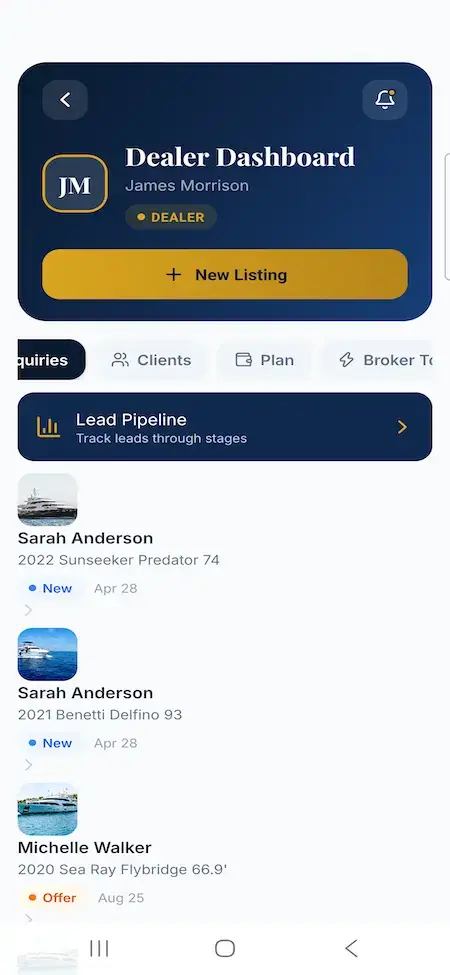
Dealer mobile inquiry list showing buyers, vessels and lead status
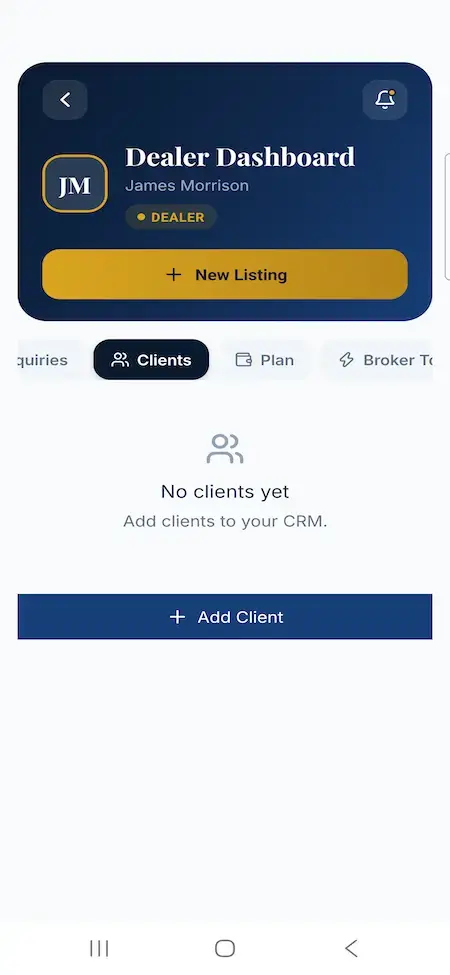
Dealer mobile client management empty state with an add client action
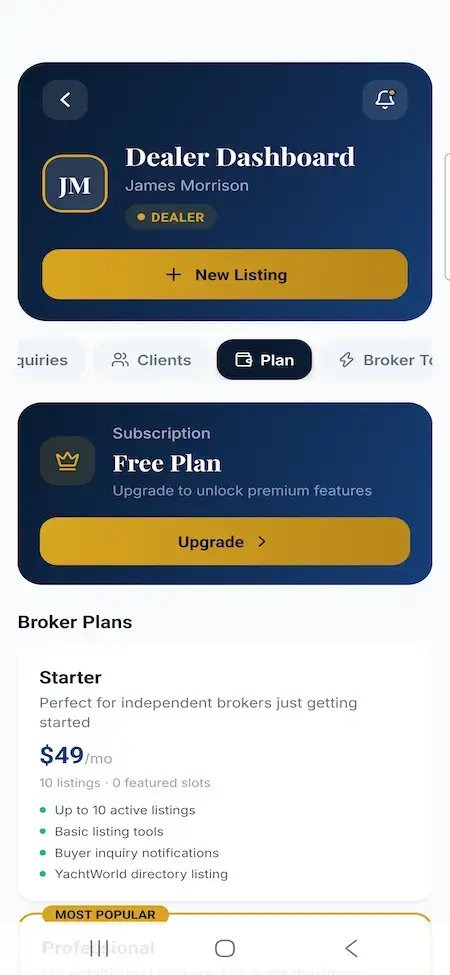
Dealer mobile pricing screen displaying subscription plans and benefits
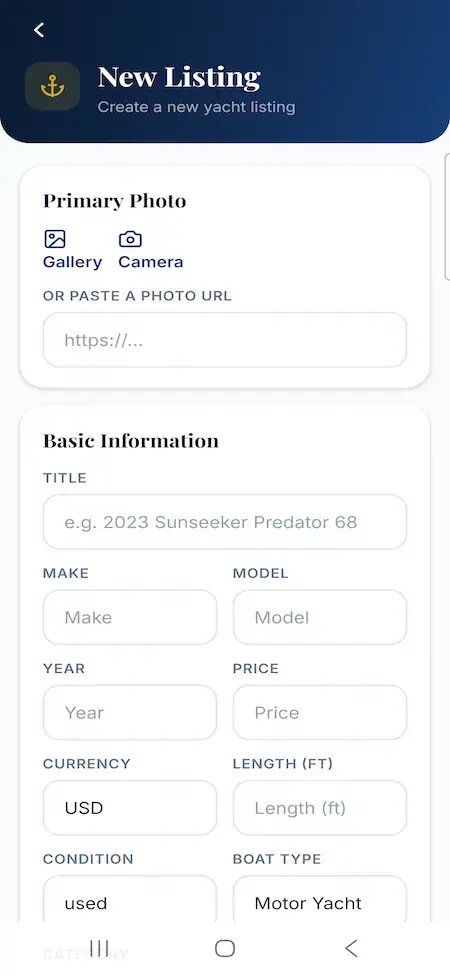
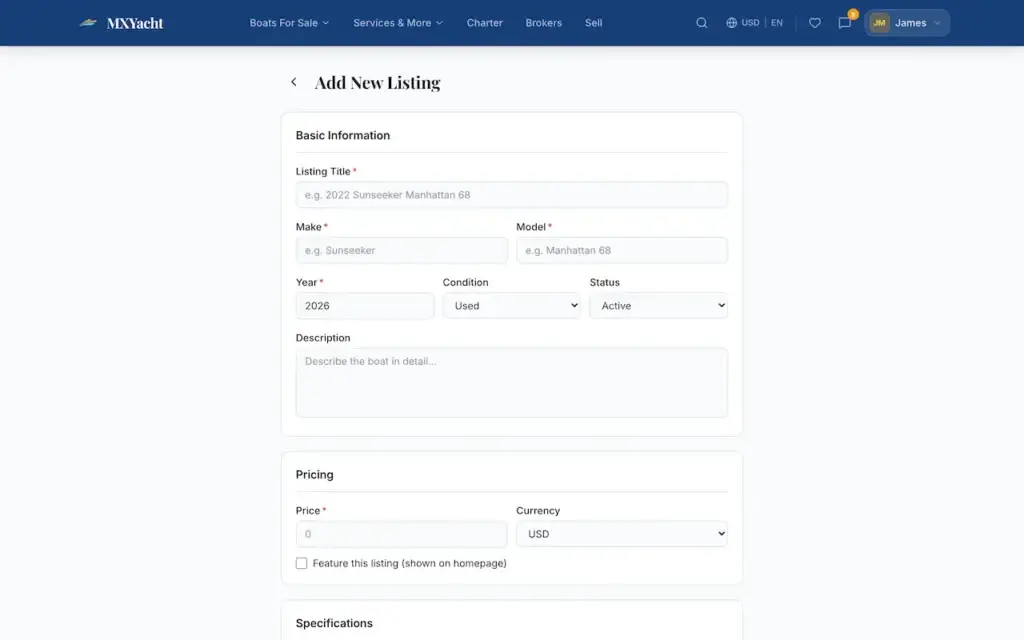
Dealer mobile form for adding yacht photos, specifications, price and condition
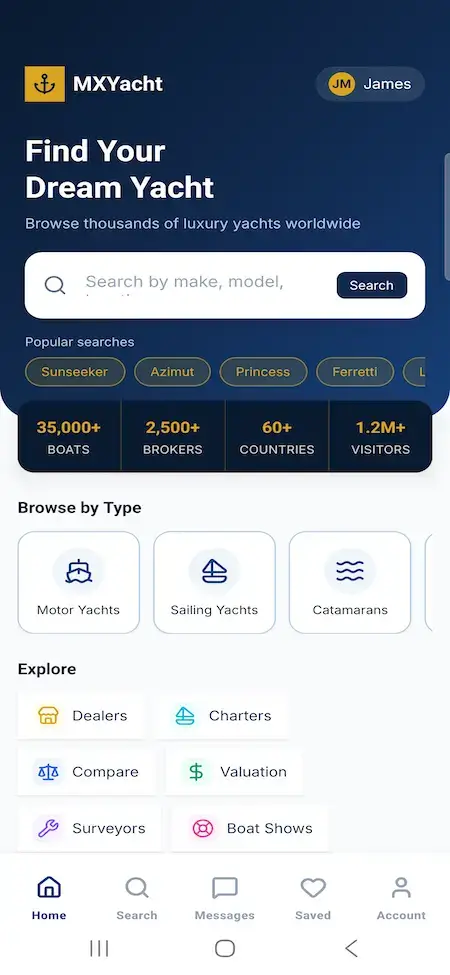
Mobile home screen with yacht search, vessel categories and marketplace services
Dealer mobile settings for profile, password and language preferences
9 screens · scroll →
Admin overview dashboard showing listing, dealer, user, inquiry and revenue metrics
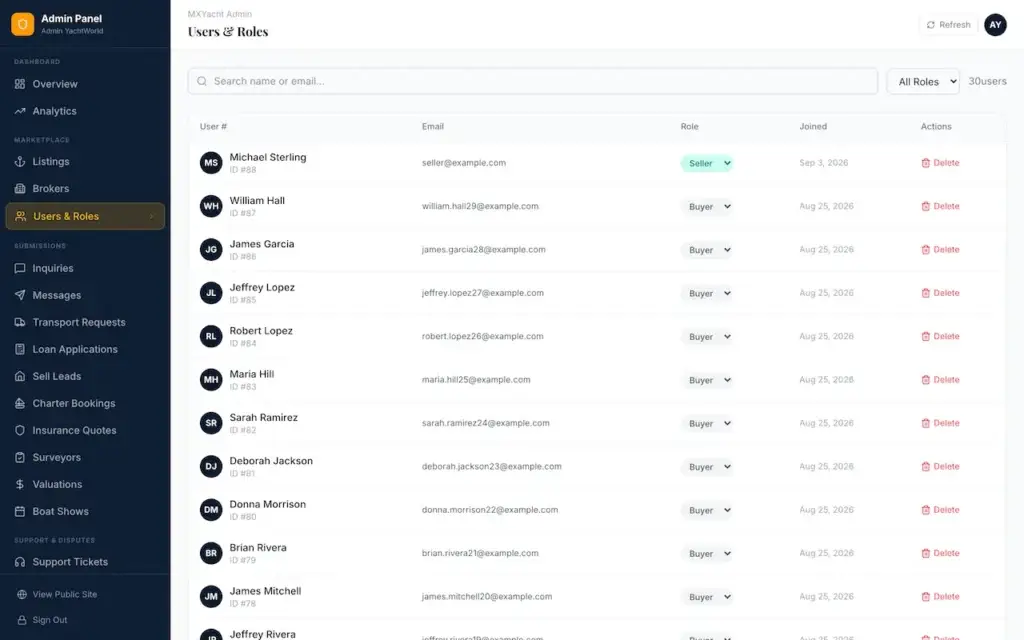
Admin screen for managing users, email addresses, roles and join dates
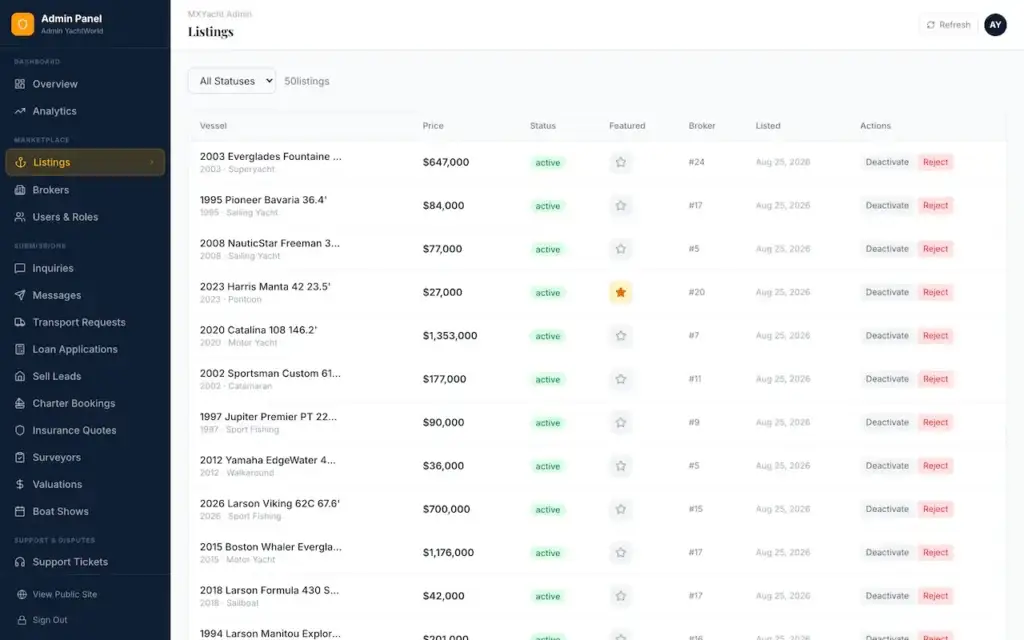
Admin listings table with yacht prices, status, featured placement, broker and date
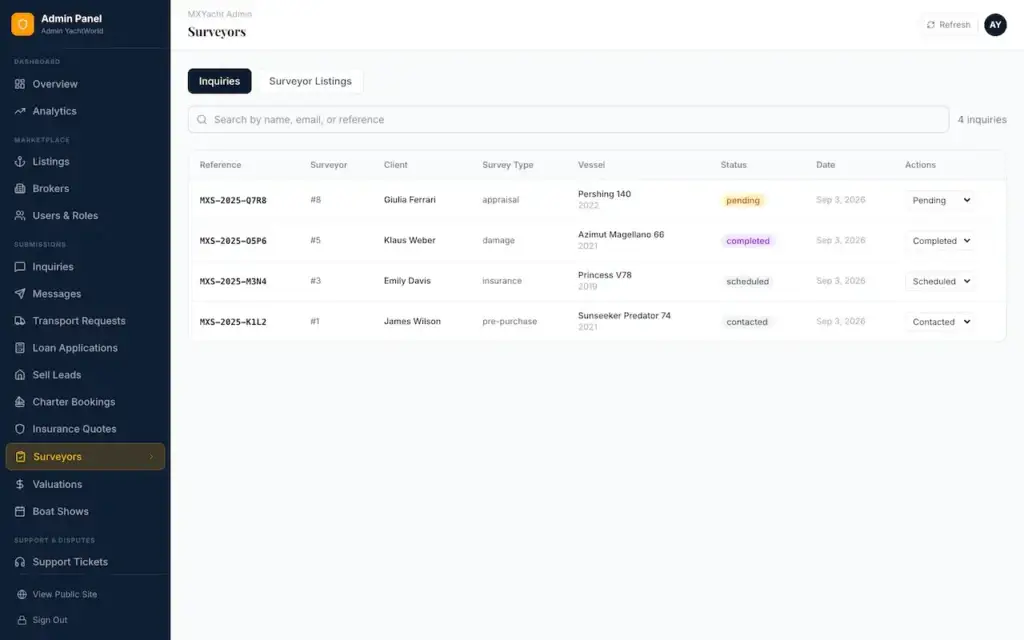
Admin surveyor screen listing references, clients, survey types, vessels and status
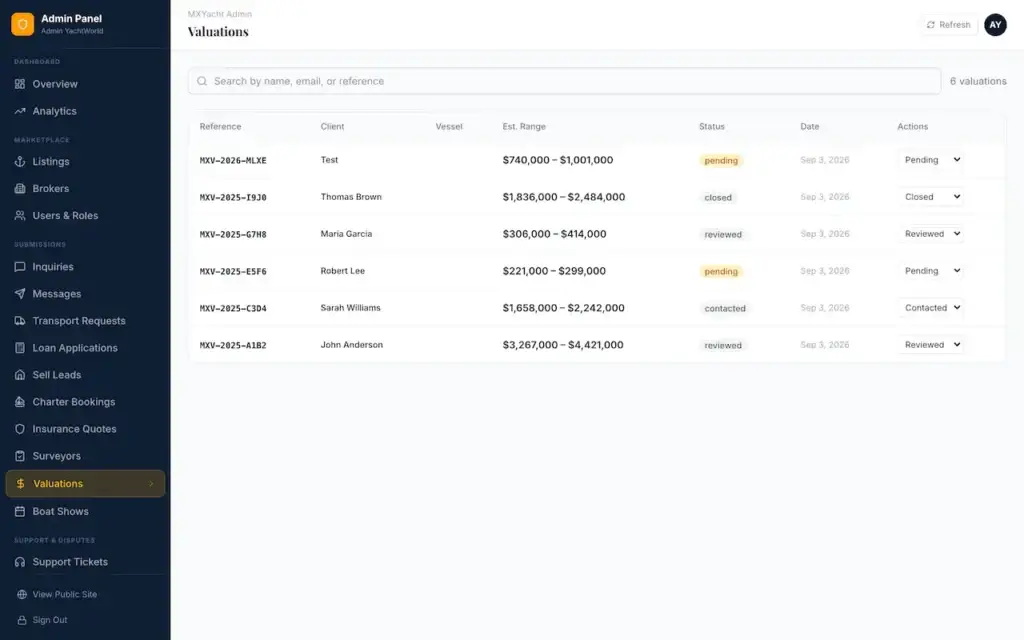
Admin valuations table with clients, vessels, estimated ranges, status and dates
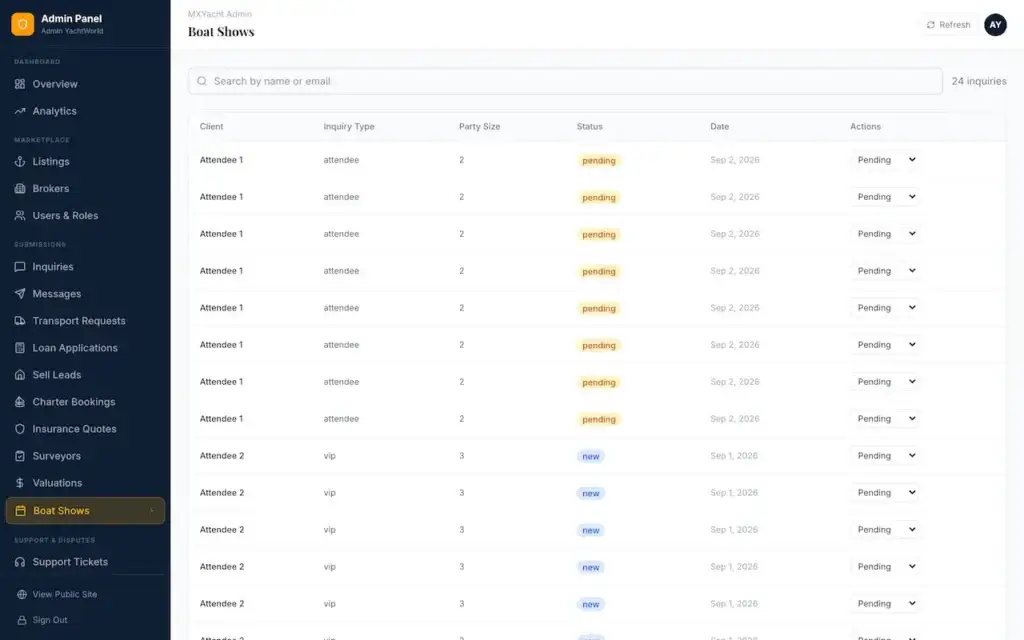
Admin boat show inquiry table with clients, inquiry types, party sizes and status
6 screens · scroll →
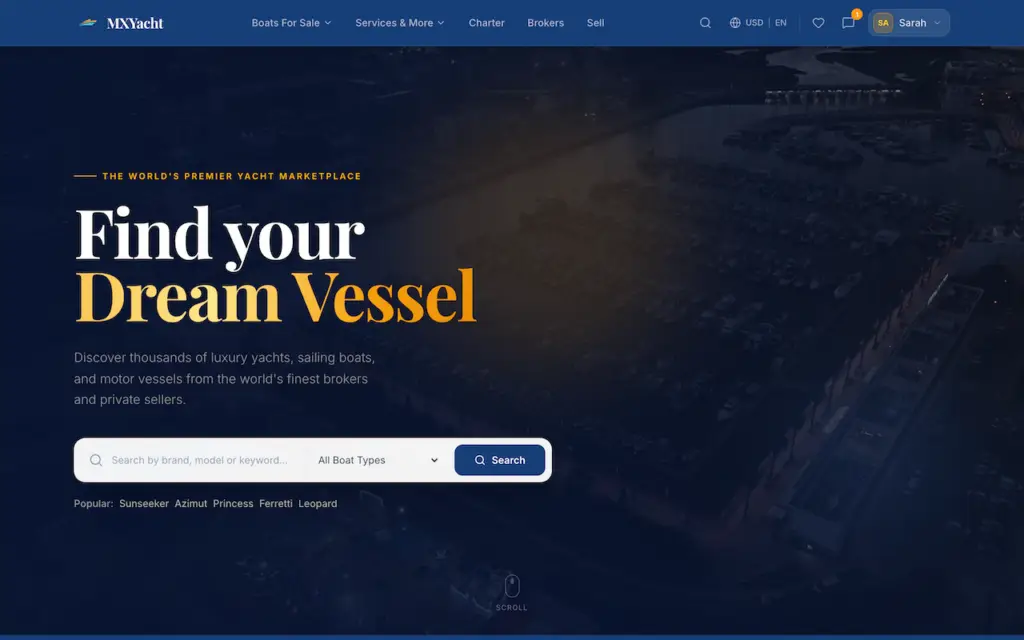
Desktop marketplace home with Find Your Dream Vessel search hero
Desktop boats for sale results with filters, listing grid, prices and badges
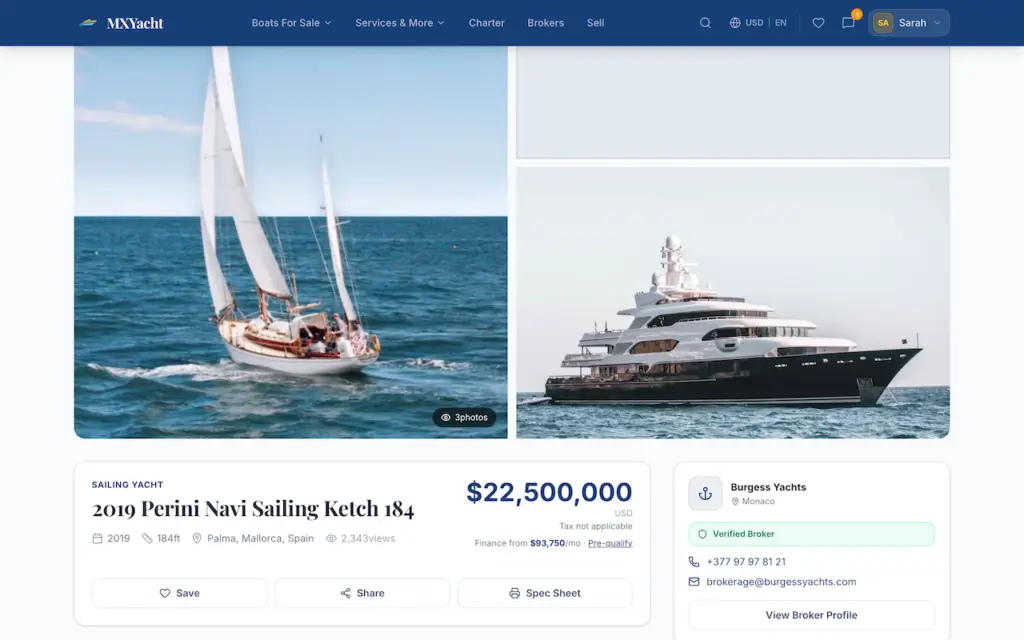
Desktop yacht detail page with photo gallery, price, specifications and broker contact
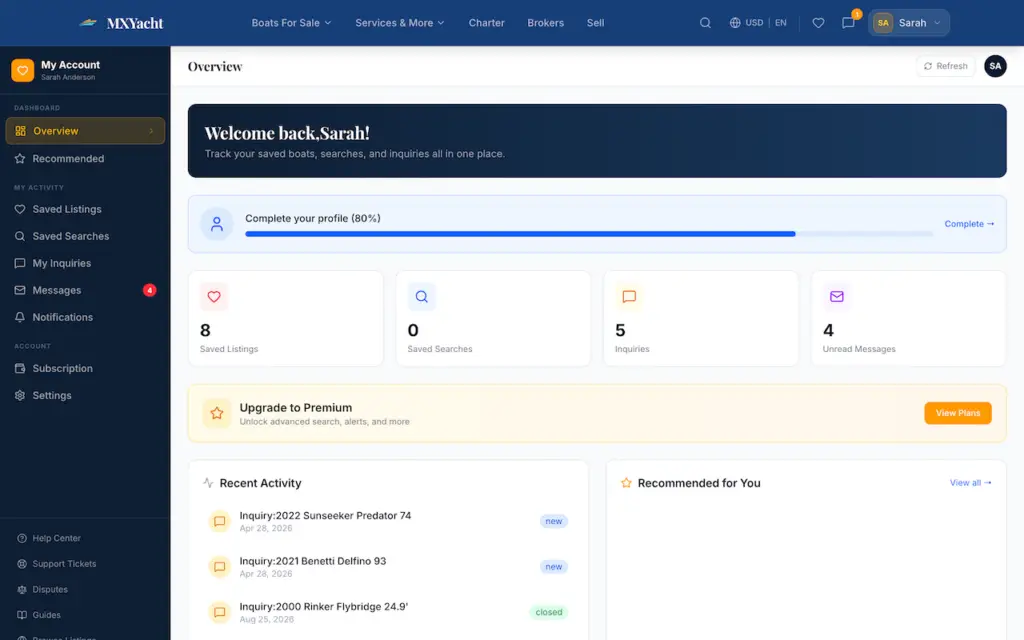
Buyer dashboard with profile completion, saved listings, searches, inquiries and recommendations
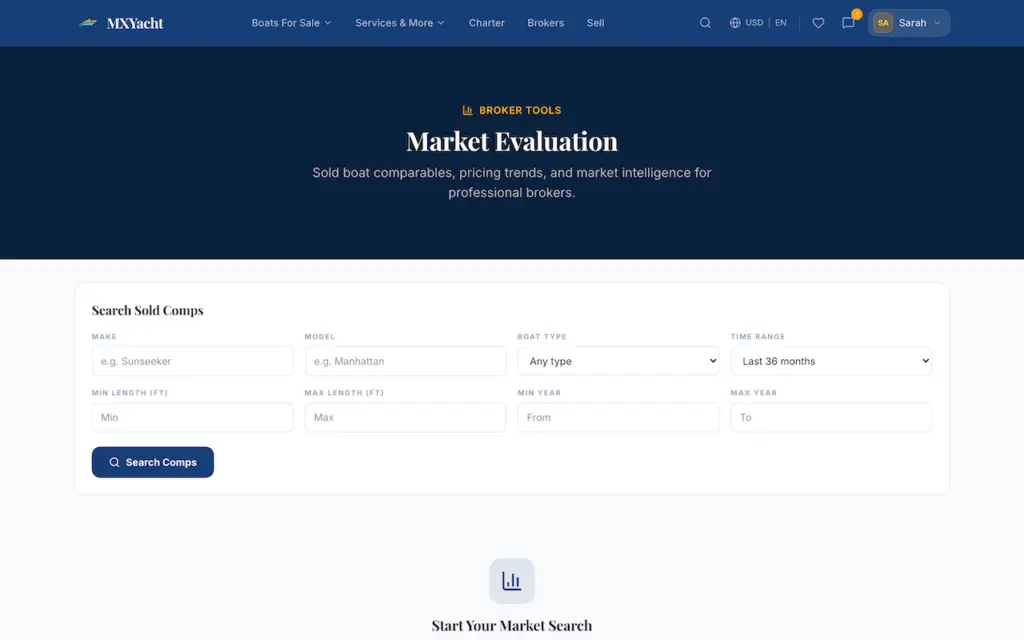
Market evaluation screen with sold comparable vessel search form
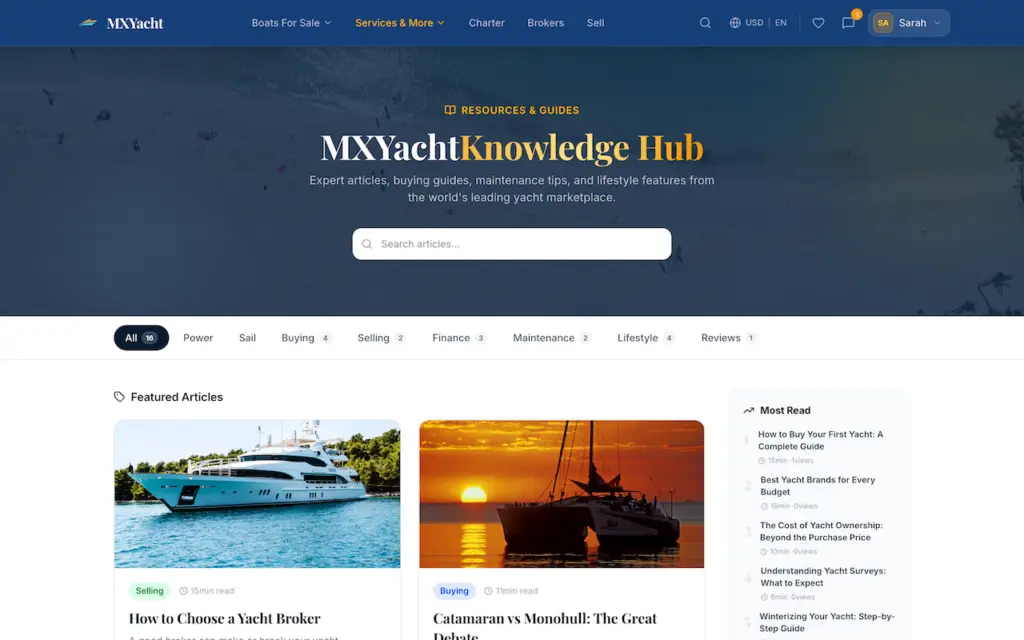
Yacht knowledge hub with article search, categories and boating resources
6 screens · scroll →
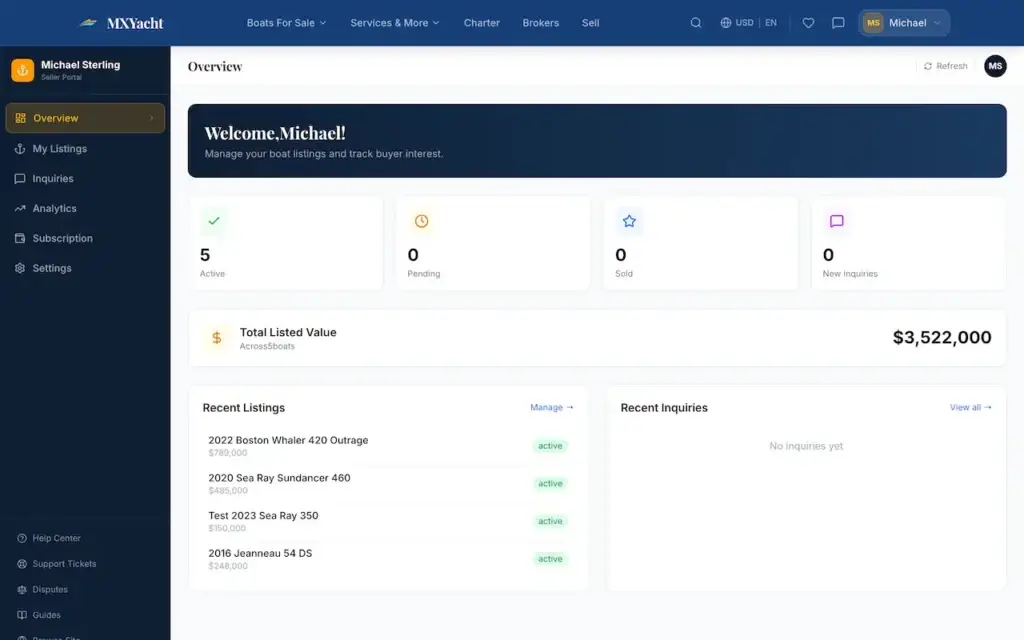
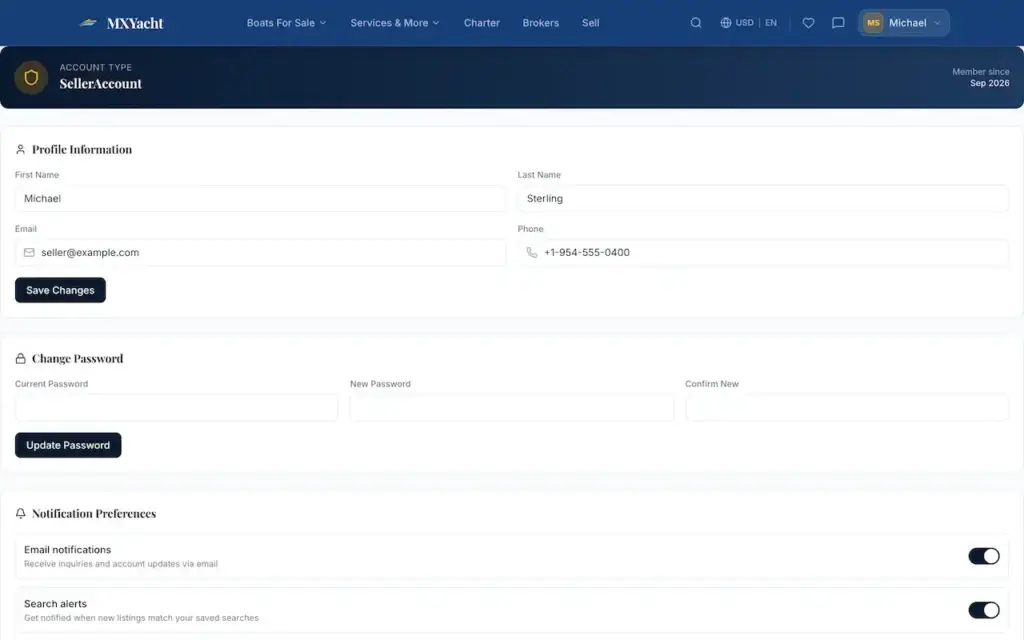
Seller dashboard with listing status, inquiries, portfolio value and recent activity
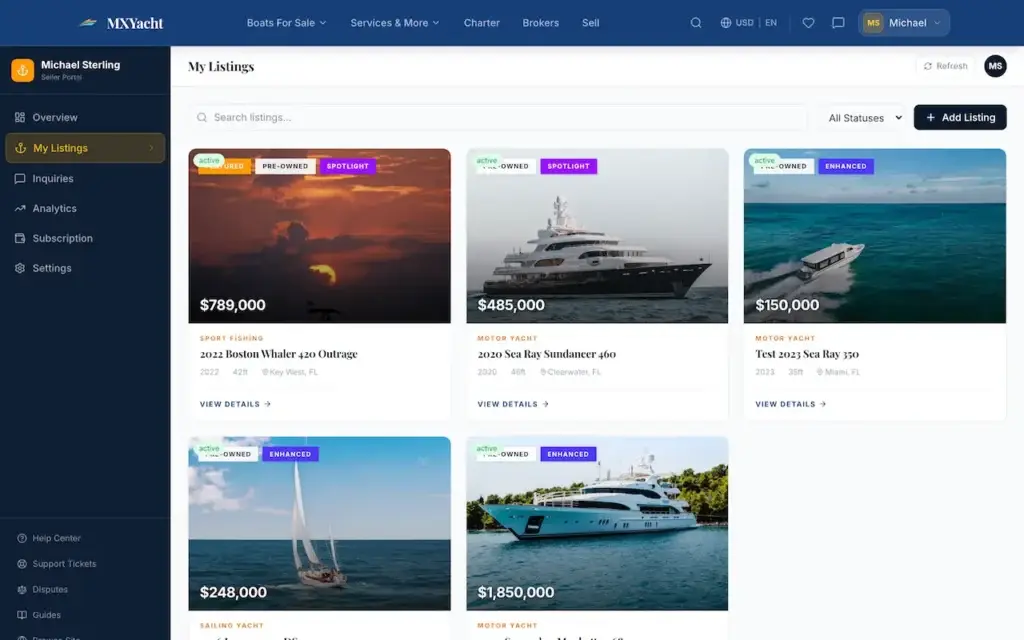
Seller desktop listings grid with yacht cards, prices and publication status
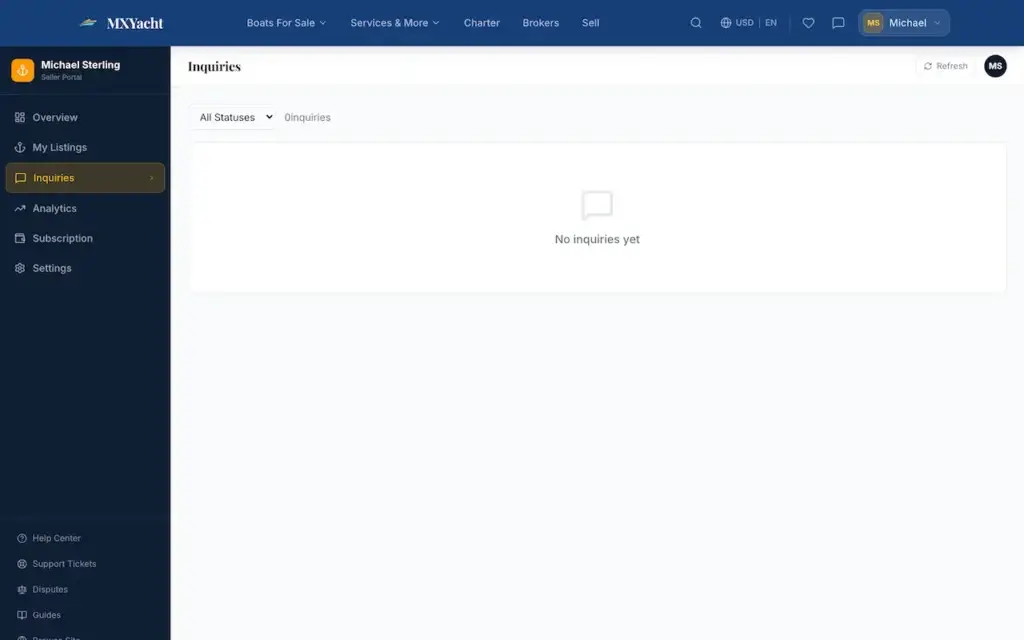
Seller desktop inquiries empty state for prospective buyer messages
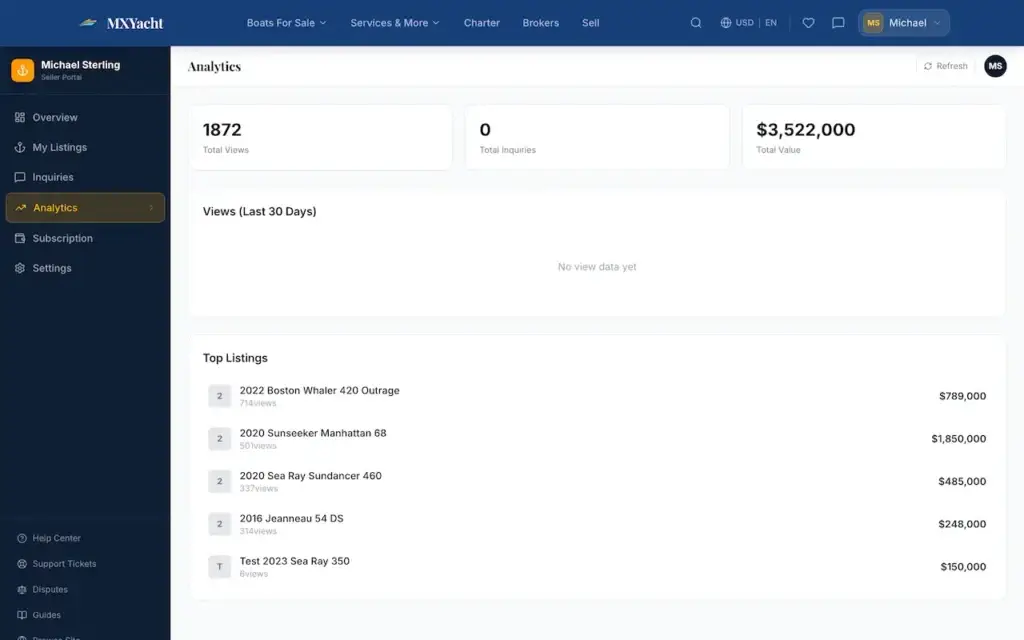
Seller analytics showing views, inquiries, total value and top listings
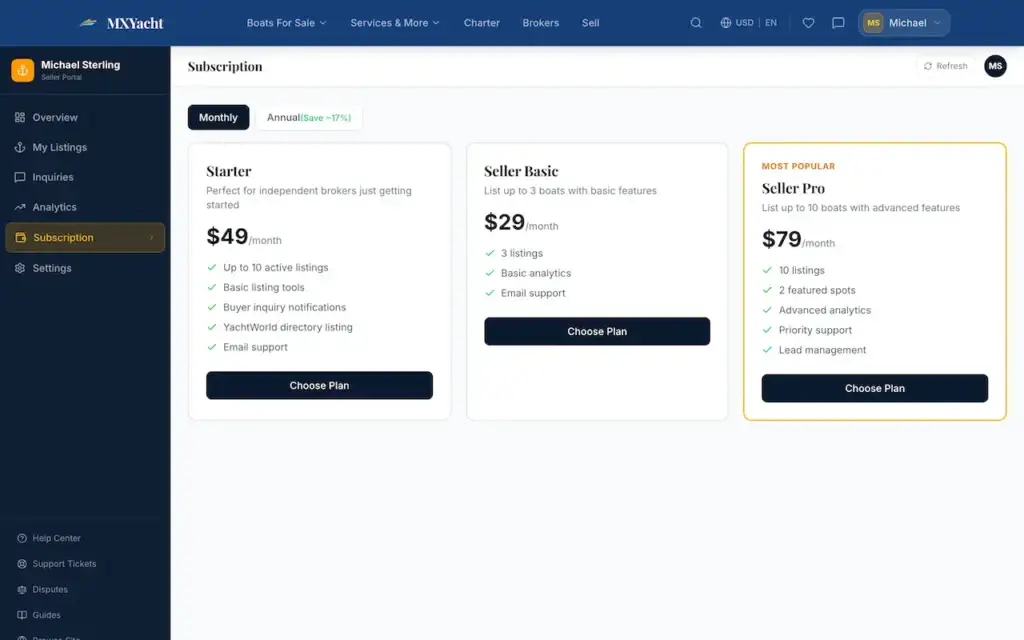
Seller pricing page with Starter, Seller Basic and Seller Pro plans
Seller settings for profile, password and notification preferences
6 screens · scroll →
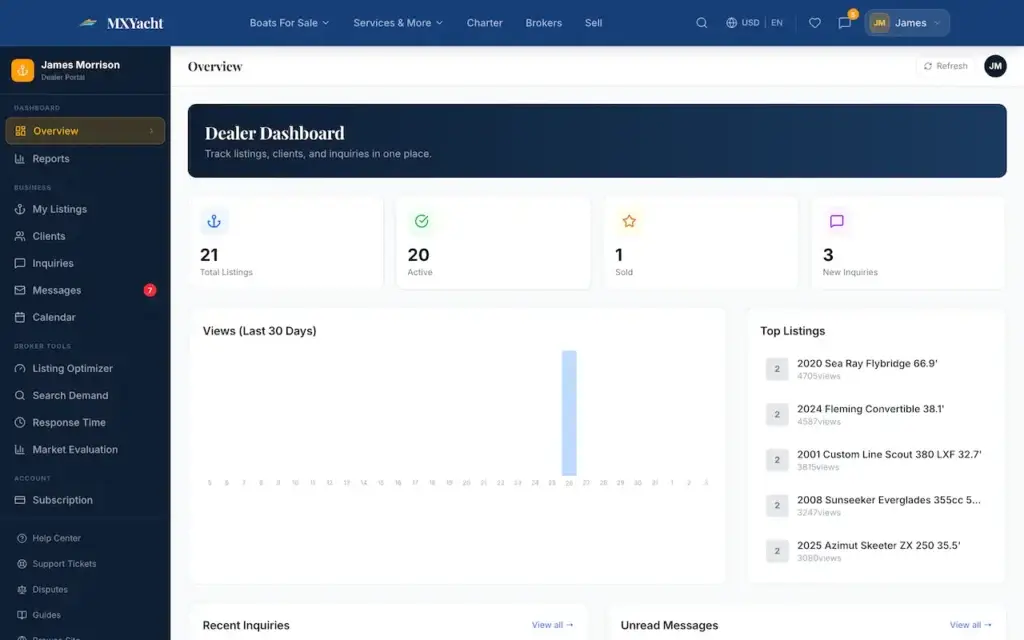
Dealer dashboard with listing statistics, views chart, top listings and recent inquiries
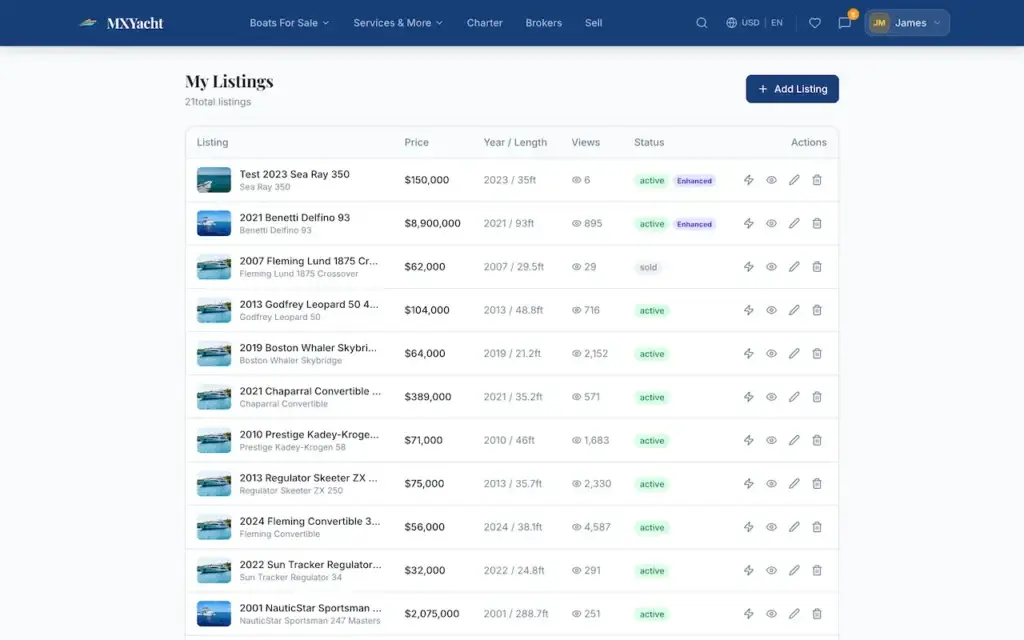
Dealer listings table with yacht inventory, prices, status and actions
Dealer lead pipeline with New Lead, Contacted, Viewing, Offer and Closed stages
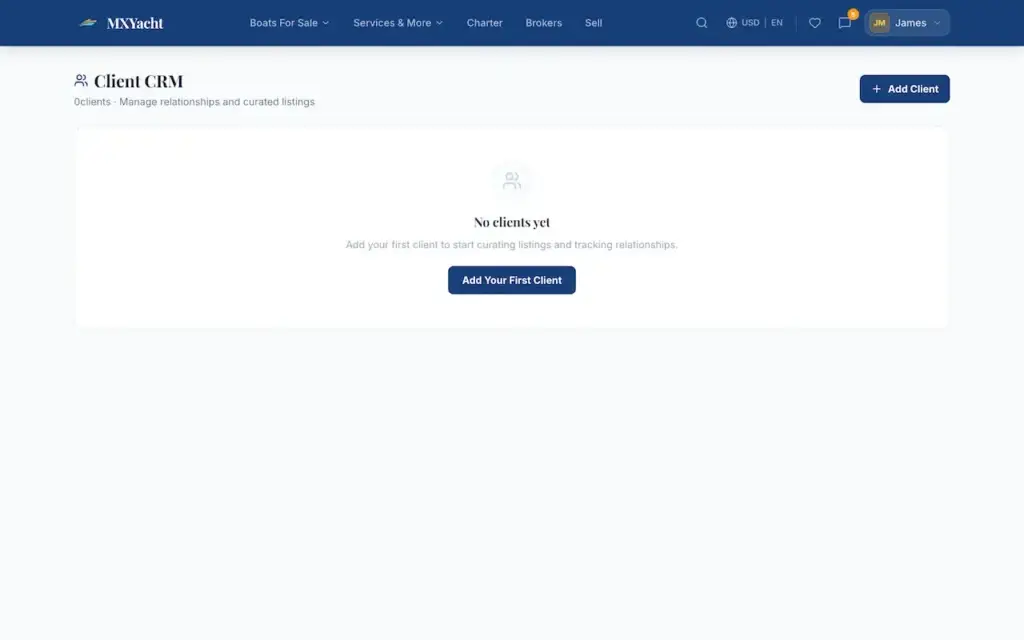
Dealer client CRM empty state with an add client action
Dealer inquiry list showing buyers, yachts, prices, status and dates
Dealer form for adding boat specifications, photos and pricing
6 screens · scroll →

Trace one buyer from a first search through favorites, compare, a saved search, an alert match, an enquiry and the LeadSmart questions, then pick the same lead up on the broker desk as it is staged, answered and given a shortlist. Web and mobile share one API, so an enquiry sent from a phone appears on the broker board with no second integration.

For a guided look at one flow, book a call and we will open it with live data in it.Explore Our Solutions

02References

No Borrowed Proof

Proof Points - Properties You Can Check in the Demo

Our portfolio includes marketplace, rental and listing builds, each published with its own figures. None of them is a marine brokerage yet, so instead of lending this page proof from a different product, what follows are properties of the software, each one checkable in the demo above.

Listing EngineBase build capability

Specification-rich listings carrying 40+ vessel fields, ordered photo galleries, video tours, append-only price history and under-offer and sold lifecycle states. Demonstrable in the buyer demo.

Lead PipelineBase build capability

A structured inquiry pipeline with source, intent, status, stage, notes and response timestamps, presented as a kanban board with response-time measurement. Demonstrable in the broker demo.

Broker CRMBase build capability

A dealer-scoped CRM holding clients, budgets, status and private notes, with curated listing shortlists attached per client. Demonstrable in the broker demo.

Service ModulesBase build capability

Eight marine service modules covering sell, charter, insurance, transport, finance, surveyors, valuations and boat shows, each with intake and an operator queue. Demonstrable in the admin demo.

Commercial PackagingBase build capability

Configurable subscription plans with listing and featured limits, plus spotlight and enhanced listing upgrades with expiry. Checkout writes records; connecting a payment provider is a configuration step.

Trust & ComplianceBase build capability

GDPR JSON export and password-confirmed account deletion, TOTP two-factor, bcrypt password hashing and route-level rate limiting. Documented control by control in the security handbook.

Browse Our PortfolioGenuine engagements, each with its own reported figures

A Worked Example

Modeled Reference - A Brokerage Group on Its Own Marketplace

A modeled reference showing how the platform is set up for a brokerage group running its own branded marketplace. It is not a client engagement, and every figure describes the software rather than a result a customer reported.

Modeled Reference Deployment
Marine Sector
Branded Brokerage Marketplace

A brokerage group whose leads arrive by email and chat apps moves stock, enquiries, client records and marine services into one branded system instead of five.

Dockside walkthroughIllustrative only, not a client job
Boating marketplaceModeled marketplace size
Marine Services, Yacht Brokerage and Lead PipelineSector
203API handlers shipped in the base build
40Database tables delivered
6 daysGo-live in weeks
Dealer dashboard with listing statistics, views chart, top listings and recent inquiries
Challenges
  • Enquiries arriving by email and chat apps, then lost, duplicated or never answered
  • No shared view of stock, clients or broker performance across offices
  • Insurance, transport and finance requests taken on paper with no queue behind them
Goal
  • Listings, the enquiry pipeline, messaging and client records in one system
  • Measured reply times, so broker accountability is visible rather than assumed
  • Eight service modules turning related demand into a second revenue line
🛠 Made for you by Miracuves
  • Each listing holds 40+ vessel fields, plus price history, video and other media
  • Dealer plans you can configure, covering listing caps, featured slots and spotlight upgrades
  • Buyers abroad are served with five UI locales and six display currencies
  • Email alerts sent on a set cadence, plus favorites, side-by-side compare and saved searches
  • Deployment assets for Docker, Nginx and PM2, along with a documented path to horizontal scale

What you see here is a modeled reference deployment rather than a client engagement. All of the capabilities above come with the base build, and you can try each one in the live demo. The numbers describe the platform itself; no customer reported them.Deployments for named clients are published on their own · The Miracuves portfolio lists genuine engagements, each with the figures its client reported.

Work this through for your own brokerageTogether we map your inventory, inquiry pipeline, broker CRM and marine service modules onto your dealer network.

03The product

Start Here

What Is a White Label Yacht Marketplace?

A white label yacht marketplace is a finished marine marketplace you publish as your own. Buyers filter vessels on location, make, length, draft and engine hours, compare a shortlist side by side, save searches that email fresh matches, and send enquiries that arrive as structured leads rather than loose emails. Brokers keep their stock current, move each lead through stages, answer inside a thread and attach alternatives from their own client files. The operator moderates supply, sets the plans and runs eight marine service desks.

Cross-platform solution with web, mobile, broker listings, yacht search, and an admin management dashboard.

More Than a Listings Grid

A listings grid is the easy part. What this adds is the lead lifecycle, the broker's client records and the service desks - the pieces a classifieds template leaves you to invent.

Owned, Not Licensed

The whole monorepo, the Drizzle schema and its migrations transfer to you. There is no seat fee, no dependence on our roadmap, and plain PostgreSQL underneath.

Built Around the Vessel

Hull material, keel, rig, displacement, berths and engine hours are real fields with their own filters. It is neither a property template relabelled for boats nor a charter booking tool.

Web, Mobile and One API

Marketplace First, Charter Second

This category is hard in a few specific places, and those are the places already solved here: a listing record rich enough to describe a seven-figure asset, search that mixes technical ranges with a map radius, a lead that keeps its history as it passes between people, and a console someone without an engineering background can run.

Desktop yacht detail page with photo gallery, price, specifications and broker contact
  1. 01Vessel listings detailed down to the specification, plus price history, video and media
  2. 02Search by technical spec, location and status, with facets and sorting
  3. 03A structured inquiry pipeline that measures response time
  4. 04Dealer CRM holding client budgets and curated shortlists
  5. 05Operator queues behind eight adjacent marine service modules
  6. 06White-label settings, listing upgrades and plans you can configure

Buying and selling vessels is the center of gravity. Charter is present, as one of eight service modules with its own catalog and enquiry form, but this is a brokerage marketplace rather than a charter booking product.

In the Base Build

Features - Vessel Listings, Search, Leads, Broker CRM & Services

Everything below is built and can be tried in the demo. Where a feature needs a third-party account or a deployment decision before it runs in production, the note sits beside that feature instead of in small print.

Feature 01 / 12

Accounts & Roles

Sign-up with a chosen role, JWT sessions, bcrypt-hashed passwords, reset and email verification for buyers, sellers, brokers and admins.

  • Sign-up with name, email and a chosen role
  • Bcrypt-hashed passwords and JWT sessions lasting seven days
  • Password change, plus forgot and reset with an expiring token
  • Email verification, phone number and avatar on the profile
  • Role claims for buyer, seller, broker and admin
Feature 02 / 12

Two-Factor & Data Rights

Two-factor sign-in, a GDPR export that leaves secrets out, deletion behind a password check, and brokerage checks on every broker route.

  • TOTP two-factor with its own sign-in challenge
  • GDPR export in JSON with passwords and reset data removed
  • Account deletion that asks for the password first
  • Middleware tying every broker route to a brokerage
  • Sessions kept on mobile through Expo SecureStore
Feature 03 / 12

The Vessel Record

More than forty real fields, from identity and dimensions through machinery, accommodation and performance to tankage, rig and location.

  • Title, make, model, year, price and listing currency
  • Length overall, beam, draft and displacement
  • Condition, type, category, fuel and hull material
  • Engines: description, count, hours and horsepower
  • Cabins, berths, heads, cruising and top speed
  • Fuel and water tankage, keel and rig
  • Location, country, state and map coordinates
Feature 04 / 12

Photos, Video & Spec Sheets

Ordered, captioned photos, video tours, a zoomable full-screen gallery, share links, printable spec sheets and JSON-LD.

  • Photos in a set order with captions and a cover image
  • Multipart uploads checked for size and file type
  • A video tour link that plays inside the gallery
  • Full-screen gallery with thumbnails, keys, swipe and zoom
  • Share links and a printable specification sheet
  • SEO metadata and JSON-LD on public listing pages
Feature 05 / 12

From Active to Sold

Three sale states with sold price and date, a price history that only appends, price-drop badges and upgrade flags that expire.

  • Active, under offer and sold, with sold price and date
  • A price history that only ever appends, with price-drop badges
  • Featured, spotlight and enhanced flags that expire
  • A view counter plus dated view events per listing
  • Similar vessels matched on category, location and price
  • Listing create, edit and delete for brokers and admins
Feature 06 / 12

Technical Search

Keywords, taxonomy, numeric ranges and a map radius in one query, with facet APIs, sorting and stable paging.

  • Keyword search over text, make and model
  • Filters for type, category, condition and make
  • Ranges for price, year, length and beam, as well as draft and engine hours
  • Fuel and hull material filters
  • Country, state, place and map-radius search
  • Toggles for price drops, under offer and video
  • Sorting, pagination and facet APIs for make, type and place
Feature 07 / 12

Saved Searches & Alerts

Favorites, compare, named saved searches with an alert rhythm, the job that finds new matches, and recommendations.

  • Favorites to add, remove and review
  • Side-by-side compare on web and mobile
  • Named saved searches stored as JSON criteria
  • Alerts switched on per search, daily or weekly
  • A background job that emails new matches (needs SMTP set up)
  • A signed-in recommendation endpoint
  • Six display currencies and five interface languages
Feature 08 / 12

Lead Pipeline

Rate-limited capture with source and intent, stages, private notes, a kanban board and a measured first reply.

  • Enquiry capture with rate limits and guest contact details
  • Subject, message, source and intent on every lead
  • Status, stage, private notes and reply fields
  • First-response time stored and reported per broker
  • A kanban board for the broker’s pipeline
  • Broker enquiry list with inline updates
Feature 09 / 12

Threads & Live Updates

Threads tied to each enquiry, an inbox showing unread counts, Web Push once VAPID is configured, and a live SSE stream with a heartbeat.

  • Messages kept inside each enquiry, with conversation summaries
  • A signed-in inbox with unread counts and mark-as-read
  • Sender, role, name and time on every message
  • A per-user SSE stream with typed events and a 30-second heartbeat
  • SSE delivery that is process-local, and documented that way
  • Web Push subscribe, unsubscribe and fan-out (needs VAPID keys)
Feature 10 / 12

Client Records & Shortlists

Client records owned by the brokerage, with budgets, status and private notes, and a shortlist of vessels attached to each.

  • Brokerage directory and profile pages with branding, bio and contacts
  • Regions served, specializations and languages
  • Ratings, review counts and a verified badge
  • Broker dashboard with totals, views and activity
  • Client records to create, edit, view and delete
  • Email, phone, budget, status and private notes per client
  • Shortlisted listings attached to each client, with notes
Feature 11 / 12

Qualification & Market Data

LeadSmart qualification with an adjustable intent threshold, listing scores, response-time benchmarks, valuations and sold comparables.

  • A public LeadSmart questionnaire
  • Signed-in submission of the buyer’s answers
  • LeadSmart answers shown to the broker on the enquiry
  • An intent threshold each brokerage sets for itself
  • Listing optimizer with a completeness score and fixes
  • Market evaluation and insight endpoints using sold comparables
  • Public market reports plus report screens for brokers
Feature 12 / 12

Plans & Service Lines

Eight marine service modules, each with intake, a reference code and its own desk, alongside plans with limits and listing upgrades.

  • Public plan pages with tier and intended audience
  • Monthly and annual prices, display order and a popular flag
  • Listing and featured-slot limits stored in plan JSON
  • Subscription records for brokers and users with period, cycle and status
  • Checkout, change and cancel for brokers and users
  • Listing upgrades to view, buy and cancel
  • Admin plan editing with an activate switch and subscriber counts
  • A sell form capturing the vessel, the owner and their price hopes
  • A charter catalog with rates, specifications and media
  • Charter enquiries with dates, party size and a message
  • Insurance quote requests with options, a reference code and a my-quotes page
  • Transport quotes with vessel, origin, destination and timing
  • Finance applications with applicant, vessel, amount, term and income
  • A surveyor directory with filters, profiles and reference-coded enquiries
  • Valuation requests with an estimated range and status
  • Boat-show pages with rate-limited RSVP and interest capture
For buyers:

each capability above can be switched on, switched off or renamed per deployment through plans, settings and taxonomy. A missing requirement can usually still be built: describe your brokerage's needs and we will scope them, include whatever suits the deployment, and quote anything else in writing.

Talk to Our Team

Run by Operators, Not Engineers

Operator Console - Supply Moderation, Plans, Service Desks & Reporting

The console covers users and brokerages, listing moderation, plans and packaging, taxonomy and settings, all eight service desks, content, trust cases and reporting. It is the part most marketplace builds postpone and never quite finish.

Admin overview dashboard showing listing, dealer, user, inquiry and revenue metrics
Admin listings table with yacht prices, status, featured placement, broker and date

Backend Scope at a Glance

  • 01

    Headline Totals

    Total and active listings, brokerages, users, enquiries, messages, views and subscriptions, on one dashboard.

  • 02

    Six-Month Trends

    Six months of user and listing growth, calculated from stored records rather than a separate reporting copy.

  • 03

    Conversion Rates

    Conversion from enquiry to message, from message to sold, and overall, measured across the whole marketplace.

  • 04

    Broker League Table

    Listings, enquiries and plan value compared broker by broker, which makes performance reviews concrete.

  • 05

    Users & Brokerages

    Find, page, edit and remove users, plus brokerage records and the moderation of their listings.

  • 06

    Supply Moderation

    Every listing in one collection, with moderation actions for stock that should not go public yet.

  • 07

    Tiers & Subscribers

    Create and edit plans, switch them on or off, see subscriber counts, and review broker and user subscriptions.

  • 08

    Eight Service Desks

    Insurance, transport, finance, charter, survey, valuation, boat-show and sell leads, each with its own status workflow.

  • 09

    Content, Settings & Taxonomy

    Articles, FAQs, help pages, platform settings, and the taxonomy covering features, conditions, categories and boat types.

  • 10

    Tickets & Disputes

    Tickets with category, priority, owner, attachments and threaded replies, together with disputes that carry evidence and an operator ruling.

  • Users: list, search, page, edit and remove
  • Brokerages: list, edit and moderate their listings
  • All listings with moderation actions
  • Plan editing with an activate switch and subscriber counts
  • Broker and user subscription lists
  • Sell leads, enquiries and messages in one place
  • Desks for insurance, transport, finance, charter, survey, valuation and events
  • Articles and FAQs with create, edit, delete and publishing
  • Surveyor and boat-show management
  • Platform settings by category
  • Taxonomy of boat types, categories, conditions and features
  • Tickets and disputes with owner, status and resolution
In plain terms:

only the platform settings are confirmed to save and reload, a few admin controls are decorative, and the six-month subscription trend is a modeled monthly-equivalent series, not settled cash. The security handbook lists every one of them; we would rather you read about them there than find them later.

See the Admin Demo

04Your deliverables and what they cost

What Transfers

In the Package - Source Code, Apps, Console & Deployment

You receive a ready-to-deploy platform: the application source code, the database schema beneath it, and the documentation a technical buyer looks for. You own all of it outright: there is no runtime license, no charge per seat, and no dependence on our plans.

Desktop marketplace home with Find Your Dream Vessel search hero
01

Web Marketplace

The React and Vite single-page app: 46 routes, TypeScript, Tailwind and generated query hooks.

  • A React and Vite web app with 46 routes
  • TypeScript end to end with a Tailwind component library
  • Public, account, marketplace, service and dashboard routes
  • Loading skeletons, empty states and error boundaries
02

Handheld App

The Expo React Native app with tab navigation, detail screens and EAS build profiles.

  • An Expo React Native app using Expo Router tabs
  • Screens for listings, brokers, charter, boat shows, surveyors and valuations
  • A dashboard each for buyer, seller, broker and admin
  • Sessions held in Expo SecureStore
Buyer mobile home with yacht search, vessel categories, dealers, charters and services
Admin overview dashboard showing listing, dealer, user, inquiry and revenue metrics
03

Harbor Dashboard

The admin-only surface for moderation, plans, taxonomy, service desks and reporting.

04

API & OpenAPI Contract

203 handlers in 35 modules, with the OpenAPI YAML and the React Query and Zod clients generated from it.

  • An Express 5 API: 203 handlers in 35 route modules
  • JWT auth with role and brokerage middleware
  • A global rate limit plus tighter limits per route
  • Structured Pino logs with query strings redacted
  • TanStack Query hooks generated by Orval from the OpenAPI file
  • Zod schemas generated from the same contract
  • One shared fetch layer that injects the token
  • A mobile copy of the spec and its generated client
05

PostgreSQL Schema

Forty PostgreSQL tables in thirty Drizzle modules, with JSONB only where a flexible shape earns its place.

  • A typed Drizzle schema over 40 PostgreSQL tables
  • Thirty schema modules, JSONB for flexible fields
  • Price history that only appends, and dated listing views
  • The background job behind search alerts
06

Deployment Kit

Profiles for Docker, Compose, Nginx, PM2 and EAS, which make launch a configuration task rather than a packaging project.

  • A multi-stage Docker image on Node 24 with pnpm
  • Compose running the app beside Nginx
  • Nginx with gzip, long-lived static caching and baseline headers
  • A PM2 setup for teams that prefer no containers
  • EAS profiles for development, preview and production
  • A health endpoint for probes and monitoring
  • A written path to scale rate limits, SSE and storage
  • Six working days to deploy on your infrastructure
07

Ten-Document Set

Ten documents covering compliance, security posture, API surface, data model and requirements.

  • The full source, owned outright, with no runtime license
  • A product requirements document and an ERD
  • A schema reference and an API collection
  • A developer and security handbook and a VAPT posture paper
08

After-Launch Care

Sixty days of guidance on the platform, twelve months of product updates and, for the first six months, priority bug fixes.

See what transfers before you sign.

We will take your technical lead through the repository, the schema and the documents, and state clearly which integrations need only configuration and which count as quoted work.

Request the Full Scope

Single Flat Fee

What Does a White Label Yacht Marketplace Cost in 2026?

A white label yacht marketplace from Miracuves starts from around $4,299 for the launch-ready build, and the price goes up with the complexity of your infrastructure, mobile scope, partner fulfillment workflows, payment-provider integration and migration from an existing inventory system.

Crew favorite

Professional

Ready-Built Package
$4,299/-flat, once only
Go-live: 6 days

Suits operators who: Regional marketplace operators, marine portals & brokerage groups

The solution matches our demo, carrying your branding and hosted on your side.

Get Started

Enterprise

Bespoke, Regulated, Heavy-Traffic Fleets
Customquote
Go-live: Based on final scope

Suits operators who: White-label partners, insurers, banks, marine media groups & dealer networks

We build it to fit your circumstances and business requirements, as a custom project.

Request a Quote

Ownership

What White Label Truly Means at the Dockside

People use the term loosely, and the bulk of white label marketplace software is really a portal rented by the seat. This is precisely where the boundary sits on our platform.

What wears your flag

The marketplace name, logo, colors and domain, the Expo app's name, icon and store listing under your own developer accounts, email wording, plan names, taxonomy labels and the service modules you choose to show. Currency and language defaults are settings, so a regional brand is configuration rather than a code change.

What stays in your harbor

Included: a React and Vite web app, an Expo mobile app, an Express 5 API with 203 handlers, a 40-table PostgreSQL schema, the OpenAPI contract with its generated clients and the Docker, Nginx, PM2 and EAS files, plus ten documents. There is no runtime license, no seat fee and no revenue share on anything you sell through it.

What the term white label does not cover

It is not a hosted listings portal that keeps your buyer data or switches off when a payment lapses, and it does not include the accounts behind it: payment provider, SMTP, Web Push and exchange-rate keys and your Apple and Google developer identities are yours, in your name. The pre-launch hardening list still applies, and live payments are a configuration step we quote.

05Who it is for

Right Fit

Who Is a White Label Yacht Marketplace For?

It fits operators who sell high-value stock to buyers who decide over months, not minutes, and who need that long decision to stay inside one system from first search to offer.

Audience 01 / 06Brokerage Networks

Brokerages with several offices that want inventory visible in one place, leads routed across offices, accountability for response times and a CRM that brokers will really use.

Audience 02 / 06Standalone Boating Portals

Neutral portals that invite dealers and private sellers onto subscription tiers and earn from service lead fees, spotlight upgrades and featured placement.

Audience 03 / 06Marine Service Hubs

Survey, valuation, insurance, transport and finance businesses that prefer an operator queue and reference codes, with structured intake in place of PDF forms.

Audience 04 / 06Charter Fleet Managers

Operators who offer a seasonal charter catalog next to brokerage inventory and record date and party-size intent instead of a generic inquiry.

Audience 05 / 06Regatta & Expo Organizers

Show operators who publish events, collect RSVPs and hand out qualified exhibitor leads from one queue.

Audience 06 / 06Reseller & OEM Partners

Marine brands, marina groups, insurers and banks that launch a regional marketplace under their own brand, using configurable taxonomy, plans and content.

If your margins depend on lead quality, on how fast brokers reply, and on service demand that currently leaks to partners with no record, an owned yacht marketplace becomes a lasting asset instead of a brochure site with a contact form.

Talk to Our Team

Six Ways to Run It

Use Cases - Brokerages, Aggregators, Service Desks & Boat Expos

The module you lead with shows what sort of operator you are. Brokerage groups depend on client records, pipeline and stock, independent marketplaces on plans and upgrades, and services businesses rely on the eight intake desks. Configuration, not separate builds, covers all three.

BrokerageInventorySingle-Brand Brokerage Portal

Every listing belongs to your own offices. Brokerage association routes each lead to the right desk, and moderation holds one quality standard across the whole group.

01
Dealer listings table with yacht inventory, prices, status and actions
MarketplaceAggregatorMulti-Dealer Aggregator

Invite brokers and private sellers onto subscription tiers, and earn from featured and spotlight placement rather than from a cut of a sale you never process.

02
Buyer mobile search results with filters, yacht cards, prices and status badges
ServicesLeadsServices-First Operator

Start from services rather than stock. Insurance, transport, finance, survey and valuation each have their own form, reference code and desk, which is enough to run a marine services lead business by itself.

03
Admin surveyor screen listing references, clients, survey types, vessels and status
CharterSeasonalCharter Alongside Sales

Run a seasonal charter catalog next to brokerage stock, with dates and party size captured as structured intent, so booking agents get a qualified enquiry instead of a contact-form note.

04
Mobile home screen with yacht search, vessel categories and marketplace services
EventsBoat ShowsBoat Shows & Regattas

Give boat shows and regattas their own pages with rate-limited RSVP, then pass qualified visitor interest to exhibitors from the operator desk.

05
Admin boat show inquiry table with clients, inquiry types, party sizes and status
White-LabelOEMLicensed Regional Instances

Offer branded regional instances under license to marine brands, marina groups, insurers or banks, each with its own domain, taxonomy, plans and modules, without forking the code.

06
Dealer dashboard with listing statistics, views chart, top listings and recent inquiries

Since taxonomy, plans, content, currency, language and active modules are all in the operator’s hands, one codebase can run as a premium single-brand portal in one deployment and as a neutral multi-dealer marketplace in the next.

Discuss Your Use Case

Industries

Industries We Serve

It suits any operator whose stock is high-value and specification-heavy, and is sold through people rather than a checkout.

  1. 01Yacht Sales Agencies
  2. 02Boat Retailers
  3. 03Charter Outfits
  4. 04Marine Cover
  5. 05Yacht Shipping
  6. 06Boat Loans
  7. 07Surveyors & Appraisers
  8. 08Boat Expos
  9. 09Harbors & Marine Networks
  10. 10Boating Media

A brokerage runs everything, from stock through to client records. Marine portals depend on service lead fees, upgrades and plans, while charter managers keep a charter catalog beside sales stock. Surveyors and valuers draw on the specialist directory, and show organizers on events and RSVP capture. Insurance, transport and finance firms treat the intake desks as an engine for leads. Marinas and dealer groups depend on moderation and multi-broker stock. Banks and insurers can license it as a portal for pre-qualification, co-branded. The wider sector view sits under travel and hospitality platform development, and custom work beyond this product falls to our marketplace development service.

The platform is built marketplace-first for brokerage, adaptable to other high-consideration assets, able to run across regions where your footprint needs it, and white-labeled entirely under your own brand.

06Under the hood

The Pipeline

How It Works - Search, Enquire, Qualify, Close

From the outside it looks like a grid of boats. Underneath, it is a sequenced pipeline of discovery, qualification, conversation and oversight. This is the route from a first search to a vessel under offer.

From First Search to a Vessel Under Offer

  1. Buyer mobile home with yacht search, vessel categories, dealers, charters and services
    1Search the Fleet

    Buyers come in through search or an alert, then cut a big catalog to a short list of candidates.

    • Keyword search over text, make and model sits beside facet APIs covering make, type and location
    • Engine hours, draft, beam, length, year and price all support range filters
    • Filter by country, state or geospatial radius, with sorting and pagination
    • Toggles for price drops, under-offer listings and listings with video, as behavioral signals
  2. Mobile yacht detail page with gallery, price, specifications, broker contact and inquiry actions
    2Interest & Return Visits

    Stated intent is recorded, which lets you bring the buyer back without paying to re-acquire them.

    • A compare interface that works side by side, plus favorites, supports high-consideration decisions
    • Each named saved search is stored as JSON criteria and alerts daily or weekly
    • A background job matches new inventory and emails the latest matches
    • Personalized surfacing comes from an authenticated recommendation endpoint
  3. Seller mobile inquiry list showing buyers, yachts and response status
    3Enquiry & Screening

    Interest turns into a structured lead instead of an email, so the broker has context before answering.

    • Inquiry capture is rate-limited and carries subject, message, source and intent
    • Guests can inquire too, with contact context, which widens the top of the funnel
    • Qualification draws on questionnaire responses from LeadSmart, which are linked to the inquiry
    • Dealers set the intent threshold that scores which leads are worked first
  4. Dealer mobile inquiry list showing buyers, vessels and lead status
    4Agent Reply

    Staging, answering and measuring the lead happens here, the stage where most brokerage operations lose value.

    • A Kanban pipeline tracking status, stage and private notes
    • Threaded messaging scoped per inquiry, plus unread counts and an authenticated inbox
    • A response-time endpoint surfaces the captured response timestamp
    • Per-user SSE gives near-real-time delivery, and Web Push is added wherever VAPID is configured
  5. Dealer mobile client management empty state with an add client action
    5Rapport & Shortlisting

    The conversation turns into a managed client record instead of a single inbox thread.

    • Private notes, status, budget, phone and email on each CRM client
    • Each client gets curated listing shortlists, annotated with notes
    • Scoring from the listing optimizer helps raise inventory quality
    • Sold comparables, market evaluation and insights to support pricing conversations
  6. Seller mobile analytics showing listing views, inquiries and performance metrics
    6Closing & Oversight

    A listing progresses through its lifecycle while the operator stays in control of supply and trust.

    • States for active, under-offer and sold, including the sold price and date
    • Price changes recorded as append-only events, plus badges that flag a drop
    • Operator console tools for moderating listings and administering users and dealers
    • Tickets and disputes that hold evidence, threaded replies and a final resolution
Route Chart ViewSearchShortlistAlert MeInquireQualifyConverseOffer Pending

Inside the Build

Platform Architecture & Backend Design

Talk to Our Team
  1. Layer 01

    One Contract, Three Clients

    A single OpenAPI YAML generates the Zod schemas as well as the web and mobile clients, so the three surfaces cannot drift apart unnoticed. The running API is the authority, and spec checks live in CI.

  2. Layer 02

    35 Self-Contained Modules

    Every API area keeps its own handlers and schema module, so a new capability is a new module, not a change threaded through a monolith.

  3. Layer 03

    The Listing at the Center

    Photos, price history, views, upgrades and enquiries all attach to the listing, so broker dashboards, search facets and price-drop badges all work without outside joins.

  4. Layer 04

    Realtime on Its Own Route

    SSE is mounted before the main router, with a heartbeat and disconnect cleanup of its own. Delivery is deliberately process-local, and the move to shared pub/sub is written down.

  5. Layer 05

    Typed Queries Throughout

    Drizzle provides a typed schema and parameterized queries over all forty tables, with JSONB kept to the few places that need a flexible shape.

  6. Layer 06

    Authorization in the API

    JWT role claims and brokerage middleware guard the broker side, and hiding a button is never treated as a permission check.

The Stack

Tech Stack - Express 5, PostgreSQL, Drizzle, React & Expo

A marketplace like this needs a schema indexed for the searches people actually run, one contract that keeps three clients in step, and deployment files nobody has to reinvent. This is what sits underneath.

Web

Web Application

React · Vite · TypeScript
  • 46 routes across public, account, marketplace, service and dashboard areas
  • Tailwind plus a shared component library
  • Query hooks generated by Orval for TanStack Query
  • Loading skeletons, empty states and error boundaries
  • Canonical tags, social metadata and JSON-LD for SEO
Mobile

Boater Phone App

Expo · React Native · NativeWind
  • Expo Router tabs for Home, Search, Favorites, Messages and Account
  • Screens for listings, brokers, charter, boat shows, surveyors and valuations
  • Sessions stored in Expo SecureStore
  • An AsyncStorage query cache for reading offline, not for syncing offline edits
  • EAS profiles for development, preview and production
API

API Layer

Express 5 · OpenAPI 3 · Zod
  • 203 handlers in 35 registered route modules
  • JWT auth with role and brokerage middleware
  • A global limit of 100 requests per 15 minutes per IP, plus per-route limits
  • Structured Pino logging with query strings redacted
  • A health endpoint and a separately mounted SSE route
Data

Database Backbone

PostgreSQL · Drizzle ORM
  • 40 relational tables in 30 exported schema modules
  • JSONB columns hold saved-search criteria, plus the features of each plan and each listing
  • Price history that only appends, and dated listing views
  • Parameterized queries everywhere
Contract

Types & Code Generation

OpenAPI · Orval · Zod
  • One OpenAPI YAML feeding both clients
  • React Query hooks generated for the web app
  • Zod schemas generated for matching validation
  • The running API stays authoritative; spec checks belong in CI
Deploy

Deployment

Docker · Nginx · PM2 · EAS
  • A multi-stage Docker image on Node 24 with pnpm
  • Compose running the app with Nginx
  • Nginx gzip, long-lived static caching and baseline headers
  • PM2 with restart, memory and log rules
  • A written path to scale out using a shared rate-limit store and object storage
Written for engineers:

the code is laid out so your team can extend it without a fight. Each of the 35 route modules owns its handlers and schema, and both clients are regenerated from the OpenAPI file. Payments, SMTP, VAPID, exchange rates and object storage each sit behind a documented seam instead of being wired to one vendor.

Talk to an Engineer

Build to Scale

Scaling - Search Indexes, a Stateless API & a Written Growth Path

Ordinary at the edges, specific where a high-consideration marketplace needs it: a relational model indexed for real search queries, a stateless API tier, and a written route from a single-node launch to horizontal scale.

01

Indexes Where Search Looks

One query path handles keywords, taxonomy filters, numeric ranges and a map radius together.

  • Whether it feels quick with ten thousand listings or with two hundred thousand is decided by that query shape
  • Range filters for year, price, length, beam, draft and engine hours
  • Make, type and location facets come from their own endpoints, so changing a filter does not force a full recount of results
02

No Sticky Sessions

The only thing held in memory is the SSE connection map, which is why the written scale path swaps it for shared pub/sub instead of pinning users to one node with sticky sessions.

  • Bearer tokens instead of server-side sessions
  • Growing means adding instances, not adding sticky routing
03
Upload seamObject storageCDN

Media Moves Out First

Listing photos and video are what outgrow an application server first.

  • Uploads pass through one endpoint that checks size and file type, and the written next step is S3-compatible storage behind a CDN
  • Because every upload already uses that one endpoint, moving storage is an adapter change, not a rewrite of every listing form
  • One upload seam for web, mobile and admin
  • Long-lived Nginx caching for static assets
04
Rate-limit storeShared pub/subObject storage

Scale Steps in Writing

Rather than hide behind the word cloud-ready, the build says plainly what it needs: a shared rate-limit store and shared pub/sub for SSE, plus object storage.

  • Rate limiting starts in the same process at launch, then moves to a shared store once there is more than one instance
  • A shared rate-limit store as the first step to more instances
  • The documents say so rather than presenting a single node as endlessly elastic
  • Events are pushed only within a single process. A second instance calls for shared pub/sub, otherwise not every user would see every event.
05
KubernetesDocker Composea VM running PM2

Containers or PM2

Compose with Nginx, PM2 on a virtual machine, or your own Kubernetes manifests. Files for the first two are included.

  • The schema ships as a working foundation. Hardening for production then introduces the constraints that keep it correct under concurrent writes and make the query planner behave predictably
  • Hardening adds foreign keys, checks, status enums and indexes measured on the columns buyers actually filter by
  • Backups with rehearsed restores and monitoring
  • The handbook lists these as pre-launch tasks rather than leaving an incident to reveal them
06

Limits Stated Up Front

Process-local SSE and in-process rate limits are described as single-node traits, not sold as enterprise messaging.

  • Server-sent events deliver new enquiries and messages in near real time, with a 30-second heartbeat and cleanup on disconnect
  • When a lead arriving two seconds late changes nothing for your marketplace, that is the right amount of machinery
  • A per-user SSE stream with typed events
  • Web Push fan-out once VAPID keys are set
Day one:

a single node is ready at launch using the included Docker Compose and Nginx files, or PM2 if you prefer a process manager to containers. Everything above is the road from there, not a condition for going live.

Discuss Your Scale & Infrastructure Plan

07Security and trust

Documented, Not Asserted

Security - What Ships and What Is Pre-Launch Work

This platform holds identities, private client notes, enquiry history and commercial terms, so its security is written down rather than claimed. It comes with a VAPT compliance paper and a developer and security handbook, and both say openly what is built and what falls to the operator.

  1. 01 · Access

    Sign-In & Access

    Bcrypt at cost 12, JWT sessions that expire after seven days, TOTP two-factor with a sign-in challenge, and role plus brokerage middleware.

    • Secure Sign-In & Role-Based Access: A broker's reach into inventory and leads is set first by dealer association; beyond that, permissions differ for admin, dealer, seller, buyer and guest.
    • Passwords hashed with Bcrypt at cost 12
    • TOTP two-factor flows: enable, verify, disable and a challenge at login
    • Middleware combines role claims carried in the token with dealer association checks
    • Admin privileges are never reachable through self-service routes
  2. 02 · Limits

    Rate Limits

    A global cap of 100 requests per 15 minutes per IP, with tighter limits on enquiry, RSVP and other submission routes.

    • Abuse Controls, Rate Limiting & Bot Protection: On a marketplace the open front door is public intake. Spam is drawn to forms anyone can submit: inquiries, RSVPs and service quote requests. Limits apply globally, with stricter ones set per route.
    • IP limiter capped at 100 per 15 minutes, applied globally
    • Stricter per-route limits cover inquiry, RSVP and quote submissions
    • Guests can send an inquiry without any unauthenticated write path being opened
    • Where a CDN and WAF sit is recorded as a deployment decision
  3. 03 · Queries

    Parameterized Data Access

    Parameterized Drizzle queries everywhere and allowlists on editable routes, so an unexpected field can never turn into a write.

    • API Protection, Sessions & Tokens: Media uploads, admin access, broker workspaces and buyer accounts share one contract, so the API enforces authentication rather than the interface. Whether a UI element is visible never counts as an authorization boundary.
    • Bearer JWT valid for 7 days, with the token injected from a single central place
    • Web, mobile and admin all call the same authenticated contract
    • Uploads pass through an endpoint that checks size and file extension
    • Ownership checks at object level on routes that take identifiers, named as a release gate
  4. 04 · Privacy

    Export & Erasure

    A GDPR export in JSON with passwords and reset data removed, and password-checked deletion that cascades to linked records.

    • Privacy-Compliant Data Handling (GDPR): Private notes, budgets and contact details live in buyer and broker records, so data-subject rights must work on day one instead of a follow-up project. Data export and account erasure are both built; the privacy work still open is listed by name.
    • A JSON export with password and reset fields removed
    • Deleting an account requires the password and cascades across related records
    • Public listing and dealer profiles are kept apart from personal data
    • A full privacy review of all forty tables is listed as a release gate
  5. 05 · Logging

    Redacted Logs

    Structured Pino request logs with query strings redacted, so tokens and personal data stay out of log tools.

    • Review, Dispute & Audit Tooling: Protecting supply quality and buyer trust falls to the operator, so listing moderation is paired with support tickets and disputes as core workflows that keep a chronological record.
    • Moderation gives admins actions to take on listings that ought not to be public
    • Tickets carry a category, priority and assignee, and replies are threaded
    • Each dispute records the parties, evidence, the listing or inquiry involved and its resolution
    • Immutable audit logging is a hardening item and is not claimed as shipped
  6. 06 · Disclosure

    Published Release Gates

    Pre-launch gates are out in the open, which closes the distance between an open foundation and an unwelcome procurement discovery. Nothing here claims a certification, and the build is not asserted to be free of vulnerabilities.

    • Written Security Policies: Commercial terms, inquiry history, private broker notes and buyer identities all live in a marine marketplace, so the posture is written down rather than just asserted. Two documents come with the build: a developer and security handbook, plus a VAPT compliance document. Each one links a control to the file implementing it.
    • Admin surface protected by role and dealer-association middleware
    • Drizzle queries are parameterized across all forty tables
    • Request logging is structured, and query strings are redacted
    • The hardening list for pre-launch is published instead of held back

For serious operators: the handbook maps each control to the file where it is implemented and labels it as built or as pre-launch hardening. The named release gates include removing the fallback JWT secret, finishing object-level ownership checks on every route that takes an identifier, encrypting TOTP secrets, hashing reset tokens, making scanned uploads private and a full privacy review across all forty tables. We would rather give you that list than have an outside tester find it.

Request the Security Handbook

Pre-Launch Checklist

Yacht Marketplace Readiness - What the Software Provides and What Operators Own

What a white label yacht marketplace gives you is software; it is no brokerage license and carries no certification. Miracuves builds the marketplace and hands it over, along with the moderation and privacy tooling described here. Operating lawfully as a yacht marketplace - who is permitted to broker a sale, how money moves, and what listings promise - remains your responsibility as operator.

Prepared for regulated brokerage use, yet neither licensed nor certified for it.

Controls included in the build, as covered on this page: moderation of listings before stock becomes public; a brokerage association that sets the listings and leads each broker can reach; public intake with rate limits; tickets and disputes that hold evidence and end with a ruling from the operator; a GDPR export in JSON; account deletion that checks the password; a security handbook publishing its pre-launch hardening list; and TOTP two-factor. No certification comes with the software, no claim of being free from vulnerabilities is made, and Miracuves adds no compliance badge for you.

Vendor Responsibilities

The feature set covers detailed specification fields on each listing, broker client records, listing moderation, an inquiry pipeline that times first responses, an append-only price history, eight service modules, and workflows for tickets and disputes. Each service module has intake, reference codes and an operator desk. They only route inquiries: not one can bind cover, approve credit, vouch for transport or certify a survey. The result is source code you own.

Operator Handover Point

You vet brokers and dealers, stand behind what each listing says, run title checks, and arrange the sea trial, survey and inspection a buyer depends on before making an offer. Terms of use, moderators, and the speed at which a disputed listing gets handled also fall to you. Your team gets tools from the software, but the decisions remain with your team.

Payment Plans, Holds and Escrow

Revenue comes from lead fees, listing upgrades and broker plans rather than from a share of any vessel sale, since the platform does not process those sales. Plan checkout is handled by a payment provider connected to your own merchant account. Should you accept deposits or keep purchase funds, bring in a licensed escrow provider; buyer money is never held by the software.

Jurisdiction Writes the Rules

Duties depend on the market. In some US states, for instance, yacht brokers and salespersons need a license; rules on distance selling and consumer protection shape how vessels may be advertised; and GDPR covers the data of EU buyers. Miracuves cannot give legal advice, so confirm with qualified counsel what applies to you.

08Grow the platform

Starter buildMXYacht
  • Detail-heavy listings
  • Lead tracking & agent CRM
  • Eight service desks
  • Control cockpit

How add-ons work

  1. 1
    Assemble your module set

    Pick them at launch or add them afterward; the core is never rebuilt.

  2. 2
    Module-by-module pricing

    Every module is scoped in writing and priced on its own.

  3. 3
    Handed over as source code

    As with the core, it comes as source code you own.

Ask About Custom Modules

Scoped Extras

Add-Ons - Live Payments, Partner Hand-Off, Enterprise & Scale

The platform is complete and demonstrable as delivered. These are the additions operators ask for most, because they need a third-party account or because scale, a security review or procurement demands them. Tell us which apply and we will scope them; some fold into the deployment and others are quoted, but none is a rebuild.

  • Gateways & integrations

    Payment Provider Hookup

    Linking a regional provider, Stripe or Adyen with the plan and subscription records already in place, using hosted fields, webhooks, settlement, refunds and tax, with real invoices in place of the mock history.

    Payment gateways · PSP
  • Gateways & integrations

    Partner Hand-Off

    Passing insurance, transport, finance, survey and valuation leads into partner systems with contracts, SLAs and status callbacks, instead of stopping at the operator desk.

    Integrations · Delivery
  • Growth & coverage

    Object Storage & a CDN

    Moving listing media off the app server onto S3-compatible storage, fronted by a CDN, usually the first change once media volume climbs.

    Storage · CDN
  • Enterprise & analytics

    Staff SSO & Audit Trail

    SAML or OIDC sign-in for staff, tamper-proof audit logs and access-review evidence for operators whose procurement asks for them.

    Single sign-on · Enterprise
  • Growth & coverage

    Dedicated Search Index

    Moving faceted search to a dedicated engine once catalog size and query load outgrow relational filtering.

    Search · Relevance
  • Enterprise & analytics

    Catalog Migration

    Bringing across your current listings, media library, brokerage records and past enquiries from the platform you use today.

    Legacy data import
  • Growth & coverage

    Portal Feeds In & Out

    Sending your stock out to other marine portals and taking broker feeds in, on whatever schedule and format each partner needs.

    Syndication · Feeds
  • Growth & coverage

    Regional Instances

    Separate regional instances or one multi-tenant deployment, each region with its own taxonomy, default currency and active service modules.

    Hosting · Regions

Related Marketplace Platforms

Entering Marine & Marketplaces? We Cover the Full Range.

This yacht marketplace sits within a wider marine, rental and listings suite. If your plans reach beyond vessel brokerage, these connect naturally.

Cross-platform solution with web, mobile, broker listings, yacht search, and an admin management dashboard.01
Pick it if: You want the YachtWorld model by nameYachtWorld Clone

Yacht marketplace and brokerage platform with spec-rich listings, a broker lead pipeline and CRM.

Explore Solution
GetMyBoat Clone02
Pick it if: Your boats are rented per trip instead of being soldGetMyBoat Clone

A peer-to-peer marketplace for renting boats, with captain options, owner listings and trip booking.

Explore Solution
Trulia Clone Real Estate Marketplace03
Pick it if: Property, not vessels, is what you listTrulia Clone

Real estate search and listing platform with price history, virtual tours and verified owner details.

Explore Solution
Dream Yacht Charter Clone04
Pick it if: Your core business is booking chartersDream Yacht Charter Clone

A charter booking platform for yachts, covering crewed or bareboat options, availability and a fleet catalog.

Explore Solution
CatalogAll 90+ solutions

09The business case

Earning Drivers

How a Yacht Marketplace Earns - Plans, Upgrades, Leads & Licensing

A yacht marketplace earns from several lines at the same time, and each one is modeled on its own so you can adjust one without disturbing the rest. Broker subscriptions and listing upgrades carry the most weight: the first is recurring and predictable, the second grows with how much stock brokers want pushed to the front.

  1. 01

    Broker Subscription Tiers

    Tiers aimed at a chosen audience, with listing limits and featured slots set in plan JSON. Subscription records hold status, period and billing cycle, and the console edits plans and counts subscribers.

  2. 02

    Featured & Spotlight Placement

    Spotlight and enhanced placements with start and end dates, shown in search and on the listing page. The per-listing upsell that sits beside the recurring plan.

  3. 03

    Marine Service Referrals

    Charter, insurance, transport, finance, survey, valuation and boat-show intake can be charged as referral fees, per-lead prices or lead bundles. The software supplies the intake and the desk; the commercial terms are yours.

  4. 04

    Boat Show Packages

    Show pages that capture RSVPs and interest feed an operator desk, which is what organizers sell exhibitor presence and lead packages against.

  5. 05

    Paid Broker Tooling

    LeadSmart, the optimizer, response-time reporting and market reports fit naturally into upper broker tiers instead of being handed to every level.

  6. 06

    Regional Licensing

    Brand, taxonomy, plans, content, currency, language and active modules are all settings, so selling branded regional instances is a sales job, not an engineering one.

Revenue table for a white-label yacht marketplace: broker tiers, featured placement, marine service referrals and boat-show packages, with the published prices and commissions that frame each.
Revenue streamHow it is chargedTake rateTypical rangeWhat sets the ceiling
Broker Subscription TiersAudience-specific plans with a cap on listings and slots for featured boats, billed per cycle.Carsales boats small-dealer plan: $110 per listing per 28 days, no monthly fee, $250 one-off setup.Inventory depth. That site's large-dealer plan instead charges a monthly $315 and $46 on each listing, so tiers should track stock volume as well as features. Prices exclude GST.
Featured and Spotlight PlacementBrokers pay for a fixed run of days in a higher slot across results and the boat's own detail page.Boat24 UK base listing: GBP 25 for 30 days, GBP 45 for 90; Highlight add-on GBP 17.Term discounts. A 90-day listing works out to GBP 15 a month against GBP 25 at 30 days, and Boat24 sells its GBP 85 Top offer as up to 10x visibility, so upgrades are multiples of the base.
Marine Service ReferralsCharter, finance, survey and valuation enquiries passed on for referral fees or per-lead prices.Charter brokers generally take 15% to 20% of the gross charter rate; sale brokerage is typically 10%.The broker's own cut. Referral fees come out of those commissions, which the owner pays and which are split when two brokers share a deal, so a partner can only pay you a fraction.
Boat Show PackagesExhibitor presence and lead bundles sold around show pages that capture RSVPs and interest.Maine Boat and Home Show 2026: $5.50 per sq ft land space, $550 for 10x10; in-tent booth $615.Volume breaks. Maine deducts 5% above 200 sq ft, and Norwalk lowers bulk land space from $9.95 to $8.50 per sq ft for members above 3,000 sq ft, so large exhibitors expect discounts.

How to read this. Subscription and listing prices are taken from the carsales boats dealer page and the Boat24 price list; neither is a Boats Group or YachtWorld rate, which are not public. The charter range is stated by Allied Yachting for MYBA members, and the 10% sale commission is described on Wikipedia's yacht broker entry, a general reference and not an industry body. Show prices come from the Maine Boats show sheet and Norwalk's rate page. These serve as comparables for modeling only, with no offer implied and no revenue promised.

Where commerce stops:

choosing a plan, billing-cycle records, checkout and cancellation are built, and invoice history is a generated six-row mock. Adding a live provider, Stripe or Adyen for example, is a standard configuration step rather than a gap, and we quote it with your deployment.

Talk to Our Team

Market Benchmarks

Market Figures for Boats & Yachts From Independent Sources: 2025-2026 Data

Those revenue models earlier on the page come from us; the figures that follow do not. Each is a published number taken from the Croatian Ministry of the Sea, Transport and Infrastructure, MarineMax and the National Marine Manufacturers Association, quoted as they appear. Since a yacht marketplace makes money from sales listings as well as charter bookings, the set matches US boat sales data against a count kept officially at national level for charter guests, companies and rentals.

NMMA01

US Recreational Marine Spending Reached $54bn in 2025

According to the National Marine Manufacturers Association, retail spending on recreational marine products in the US totaled $54 billion in 2025. Of boat unit sales, 20.3 percent were new boats and 79.7 percent pre-owned. A separate pre-owned report from NMMA for 2025 puts pre-owned sales at 867,059 units, worth $10.8 billion in market value.

MarineMax02

Used Boats Brought In 13.3% of MarineMax Revenue

MarineMax's annual report covering the fiscal year ending 30 September 2025 says used boat sales made up 13.3 percent of revenue, approximately $307.7 million, while new boats were 60.9 percent ($1.407 billion). Worldwide, it reports more than 70 retail dealership locations and more than 65 marina and storage locations.

Croatian Ministry03

Croatia Welcomed 586,911 Charter Guests in 2025

Croatia's Ministry of the Sea, Transport and Infrastructure logged 586,911 arrivals of charter guests, who stayed 3,779,015 nights, in 2025. The count spans boats, yachts and ships under Croatian or foreign flags. In the 2024 report the totals were 584,381 arrivals against 3,765,492 nights, which makes 2025 about 0.4 percent higher on both, with the average stay near 6.4 nights (our own arithmetic on reported figures).

Croatian Ministry04

Croatia Had 1,080 Charter Companies Active in 2025

In 2025, 86,487 charter rentals were recorded over the full year, and that ministry counts 1,080 charter companies as active, from 3,063 registered. For 2024 the figures are 86,993 rentals and 1,047 companies that were active. Of 7,776 registered vessels, 4,850 were active: 680 sailing yachts, 37 motor yachts and 4,133 boats (our arithmetic on reported figures).

Cited public sources.

National Marine Manufacturers Association, U.S. Recreational Marine Spending Reached $54 Billion in 2025, 6 July 2026 - nmma.org

National Marine Manufacturers Association, NMMA Releases 2025 Pre-Owned Boat Market Sales Trends Report, 17 June 2026 - nmma.org

MarineMax, Inc., Form 10-K for the fiscal year ended 30 September 2025, filed 17 November 2025 - sec.gov

Croatian Ministry of the Sea, Transport and Infrastructure, Number of charter guests who arrived 1 January-31 December 2025, by nationality and vessel type, statistical report, 5 January 2026 - mmpi.gov.hr

Croatian Ministry of the Sea, Transport and Infrastructure, Rental of yachts and boats, 1 January-31 December 2025, statistical report, 5 January 2026 - mmpi.gov.hr

Croatian Ministry of the Sea, Transport and Infrastructure, Number of charter guests who arrived 1 January-31 December 2024, by nationality and vessel type, statistical report, 3 January 2025 - mmpi.gov.hr

Croatian Ministry of the Sea, Transport and Infrastructure, Rental of yachts and boats, 1 January-31 December 2024, statistical report, 3 January 2025 - mmpi.gov.hr

Every figure is taken from the statistics and filings that each publisher reported itself, quoted unchanged. The Croatian charter numbers come from the ministry's registry for a single national market; the change from year to year, the vessel totals and the average stay are our own arithmetic on reported figures. What they show is the market, not how any platform built by Miracuves performs, and none of it projects revenue for your business.

The Timing

Why Own a Yacht Marketplace in 2026?

Generic classifieds software has served premium marine poorly for years. A yacht is not a stock item: photos, technical specs, service records, survey evidence, provenance and the broker’s name all carry weight, and a platform that squeezes all of that into a price and three pictures leaves buyers unsure and brokers slow.
01

Buyers Take Months

Buying a yacht takes months. The platform that keeps the buyer's attention with alerts, saved searches and a broker relationship is usually the one that closes the sale.

02

Response Speed Wins

The same boat often sits on several portals at once. What sets an operator apart is how fast a lead is qualified and answered, which the pipeline and response-time metric track.

03

One Sale, Several Services

Every vessel sale pulls in insurance, transport, finance, survey and valuation. Capturing that in one system turns a single deal into several revenue events.

04

Buyers Cross Borders

Yacht buyers shop across borders. Six display currencies and five interface languages are in the base build rather than a phase-two project.

05

Keep the Buyer Data

Pushing stock to other portals rents you reach and leaves the data with them. An owned platform keeps the searches, saved criteria and conversations.

06

Broker Hours Are Margin

An hour spent rebuilding context from an inbox is margin gone. Client records, shortlists and a staged pipeline give that hour back to selling.

Build Metrics

203

API Handlers

40

Tallied Schema Tables

46

Browser App Routes

35

API Modules

The slow part is building the layer that handles this properly: a listing record rich enough for the asset, search that mixes technical ranges with a map radius, a lead that survives changing hands, and a console a non-engineer can run. Each is unglamorous, necessary and slow to get right.

The Numbers Side

Revenue Potential & Commercial Outlook

The economics are unusual because each asset is worth a great deal and deals are few. Volume is not what makes the platform valuable; what it needs is to keep hold of the few high-value leads it gets. For that reason the lead record, the response-time metric and the client files matter more here than in a high-frequency marketplace.

  1. 01

    Two Revenue Rhythms

    Broker subscriptions bring steady recurring income while upgrades rise with stock pressure, so no single lever carries the model.

  2. 02

    Services Captured, Not Leaked

    With eight service modules, insurance, transport, finance, survey and valuation demand is captured instead of drifting to partners with no record and no fee.

  3. 03

    No Cost per Extra Broker

    You own it outright with no seat fee and no revenue share, so each extra broker and listing adds no license cost.

  4. 04

    Billing Records Already There

    Plan, subscription and upgrade records already carry periods, cycles and status, so adding a payment provider is wiring, not redesign.

Yacht Marketplace Income Lines
  • Broker Subscription Tiers
  • Featured & Spotlight Placement
  • Marine Service Referrals
  • Boat Show Packages
  • Paid Broker Tooling
  • Regional Licensing
Durable Upside

The same boat frequently appears on several portals, so the edge is not supply but who replies first with context.

  1. 01The buyer relationship
  2. 02The qualification data
  3. 03The habit of replying fast
  4. 04Software you either own or rent
Three Illustrative Models

The case for ownership is that brokerage stock is usually syndicated across several portals, so the listing itself is not the lasting asset. What lasts is the relationship with the buyer, the qualification data and the habit of replying fast, and all three sit in software that you either own or rent.

Model A: One Brokerage Desk25brokersInternal seats

Brokers on internal seats rather than paid tiers, with the return coming as commission kept through faster, better-qualified deals.

Here the lever is reply speed and curation, not subscription income. An illustrative model, not a forecast or an observed result.

Model B: A Regional Marketplace150dealersTiered broker plans

Brokers subscribe to a basic or pro tier, each with listing and featured limits, and can buy spotlight upgrades per listing in peak season.

Take your own plan prices and multiply them by your own broker count; the software supplies the mechanism and you set the numbers. An illustrative model only.

Model C: A Multi-Region Network500+dealersSubscriptions, boosts and service leads

The eight service modules add per-lead or referral income on top of subscriptions and upgrades across regions.

At this size the service lines and regional licensing often matter as much as broker plans. An illustrative model only.

10Why Miracuves

Why Miracuves

Miracuves vs Other Yacht Marketplace Builders

You can reach a yacht marketplace through a classifieds script, a freelancer, an agency, or by owning the platform outright.

Not every path to a marine marketplace survives its first broker network. A classifieds script gives you a grid of boats with no lead lifecycle. A freelancer gives you the pages you listed and no console. An agency gives you both on a twelve-month timeline. The cards below are what separates them once real stock and real brokers arrive.

Why Founders Pick Miracuves Over DIY

  • 01

    A Schema Built for Boats

    Hull, keel, rig, displacement, berths and engine hours are proper fields with filters of their own, not property-listing labels renamed for boats.

  • 02

    The Broker Desk Ships

    Enquiry pipeline, client records, LeadSmart, the optimizer and response-time reports ship together - the layer generic marketplace kits leave to you.

  • 03

    A Finished Console

    Moderation, plans, taxonomy, settings, eight service desks, tickets and disputes. The admin side is what usually gets postponed and never finished.

  • 04

    Source Code Transfers

    The monorepo, the schema and the generated clients are yours outright on standard PostgreSQL: no runtime license, no seat fee, no revenue share.

  • 05

    Integrations Start From a Contract

    An OpenAPI contract with generated React Query and Zod clients cuts the cost of the integrations every brokerage ends up needing.

  • 06

    Boundaries in Writing

    Payment wiring, partner fulfillment and app-store publishing are named as setup steps at the start, not discovered after the invoice.

Here Is How We Compare, and Why Clients Pick Us as the #1 Partner When You Need Ready-Made Clone Solutions

CriteriaMiracuvesMiracuves White Label Yacht MarketplaceGeneric Clone ScriptCustom Dev Agency
Time to Launch6 days (Production)Unknown / DIY6-9+ months
Source-Code Ownership✔ FullOften limited / encryptedUsually yes
Feature DepthHigh (listings, pipeline, CRM, services)Basic (listing grid only)Depends on budget
Security & ComplianceDocumented controls, GDPR-readyMinimalVaries widely
Scalability & PerformanceDocumented horizontal-scale pathRarely consideredDepends on architecture
Monetization OptionsPlans, upgrades, service lead feesLimited / needs custom workCustom (more time & cost)
Admin & AnalyticsFull-fledged dashboardVery basic or missingCustom build (extra cost)
Cost vs Speed vs QualityBalancedCheap but riskyHigh cost, slow
Ongoing Support & UpdatesAvailable with clear plansUsually noneDepends on contract

Changelog

Release Log - Version History & Updates

VersionDateWhat’s New
v2026.1Sep 2026First release, made up of eight marine service modules, an admin console, an Expo mobile app, 46 web routes, 40 tables, 203 handlers and 35 API modules.

Let’s build together

Your idea can become a seaworthy marketplace.

Honest answers, a clear timeline and a free consultation are yours from the start. Winning your trust matters more to us than hurrying a sale.

  • Reply in 24 hrs
  • Free consultation
  • No lock-in contracts
  • Full source code ownership

11Learn more

Blog & Resources

Yacht Marketplace Reads & Playbooks

Guides, trends and case studies covering marine brokerage, charter platforms, boat rental businesses and yacht marketplaces.

Product & Fit4 questions

01What is a white label yacht marketplace?

A white label yacht marketplace is a complete marine marketplace published under your own brand. In the Miracuves White Label Yacht Marketplace, buyers search by draft, make, length, engine hours and location, compare a shortlist, receive emails for new matches on saved searches and submit enquiries that reach brokers as structured leads. Brokers keep their stock current, stage each lead, reply in threads and attach shortlists from their client records. You moderate supply, set the plans and run eight marine service desks. It comes as a web app, an Expo mobile app, an operator console and an OpenAPI contract, with the full source code.

02Is it a charter booking platform?

Not mainly. The Miracuves White Label Yacht Marketplace is built for brokerage: buying and selling vessels through a lead pipeline and broker client records. Charter is one of eight service modules, with its own catalog and a date and party-size enquiry form. If charter booking is your core business, a charter or peer-to-peer boat rental platform is the closer fit, and Miracuves will tell you so.

03Which eight marine service modules ship with it?

You can sell boat shows, valuations, surveyors, finance, transport, insurance, charter and leads. Every one comes with an operator-console desk, a status workflow, a public intake form and, where built, a reference code. Their job is to route inquiries. Binding cover, approving credit, guaranteeing transport or certifying surveys is outside what they do, and the platform never claims otherwise. The regulated work behind them remains with you and your partners.

04How is this different from renting a listings portal?

A rented portal or SaaS listing tool charges per seat or per listing and keeps your buyer data on its servers under its terms. With the Miracuves White Label Yacht Marketplace, the source code, the database and the buyer history are yours, hosted where you choose, with no runtime license, seat fee or revenue share, and nothing switches off if a subscription lapses.

Branding, Pricing & Ownership10 questions

05What precisely is rebranded?

Everything a buyer or broker sees: the marketplace name, logo, colors and domain, the mobile app’s name, icon and store listing under your own developer accounts, email wording, currency and language defaults, taxonomy labels, plan names and the service modules you choose to show. No Miracuves name appears anywhere in the product. Deeper layout or workflow changes are code, and Miracuves quotes them as customization.

06How much does it cost, and how long does launch take?

The launch-ready white label yacht marketplace starts from $4,299 and covers the 46-route web app, the Expo mobile app, the operator console, 203 API handlers in 35 modules, the 40-table PostgreSQL schema, the deployment files and the documentation set. Miracuves deploys it in six working days on your infrastructure. The price goes up when you add payment-provider integration or partner fulfillment, move data over from an existing inventory system, or run a more complex infrastructure; custom work runs two to eight weeks.

07Does it handle payments?

Plan selection, billing records, checkout and cancellation are built, while the invoice history is a mock made of six generated rows. Linking a live provider such as Stripe or Adyen to your own merchant account is a standard configuration step that Miracuves quotes with your deployment. We state this openly instead of suggesting that the base build includes live card processing.

08Do we own the source code?

Yes. Everything in the monorepo transfers: the Docker, Nginx, PM2 and EAS files, the Express 5 API, the Expo mobile app, the web app built with React and Vite, the Drizzle schema of 40 tables across 30 modules, the search-alert job, and the OpenAPI contract together with its generated clients. There is no runtime license, no seat fee, no revenue share and no tie to the Miracuves roadmap.

09What if we need something the platform does not have?

Tell us. The base build is a floor, not a ceiling. Inventory migration, feed syndication to other portals and partner fulfillment have all been scoped before, as have a dedicated search engine and enterprise SSO, along with object storage. Some fold into the deployment and others are quoted in writing, and the conversation starts with what your brokerage needs.

10What makes Miracuves the right builder for a white label yacht marketplace?

Miracuves White Label Yacht Marketplace completes what yacht marketplaces tend to leave unfinished: vessel records with genuine specification fields, a lead pipeline for brokers that includes client records, an operator console holding eight service desks, and full ownership of the source with no revenue share. The catalog stands at 90+ ready-made solutions, and 6,000+ clients have received 9,000+ projects since 2010. A ready-made build is live within six working days. Included are product updates for twelve months, priority bug fixes for six months and 60 days of platform guidance. Support answers first within two hours, Monday through Saturday, from 10:00 to 19:00 IST.

11Where does the revenue actually come from?

Broker subscriptions form the recurring line, while listing upgrades form the line that scales with stock. Service lead fees come third, and operators most often underestimate them: insurance, transport and finance demand shows up with every sale, whether you capture it or not.

12Which settings need no developer to change?

Branding, the taxonomy of boat types and categories, content and FAQs, plan tiers with their limits and displayed prices, default currency and language, dispute reasons and support categories, plus which of the eight service modules to switch on at all.

13How are payments handled?

Checkout and cancellation are built, along with plan selection and billing-cycle records, and invoice history shows a generated six-row mock. A live payment provider can be connected as a standard configuration step, quoted with your deployment, rather than a platform limitation.

14Are the three models above real customer figures?

No, and we do not intend to describe them in that light. What they are is arithmetic applied to plan values that you set yourself, shown so you can see which levers move together. There is not yet a marine brokerage deployment from Miracuves to point to, whereas the portfolio lists the engagements that do exist, each with its own figures.

Brokers, Search & Technology9 questions

15How many user roles are there?

Five: guest, buyer, seller, broker and admin. Role claims sit in the JWT, brokerage association is enforced by middleware on broker routes, and each role has its own dashboard. The four signed-in roles all have working logins in the Miracuves live demo.

16Can brokers manage their own stock and leads?

Yes. Brokers get a listing manager with photo and upgrade control, a kanban enquiry board with status, stage and private notes, messaging scoped to each enquiry, client records with budgets and notes, a shortlist per client, LeadSmart review with an adjustable intent threshold, listing optimizer scores and a response-time report.

17How does search handle technical criteria?

Range filters apply to year, price, length, beam, draft and engine hours, with filters for category, type, make, condition, fuel and hull material, country, state and a map radius, plus toggles for price drops, under offer and video. Separate facet endpoints for make, type and location feed the filter panel, so refining a search does not force a full recount.

18Which currencies and languages ship?

Six currencies are available for display: AED, CAD, AUD, GBP, EUR and USD, converted by a cached exchange-rate API from a provider of your choosing. The interface comes in five languages: Italian, German, French, Spanish and English. The operator chooses both defaults from the console.

19Is there a phone version?

Yes. The Expo React Native app uses Expo Router tabs for Home, Search, Favorites, Messages and Account, with listing, broker, charter, boat-show, surveyor, valuation, compare and dashboard screens, all on the same API as the web app. EAS build profiles are included; publishing to the stores needs your own developer accounts and signing.

20How do real-time notifications work?

Each user gets a server-sent event stream with typed events, a 30-second heartbeat and cleanup on disconnect, and Web Push fan-out works once VAPID keys are added. SSE delivery is process-local and not a durable queue, and the documented scale step is shared pub/sub. Miracuves names that limit instead of calling it enterprise messaging.

21What protects it?

Bcrypt hashing, JWT with role and brokerage middleware, TOTP two-factor, global and per-route rate limits, parameterized Drizzle queries, update allowlists, request logs with query strings redacted, password-checked deletion and upload size and type checks. The handbook maps each control to its source file and publishes the pre-launch hardening list. We make no certification or vulnerability-free claim; broker licensing, escrow through a licensed provider and listing accuracy stay the operator’s job, and Miracuves does not give legal advice.

22Why does broker response time matter so much?

Several portals often carry the same boat, so the edge is not supply but who replies first with context. The platform records first-response time per broker and shows it on the dashboard, turning an invisible habit into a managed number.

23Can it run a network of brokerages?

Yes. Both users and listings carry a brokerage association, dashboards change with the role, and moderation spans the entire network, which is what a multi-office group needs from the first day.

Disclaimer

Miracuves is an independent software development company. We are not affiliated with, connected to, sponsored by, or endorsed by YachtWorld, or any other yacht, boat or marine listing service.

Read our full Legal Notice & Disclaimer →
On this section

“White label yacht marketplace” describes a category of product, not any one company. Brand names appear elsewhere on this site only to describe the kind of platform being built and the terms buyers search for.

Who engineered this

The entire design and codebase is built by our own team. The product contains no code, design, graphics, or content originating from any third-party marine marketplace website or application.

Listings, brokerage and regulated services are yours

No vessels, listings, brokers or service partners are supplied with the platform. Broker licensing, listing accuracy and title checks, and the regulated work behind the insurance, finance, transport and survey modules belong to you and your partners; the modules only route enquiries. All third-party names and marks are the property of their respective owners.