



















Key Takeaways
- Multi-currency investing can make a fractional real estate platform easier to access for investors who fund opportunities from different countries.
- The platform should clearly separate the investor’s payment currency, the property’s investment currency, and the currency used for distributions or exits.
- Exchange rates, conversion fees and settlement amounts should be visible before an investor confirms a transaction.
- International growth depends on combining currency flexibility with local payment support, compliance checks and transparent transaction records.
Currency and Investment Flow
- Investors can view property opportunities in a familiar currency while the platform keeps the underlying asset value tied to its base investment currency.
- At checkout, the system should show the applicable exchange rate, converted investment amount and any currency-related charges before payment.
- Investment records should preserve both the original transaction currency and the converted amount so statements and reconciliations remain clear.
- Rental distributions, returns and exit proceeds need defined currency rules so investors understand how future payments will be calculated and received.
International Growth Insights
- Supporting multiple currencies can reduce payment friction when expanding into markets where investors prefer local payment methods and account balances.
- Currency conversion does not remove foreign-exchange risk, so platforms should clearly explain that investment values and returns may change when currencies move.
- International expansion should also consider investor verification, payment regulations, tax reporting and investment eligibility in each target market.
- Multi-currency support becomes most valuable when it is connected with localized onboarding, transparent fees and consistent portfolio reporting across different markets.
Fractional real estate investing is becoming more attractive to founders, property operators, developers, and investment businesses because it lowers the entry barrier for investors. Instead of buying an entire property, users can invest in a share of an asset and receive returns based on the platform’s investment and distribution model.
But when a platform wants to grow beyond one local market, the challenge changes.
The question is no longer only, “Can users invest in property online?”
The better question becomes, “Can investors from different countries understand, fund, hold, track, and receive value in currencies that make sense to them?”
That is where multi-currency investing becomes important.
For a fractional real estate investment platform, multi-currency support is not just a nice interface feature. It affects investor confidence, onboarding, deposits, wallet balances, rental distributions, reporting, cross-border expansion, and the way the operator manages financial workflows behind the scenes.
A platform that is built for one currency may work in one market. A platform built with multi-currency logic can support international growth more naturally.
Why Multi-Currency Support Matters in Fractional Real Estate
Real estate is local, but investors are increasingly international.
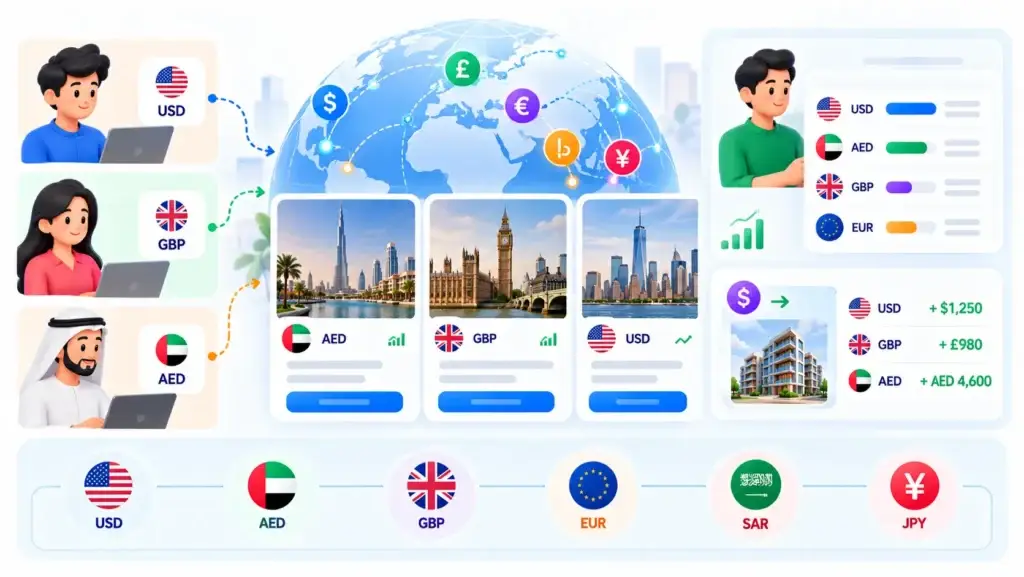
A property may be located in Dubai, London, Riyadh, New York, or another high-demand market, while investors may live in different countries, earn in different currencies, and report their income in another currency altogether. If the platform forces every investor into one currency, the investment journey becomes harder to understand.
Multi-currency investing solves this by allowing the platform to present investment opportunities, wallet balances, deposits, and distributions in currencies that match the investor’s context.
For example, an investor may want to view a property in AED because the asset is located in the UAE. Another investor may prefer to understand their portfolio value in USD or GBP. A platform that supports this natively can reduce confusion and make the investment decision feel more transparent.
This matters because fractional real estate platforms depend heavily on trust. Users are not only browsing products. They are committing capital into an asset. Every unclear currency conversion, hidden FX assumption, or confusing payout value can create hesitation.
Multi-Currency Investing Helps Platforms Reach International Investors
International growth usually fails when a platform treats every market the same.
A founder may start with one property market but later want to attract investors from nearby regions, expatriate communities, overseas buyers, family offices, or global retail investors. Each audience may have different expectations around currency, minimum investment size, language, documents, and reporting.
Multi-currency support allows the platform to serve these groups without creating a separate app for every region.
Instead of hardcoding one currency into the platform, the operator can structure the system around market-specific currency rules. This makes expansion easier because each new market can be configured with its own currency settings, investment thresholds, and user experience expectations.
That flexibility is especially important for fractional property platforms because real estate investing involves multiple money moments:
- funding the investor wallet
- reserving shares in a property
- confirming investment value
- calculating ownership
- distributing rental income
- processing withdrawals
- showing portfolio performance
- supporting secondary market exits
If these money moments are not designed for multiple currencies from the beginning, international expansion becomes expensive to retrofit later.
Currency Familiarity Builds Investor Confidence
Investors make decisions faster when the numbers feel familiar.
If a user earns in GBP but sees every investment only in AED, they may need to manually calculate whether the investment fits their budget. If a user reports income in USD but receives distribution values in another currency without clear conversion logic, they may question the reliability of the platform.
A well-designed multi-currency investment experience should help users answer practical questions:
- How much am I investing in my preferred currency?
- What exchange rate is being used?
- When is the conversion applied?
- What currency does the property use?
- What currency does my wallet hold?
- How will rental distributions appear?
- Can I track my portfolio across more than one currency?
When the platform gives clear answers, the user experience feels more professional. When it does not, investors may assume the platform is not ready for cross-border capital.
For founders, this is not just a UX issue. It is a conversion issue. A confused investor is less likely to complete onboarding, fund a wallet, or commit to a property.
Multi-Currency Wallets Are More Than Display Conversion
A common mistake is treating multi-currency support as a front-end display feature.
In reality, a serious investment platform needs wallet and ledger logic that understands money accurately. Showing a converted number on a dashboard is not the same as supporting multi-currency investing.
A platform may need to track:
- wallet balance by currency
- deposit currency
- investment currency
- settlement value
- FX conversion rate
- rental distribution currency
- withdrawal currency
- historical exchange rate used for a transaction
- audit trail for every money movement
These fractional real estate platform features are not just technical extras. Wallet balances, FX records, investment confirmations, withdrawal flows, admin approvals, and transaction histories work together to create the financial control layer investors expect from a cross-border property investment experience.
This matters because investors may ask why one value changed, why a payout differs from expected, or what rate was used at the time of conversion. The operator should be able to answer from platform records rather than reconstructing the event manually.
For a fractional real estate investment platform, the financial core should be designed around accuracy, traceability, and investor clarity. The right fractional real estate investment platform architecture connects wallet records, transaction history, investor dashboards, ownership data, reporting, and admin approvals so multi-currency support becomes a trust layer rather than a surface-level display feature.
Country Profiles Make International Expansion Easier
A country profile is a practical way to manage market differences inside one platform.
Instead of building separate systems for each region, the operator can define market-level rules. These rules may include:
| Configuration Area | Why It Matters for International Growth |
|---|---|
| Base currency | Helps align investment pricing with the market or property location |
| Minimum investment amount | Allows each market to set a realistic entry ticket |
| Investor eligibility | Helps the operator manage suitability or local onboarding requirements |
| Language and formatting | Improves comfort for users across regions |
| Date and number formats | Reduces confusion in financial statements and dashboards |
| Payment and withdrawal flows | Supports market-specific funding behavior |
| Reporting currency | Helps investors understand portfolio value more clearly |
This structure helps founders avoid a common scaling problem: launching in a new market and discovering that core assumptions are buried inside the codebase.
If market rules are configurable, expansion becomes a business decision. If market rules are hardcoded, expansion becomes a rebuild.
A white-label real estate crowdfunding platform can support this kind of market-specific configuration when operators want to manage currencies, investor eligibility, minimum investment amounts, payout preferences, and localized investment experiences without creating a separate product for every region.
How Multi-Currency Support Improves Investor Acquisition
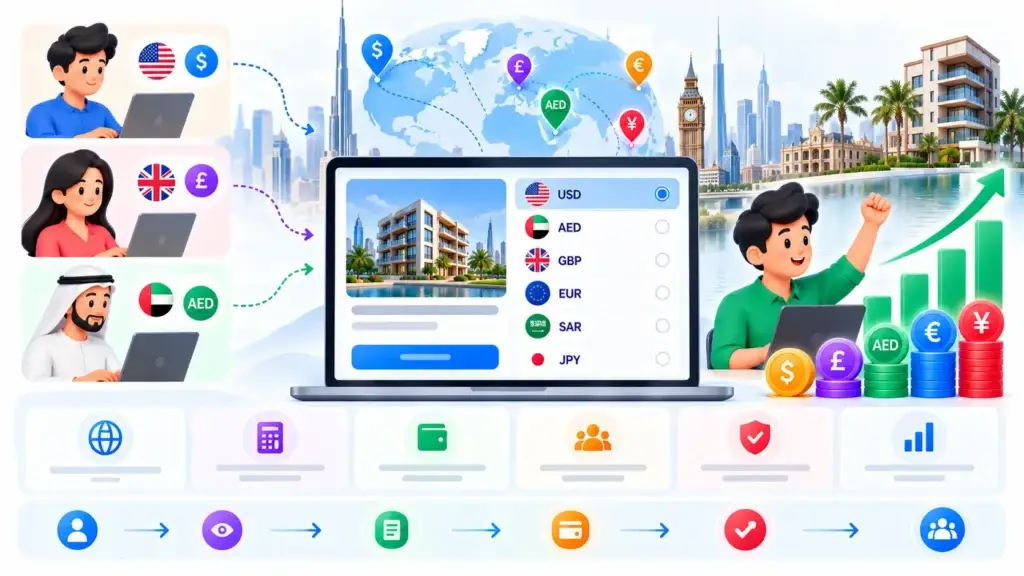
Investor acquisition is not only about paid ads, referral campaigns, or property supply. It is also about reducing hesitation during the investment journey.
A user may arrive on a platform because the property opportunity is attractive. But they will only continue if the platform makes the process feel understandable and secure.
Multi-currency features can improve acquisition by:
- allowing users to evaluate opportunities in a familiar currency
- reducing mental conversion work
- making deposits and withdrawals easier to understand
- supporting expatriate and overseas investor segments
- improving trust in portfolio reporting
- making the platform feel built for international users from day one
Multi-currency support also strengthens the fractional real estate investment business model because it allows operators to attract investors across regions, localize entry amounts, improve wallet funding confidence, and support monetization paths built around international property demand.
This is especially useful for platforms targeting property markets with global investor interest. When users from different countries can understand the offer without friction, the platform has a stronger chance of converting traffic into funded investors.
How Multi-Currency Support Affects Rental Distributions
Rental distributions are one of the most sensitive parts of a fractional real estate investment platform.
Investors want to know what they earned, when they earned it, what deductions were applied, and what currency they received. If a platform supports multiple currencies, the distribution workflow must be clear enough for both investors and operators.
A strong distribution workflow should answer:
- What was the property’s income currency?
- What share does each investor own?
- Was any FX conversion required?
- What rate was applied?
- Was the distribution approved before release?
- What transaction record was created?
- Can the investor download or view the distribution history?
This is where multi-currency investing becomes operational, not just visual.
If the platform only displays property listings beautifully but handles distributions manually, the operator may face problems as investor volume grows. A scalable platform needs the money workflow to be structured from the beginning.
In many property investment models, distribution clarity is also connected to legal ownership structure. Founders planning investor payouts, rental income records, and ownership documentation should understand how SPVs work in real estate crowdfunding because entity structure, investor rights, income allocation, and reporting workflows often need to operate together.
Founder Decision Signals for Multi-Currency Fractional Real Estate Platforms
Investor Geography
If investors will come from more than one country, multi-currency support should be treated as a core platform requirement rather than a future enhancement.
Property Market
If assets are listed in a market where investors commonly earn, save, or report in another currency, currency clarity becomes part of the investment experience.
Distribution Complexity
If rental income, fees, withdrawals, and exits may involve conversion, the platform needs ledger-backed workflows and clear transaction records.
Expansion Plans
If the business plans to enter new regions, country profiles can reduce the cost and risk of adapting the platform for each market.
Multi-Currency Investing Also Supports Better Portfolio Visibility
Investors do not only care about individual transactions. They want to understand their overall portfolio.
A fractional property investor may hold shares across multiple assets, each with different currencies, locations, yields, and distribution schedules. Without thoughtful currency handling, the portfolio dashboard can become confusing.
A useful portfolio experience should help investors see:
- total invested amount
- current holding value
- currency exposure
- property-level performance
- rental income history
- realized and unrealized returns
- withdrawal-ready balances
- secondary market activity where available
This helps investors feel in control. It also helps the platform operator present a more mature investment experience.
For international platforms, portfolio visibility can become a retention advantage. Users are more likely to continue investing when they can clearly understand what they own and how their holdings are performing.
What Founders Should Avoid When Adding Multi-Currency Features
Treating Currency Conversion as a UI Feature
Displaying converted values is not enough. The platform should record transaction currency, conversion logic, wallet movement, and historical values so investors and operators can understand what happened later.
Using One Currency Assumption for Every Market
A platform built around one default currency can become difficult to expand. Market-level configuration helps operators adapt pricing, minimums, and investor experience without rebuilding the product.
Ignoring Distribution Workflows
Many founders focus on property listings and onboarding, but distributions are where investor trust is tested. Rental income, approvals, conversions, and payout records should be designed carefully.
Launching Without Clear Investor Records
International platforms need clean records for ownership, transactions, wallet balances, and payouts. Without this, support teams and finance teams may struggle to answer investor questions.
Where Miracuves Fits Into This Strategy
Building a fractional real estate investment platform for international users requires more than property pages and payment buttons. The platform needs investor onboarding, wallet logic, country-level configuration, portfolio tracking, ownership records, distribution workflows, admin controls, and a reliable path for scaling across currencies.
Miracuves helps founders and operators launch white-label, source-code-owned investment platforms with the product foundation already in place. For ready-made deployments, Miracuves’ 6-day delivery timeline can help teams move faster from planning to market validation while still allowing brand, currency, workflow, and operational configuration based on the launch scope.
For founders evaluating a cross-border property investment model, a launch-ready platform can reduce the risk of building every module from zero. The stronger decision is not simply to launch quickly. It is to launch with the right financial and operational foundation.
Explore Miracuves’ fractional property investment platform to see how a ready-made build can support multi-currency investing, investor onboarding, ownership tracking, and property investment workflows.
Final Thoughts
Multi-currency investing is not just a feature for fractional real estate platforms. It is part of the growth strategy.
When a platform serves investors across countries, currency affects every major decision: how users understand opportunities, how they fund wallets, how they receive distributions, how they read reports, and how much confidence they place in the platform.
For founders, the key lesson is simple. International growth should not be added after the product is already built around one market. If cross-border investors are part of the plan, multi-currency logic, country profiles, wallet records, FX workflows, and distribution visibility should be designed into the foundation from the start.
A platform that handles currency clearly can make international investing feel simpler, safer, and more scalable for both investors and operators.
FAQs
Why is multi-currency support important in fractional real estate investing?
Multi-currency support helps investors from different countries understand investment amounts, wallet balances, rental distributions, and portfolio performance in currencies that are relevant to them. This reduces confusion and improves trust during the investment journey.
Is multi-currency investing only useful for international platforms?
It is most valuable for platforms targeting international investors, expatriate communities, overseas property buyers, or assets located in markets where investors commonly earn or report in different currencies. Even regional platforms can benefit if their investor base is cross-border.
What is the difference between display conversion and real multi-currency wallet support?
Display conversion only shows an estimated value in another currency. Real multi-currency wallet support tracks balances, deposits, withdrawals, transaction currency, FX conversion, and historical records as part of the platform’s financial core.
How do country profiles help a property investment platform expand?
Country profiles allow the platform operator to configure market-specific rules such as currency, minimum investment amount, eligibility requirements, language, date formats, and reporting preferences. This makes expansion easier than rebuilding the platform for every market.
Can multi-currency support improve investor conversion?
Yes. When investors can understand pricing, funding, and returns in a familiar currency context, they are more likely to trust the platform and complete the investment journey. Currency clarity reduces hesitation during onboarding and funding.
What should founders check before launching a multi-currency investment platform?
Founders should check wallet architecture, FX conversion logic, transaction records, distribution workflows, admin approvals, country configuration, investor reporting, and compliance-support workflows before launch.
Does multi-currency support replace compliance work?
No. Multi-currency support helps with platform functionality and investor experience, but legal permissions, capital-raising rules, payment requirements, and compliance obligations depend on the operating jurisdiction and should be reviewed with qualified advisors.
How can Miracuves help with a multi-currency fractional property platform?
Miracuves can help founders launch a ready-made, white-label property investment platform with source-code ownership, admin controls, investor workflows, and configurable financial features. Ready-made delivery can support faster launch planning when the required scope matches the available product foundation.
Miracuves is an independent software development company. We are not affiliated with, connected to, sponsored by, or endorsed by any company or product named in this article.
Terms such as “X Clone” are used descriptively. It is how the software industry refers to building a platform with functionality comparable to a known service, and how clients search for it.
The entire design and codebase of our products is built by our own team. Our products contain no code, design, graphics, or content originating from any third-party website or applications.
All third-party names and marks referenced in this article are the property of their respective owners, referenced solely to identify the services discussed.