



















Key Takeaways
- Microdrama Streaming Platform Localization should be planned around retention, paywall crossing, coin unlocks, VIP conversion, rewarded ads, and market fit—not translation alone.
- Subtitles are usually the better first step for fast market testing, wider language coverage, and lower localization cost.
- Dubbing becomes more valuable in priority markets where emotional performance, listening preference, and stronger revenue potential justify deeper investment.
- A staged strategy works best: subtitle first, measure performance, identify winning titles, then dub the markets and series that prove demand.
- Operators should manage subtitles, dubbed tracks, interface copy, pricing, currencies, and market availability directly from the admin console.
Localization Signals
- Use subtitles when testing multiple markets, large catalogs, or audiences that already accept captioned content.
- Upgrade to dubbing when a title shows strong retention, trailer performance, unlock behavior, or payment intent.
- Subtitle quality should consider timing, reading speed, vertical-screen placement, emotional adaptation, and right-to-left support where needed.
- Dubbing quality depends on script adaptation, voice casting, emotional direction, scene timing, audio mixing, and cultural fit.
- Localization performance should be measured through completion, episode progression, paywall crossing, coin unlocks, VIP upgrades, ad engagement, and market-level conversion.
Real Insights
- Localization quality directly affects whether viewers stay emotionally connected long enough to reach and cross the paywall.
- Dubbing the entire catalog before proving market demand can create unnecessary localization cost.
- If subtitle retention is strong but payment conversion is weak, the real issue may be pricing, payment methods, free episode windows, or content fit rather than language.
- Hardcoded language assets slow expansion because every subtitle, audio, pricing, or copy adjustment then depends on a new developer release.
- The strongest path is: subtitle selected titles → measure retention and monetization → improve local packaging → dub proven winners → keep long-tail markets subtitle-led → scale each market based on performance.
A microdrama streaming platform does not scale internationally simply by adding more episodes. For founders planning regional expansion, a DramaBox-style streaming platform can provide a foundation for managing localized subtitles, dubbed audio tracks, and language-specific viewing experiences across different markets.
International growth depends on making the same emotional story resonate with audiences across languages and cultures.
That is where localization becomes a growth decision. Founders often start by asking whether they should use subtitles or dubbing. But the more important question is which localization method keeps viewers emotionally connected long enough to cross the paywall, unlock episodes, buy coins, watch rewarded ads, or upgrade to VIP access.
Subtitles are generally faster, more affordable, and easier to test across multiple languages. Dubbing can create a more immersive, locally familiar viewing experience, especially for audiences who prefer listening over reading. Neither approach works equally well in every market. The right choice depends on audience preferences, genre, content depth, acquisition strategy, and monetization goals.
Short-drama viewers often decide within seconds whether to continue watching. Poorly timed subtitles, unreadable text, or captions covering important visual details can interrupt the experience. Similarly, unnatural dubbing, flat voice performances, or culturally mismatched dialogue can weaken emotional engagement. In microdrama streaming, localization quality can directly influence viewer retention and episode progression.
Miracuves helps founders launch ready-made and white-label short-drama platforms with multilingual support, subtitle workflows, dubbed audio tracks, coin wallets, VIP access, rewarded ads, and operator controls. This guide explains when subtitles are the better choice, when dubbing justifies additional investment, and how founders can build a practical localization strategy for international growth.
Why Localization Matters More in Microdrama Than Traditional OTT
Traditional OTT platforms often rely on long-form viewing. A user may tolerate slower pacing, heavier subtitles, or occasional awkward translation because they already committed to a movie or full episode.
Microdrama is different.
The story is compressed into short vertical episodes. Every second matters. The opening hook, character emotion, subtitle timing, voice performance, cliffhanger, and next-episode prompt all influence whether the user continues.
In a Microdrama Streaming Platform, localization affects:
- First episode completion
- Hook performance
- Episode-to-episode retention
- Paywall crossing rate
- Coin unlock conversion
- VIP upgrade behavior
- Rewarded ad engagement
- App-store creatives
- Trailer performance
- Market-level content discovery
This is why localization should not be treated as a final upload task. It should be part of the monetization architecture.
If a viewer cannot understand the emotional stakes, they will not pay to continue the story.
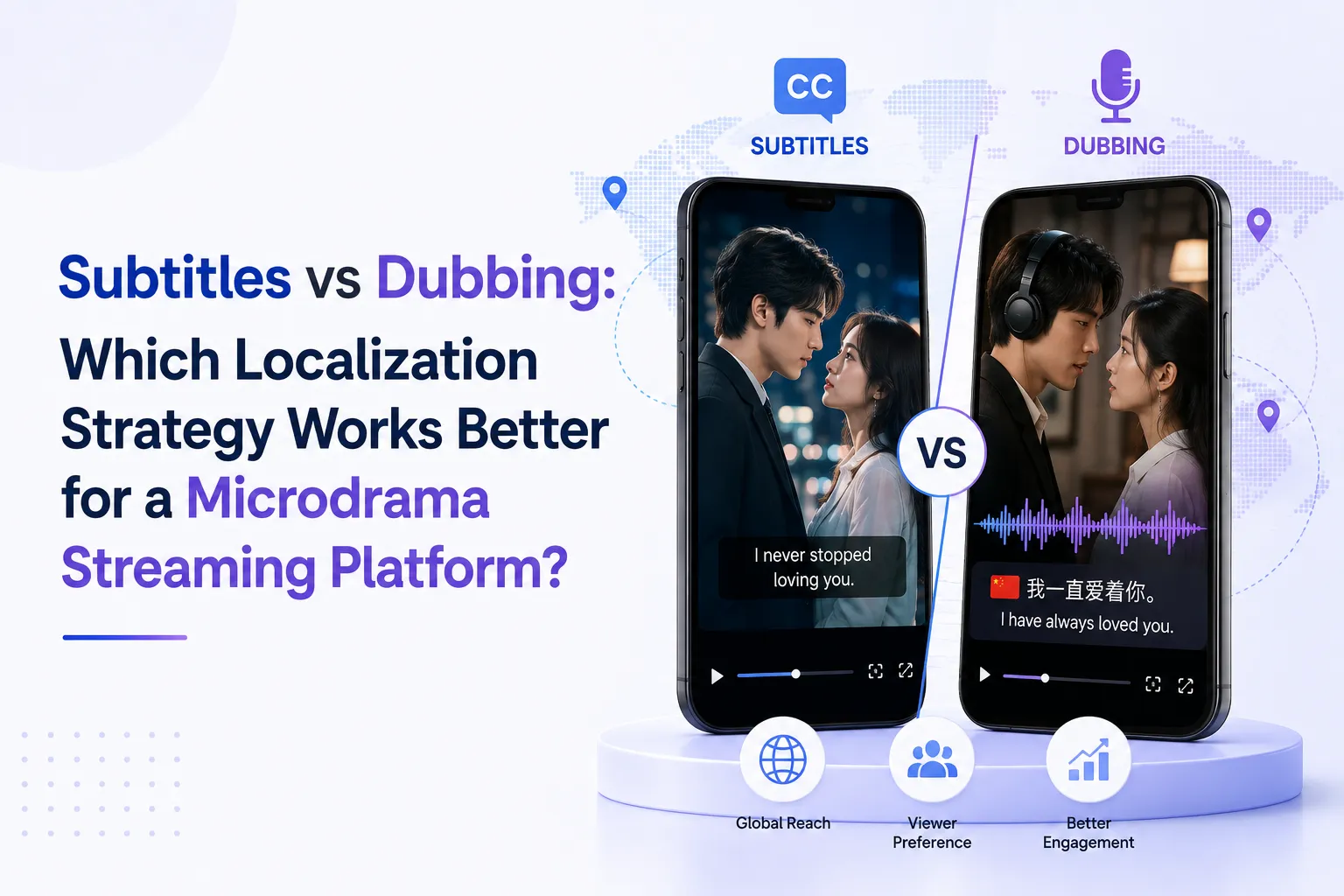
Subtitles vs Dubbing: The Core Difference for Short-Drama Apps
Subtitles translate the dialogue into on-screen text while keeping the original audio. Dubbing replaces the original spoken dialogue with localized voice performance.
Both methods solve language access, but they create different viewing experiences.
Subtitles vs Dubbing: Cost, Translation Accuracy, Accessibility, and Turnaround Time
| Comparison Factor | Subtitles | Dubbing |
|---|---|---|
| Production Cost | Generally more affordable because production mainly involves translation, subtitle timing, formatting, and quality checks. | Generally more expensive because it requires script adaptation, voice recording or AI voice generation, audio synchronization, and quality checks. |
| Translation Accuracy | Preserves the original dialogue and voice performances, allowing viewers to hear the original audio while reading translated text. Accuracy depends on translation quality and cultural adaptation. | Requires accurate script adaptation to preserve dialogue meaning, emotional tone, and cultural context. Poor voice delivery or synchronization can affect the viewing experience. |
| Accessibility | Supports viewers who prefer reading and can improve accessibility for deaf or hard-of-hearing audiences when appropriate captions are provided. | Makes content easier to follow for viewers who prefer listening in their native language, but does not replace captions for hearing accessibility. |
| Turnaround Time | Usually faster to produce and deploy across multiple languages because no additional voice recording is required. | Typically takes longer because of voice selection, recording or generation, audio editing, synchronization, and quality assurance. |
| Viewer Experience | Maintains original voice performances and emotional delivery, but requires viewers to read while watching fast-paced scenes. | Allows viewers to focus on visuals without reading subtitles, provided the dubbed voices sound natural and match the characters. |
| Best Use Case | Suitable for testing new language markets, localizing large content catalogs, and launching with a limited localization budget. | Suitable for priority markets where native-language audio can improve the viewing experience and justify additional production investment. |
| Main Limitation | Fast dialogue, small mobile screens, and poorly timed subtitles can make episodes harder to follow. | Higher production requirements and unnatural voice performances can reduce immersion and emotional impact. |
For microdrama startups, subtitles are generally a faster and more cost-effective way to test multiple language markets, while dubbing requires additional investment in voice production and audio quality. However, cost and speed should not be the only deciding factors. Translation accuracy, accessibility, viewer preferences, and emotional storytelling also matter. A practical approach is to begin with professionally reviewed subtitles and invest in dubbing for markets and series that demonstrate strong viewer engagement and commercial potential.
When Subtitles Work Better for a Microdrama Streaming Platform
Subtitles are usually the smarter first move when founders are testing new markets.
They allow a platform to localize faster, launch more languages, and measure early viewer behavior before committing to full dubbing. For microdrama startups, this matters because not every title will justify expensive localization in every region.
Subtitles work best when:
- You are testing multiple markets quickly.
- The catalog is large and needs fast localization.
- The target audience is comfortable with captioned content.
- The platform needs lower-cost market validation.
- The original audio performance is strong.
- The first goal is reach, not full immersion.
- You want to test trailers, ads, and first episodes before deeper investment.
- The content is dialogue-light or visually clear.
For early-stage founders, subtitles help answer the most important question: does this story travel?
If a subtitled title performs well, the platform can later upgrade that title with dubbing in high-value markets. If it does not perform, the operator avoids spending heavily on audio localization before proving demand.
For a broader strategy comparison, this guide on short drama apps vs traditional OTT platforms explains why short-drama platforms need different content pacing, retention logic, and monetization flows than traditional streaming apps.
When Dubbing Works Better Than Subtitles
Dubbing becomes more valuable when the market is important enough to justify deeper localization.
In microdrama, emotion drives monetization. Romance, betrayal, revenge, family conflict, transformation arcs, and cliffhangers depend on tone. If the viewer is busy reading subtitles, they may miss facial expressions, music cues, gestures, and fast cuts.
Dubbing works better when:
- The target market strongly prefers localized audio.
- Viewers consume content while multitasking.
- The genre depends heavily on emotion and voice performance.
- The platform is investing in paid acquisition.
- The title has already shown strong subtitle performance.
- The market has strong revenue potential.
- The platform wants to improve retention and binge behavior.
- The catalog is small enough to localize deeply.
Dubbing is not only translation. It is performance adaptation.
The local voice should match character age, status, emotion, cultural expectations, pacing, and scene intensity. A poorly dubbed betrayal scene can feel unintentionally funny. A well-dubbed scene can feel native enough for the viewer to forget the content was localized.
That difference affects whether users unlock the next episode.
The Best Strategy Is Usually Subtitles First, Dubbing Second
Most founders should not ask, “Should we subtitle or dub everything?”
A stronger question is, “Which titles deserve dubbing after subtitles prove demand?”
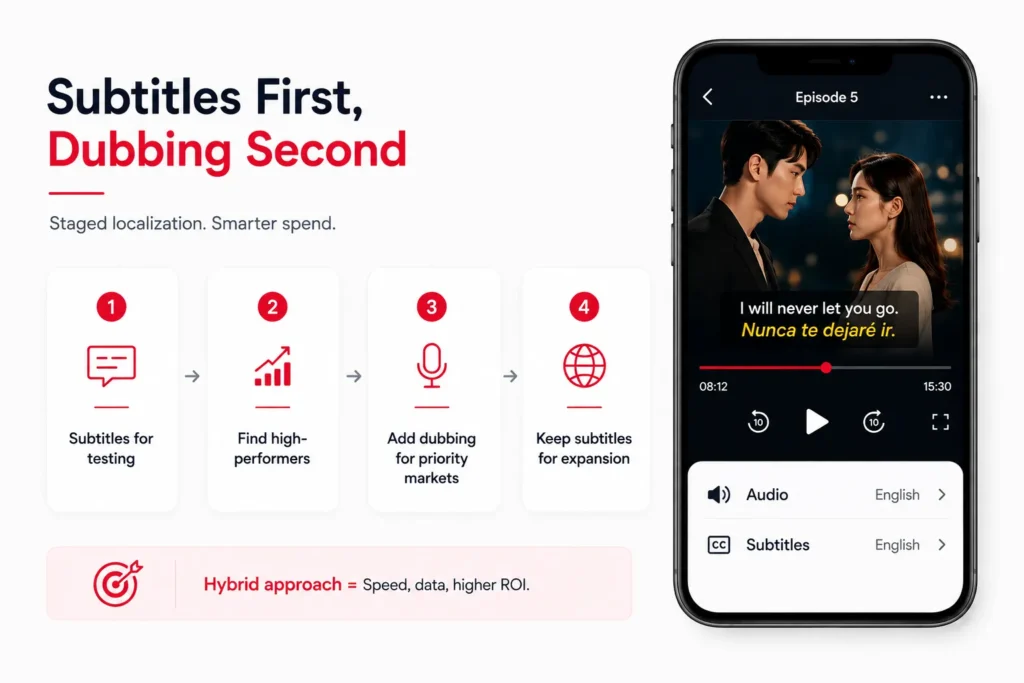
A staged localization model protects budget and improves decision-making.
Stage 1: Use Subtitles for Market Testing
Start with subtitles for selected markets. Track completion, episode progression, paywall crossing, ad engagement, and coin unlock behavior.
At this stage, the goal is not perfect localization. The goal is signal.
Stage 2: Identify High-Performing Titles
Once a title shows strong retention, high unlock rates, or strong trailer performance in a target market, it becomes a candidate for dubbing.
Do not dub the whole catalog just because one market looks attractive. Dub the series that already shows traction.
Stage 3: Add Dubbing for Priority Markets
Use dubbing where deeper immersion can improve conversion. This is especially useful for romance, revenge, family drama, and emotionally intense genres.
Stage 4: Keep Subtitles for Wider Expansion
Subtitles can continue supporting long-tail markets, secondary languages, and catalog testing while dubbing focuses on high-return titles.
This hybrid approach gives founders speed without wasting localization budget.
What Founders Should Measure Before Choosing Dubbing
Dubbing should be based on performance signals, not guesswork.
Before investing in dubbed audio, operators should check:
- Trailer click-through rate
- First episode completion
- Episode 1 to episode 3 retention
- Paywall crossing rate
- Coin unlock rate
- Rewarded ad completion
- VIP upgrade behavior
- Cost per paying viewer
- Market-level payment conversion
- Comments and user feedback
- Drop-off points around subtitle-heavy scenes
If a market has strong subtitle retention but weak payment conversion, dubbing may not fix the issue. The real problem may be pricing, payment methods, free episode window, coin pack structure, or content fit.
If a market has strong trailer interest but weak episode completion, localization quality may be the issue.
A Microdrama Streaming Platform should help operators see these signals from the admin console. Localization decisions should be tied to retention and monetization data, not assumptions.
Subtitle Quality: What Makes Captions Work in Vertical Drama
Subtitles for vertical short drama require different rules than long-form TV.
The screen is smaller. The pacing is faster. The user may be watching on mobile with UI overlays, coin prompts, captions, comments, or next-episode buttons. Poor subtitle placement can cover faces, emotional expressions, or key visual details.
Strong subtitle localization should consider:
- Reading speed
- Line length
- Timing
- Subtitle safe zones
- Font size
- Contrast
- Speaker clarity
- Cultural adaptation
- Slang and idioms
- Character names
- Emotional tone
- Consistency across episodes
- Support for right-to-left languages where needed
Literal translation is often not enough. Microdrama dialogue can be dramatic, emotional, and culturally specific. A direct translation may be technically correct but emotionally weak.
For founders, subtitle quality matters because the viewer is not reading a document. They are deciding whether to unlock the next episode.
Dubbing Quality: What Makes Localized Audio Convert Better
Dubbing succeeds when it feels emotionally natural.
A Microdrama Streaming Platform should not treat dubbing as a simple audio replacement. The localized voice should match the dramatic rhythm of the original scene while fitting local audience expectations.
Good dubbing planning includes:
- Script adaptation
- Voice casting
- Character tone guide
- Pronunciation guide
- Emotional performance direction
- Scene timing
- Audio mixing
- Background audio balance
- Quality review
- Episode-level consistency
- Market-specific cultural checks
The goal is not only language accuracy. The goal is emotional continuity.
If a villain sounds too flat, a romantic lead sounds unnatural, or a family conflict sounds overly formal, the story loses its hook. In short-drama streaming, emotional hook is revenue logic. The more naturally the viewer connects, the more likely they are to continue.
Localization and Monetization: Why Language Strategy Affects Coins, VIP, and Ads
Localization affects revenue because it affects how far viewers travel through the story.
A viewer who drops before the paywall creates little value. A viewer who reaches the locked episode may buy coins, watch rewarded ads, or consider VIP access. That means subtitle and dubbing quality influence the platform’s monetization system.
A short-drama platform should connect localization with:
- Free episode window
- Locked episode position
- Coin price per episode
- Coin pack offers
- VIP access value
- Rewarded ad unlock limits
- Market-level pricing
- Currency display
- Payment method selection
- Push notifications
- Localized app-store creatives
- Trailer captions and voiceovers
For example, a subtitled market may need a larger free window so users have time to adjust to the story. A dubbed priority market may support earlier paywall placement because viewers understand the story faster. A low-payment market may rely more on rewarded ads and smaller coin packs.
A strong microdrama streaming business model should connect subtitles, dubbing, coins, VIP access, rewarded ads, licensing, rewards, and market pricing into one controlled revenue system.
Operator Control: Why Localization Should Not Require a Developer Release
Localization becomes expensive when every language change requires a developer.
A Microdrama Streaming Platform should allow operators to manage language assets, interface copy, subtitles, dubbed audio tracks, metadata, episode availability, coin pricing, and market settings from the admin console.
The operator should be able to manage:
- UI language strings
- Series titles by language
- Episode titles by language
- Localized synopsis
- Genre tags
- Subtitle files
- Dubbed audio tracks
- Trailer captions
- App banner copy
- Push notification copy
- Currency labels
- Coin pack text
- VIP plan text
- Market-specific availability
- Right-to-left layout support where needed
This matters because localization is never finished on launch day. Titles are renamed. Trailer hooks are tested. Subtitles are improved. Voice tracks are replaced. Payment wording changes. VIP offers are adjusted. New markets are added.
A platform that lets operators manage this directly can move faster than a platform where every copy change waits for a build cycle.
Founders exploring module-level localization and monetization tools can review this microdrama platform feature breakdown to compare subtitles, dubbed tracks, coin wallets, VIP windows, rewarded ads, language settings, and operator controls.
Cost Planning: Why Dubbing Should Follow Market Proof
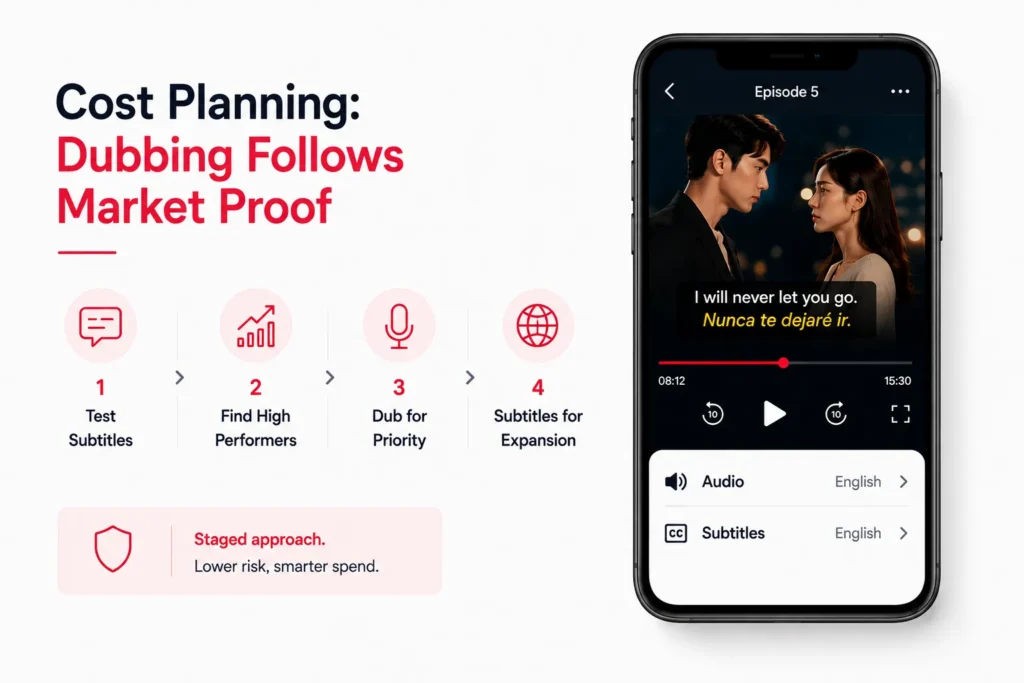
Subtitles and dubbing have different cost profiles.
Subtitles usually cost less and can be produced faster, especially when the founder is testing multiple markets. Dubbing requires more coordination because it may involve script adaptation, voice casting, recording, audio review, mixing, and quality checks.
For a Microdrama Streaming Platform, the cost is not only per minute. It is catalog multiplied by languages multiplied by market priority.
Founders should plan localization cost around:
- Number of episodes
- Episode duration
- Number of target languages
- Subtitle quality level
- Dubbing quality level
- Voice talent requirements
- Turnaround time
- Review workflow
- Subtitle file management
- Audio track storage
- CDN delivery cost
- Market-level payment setup
- App-store content listing updates
This is why staged localization is usually safer. Test subtitles first. Dub what performs. Keep long-tail markets subtitle-led until the data supports deeper investment.
Founders comparing development and localization scope can review this microdrama platform development cost breakdown before deciding whether to build from scratch or start with a ready-made foundation.
If your product also needs native iOS and Android apps, custom playback flows, app-store-ready monetization, or deeper mobile user experience work, a custom mobile app development team can help scope the mobile experience properly.
Founder Decision Signals
Use Subtitles First
Choose subtitles when you are testing multiple markets, validating catalog demand, controlling cost, or launching before you know which regions deserve deeper localization.
Upgrade to Dubbing
Choose dubbing when a market already shows strong retention, payment intent, trailer performance, or cultural preference for localized audio.
Watch Paywall Data
If users complete free episodes but do not unlock paid episodes, check localization quality, wall position, coin pricing, and payment methods before blaming the content.
Keep Operators in Control
If language assets, audio tracks, pricing, and interface copy cannot be changed from the console, the platform may slow down multi-market expansion.
Suggested Localization Rollout Plan for Microdrama Startups
A practical localization rollout should protect budget while still allowing market expansion.
Subtitles-to-Dubbing Rollout Plan
| Stage | Localization Move | What to Measure | Decision Rule |
|---|---|---|---|
| Launch Test | Subtitle 3–5 strong titles in one or two target languages. | Completion, paywall crossing, unlocks, ad views, comments, and drop-off. | Continue only if viewers reach the locked episode and show intent to continue. |
| Market Validation | Improve subtitle quality and localize titles, metadata, trailer captions, and push copy. | Trailer CTR, app install quality, first-session watch time, and episode progression. | Optimize packaging before investing in dubbing. |
| Dubbing Pilot | Dub only the best-performing series in the strongest market. | Retention lift, unlock lift, VIP conversion, and cost per paying viewer. | Scale dubbing only if revenue signals improve enough to justify cost. |
| Priority Market Expansion | Dub premium titles and keep secondary titles subtitled. | Lifetime value, repeat unlocks, coin pack purchases, and binge behavior. | Use dubbing for high-value content, not the entire catalog by default. |
| Multi-Market Scaling | Operate a mixed catalog: dubbed hero titles, subtitled long-tail titles, localized offers. | Revenue by market, delivery cost, payment conversion, and churn. | Keep localization flexible so each market gets its own strategy. |
Mistakes Founders Should Avoid
Dubbing the Entire Catalog Too Early
Dubbing every title before testing demand can waste budget. Use subtitles to find market signals first, then dub the strongest titles.
Using Literal Subtitles Without Emotional Adaptation
Short-drama dialogue often depends on emotion, insult, confession, jealousy, betrayal, and urgency. Literal translation can weaken the scene even when it is technically correct.
Ignoring Subtitle Placement on Vertical Screens
Subtitles should not cover faces, text overlays, coin prompts, or action. Poor placement can reduce comprehension and completion.
Assuming Dubbing Automatically Improves Revenue
Dubbing helps when the market and title justify it. If the story, pricing, payment method, or paywall timing is wrong, dubbed audio alone will not fix conversion.
Hardcoding Language Assets Into the App
Language copy, subtitles, audio tracks, currency labels, and offer text should be operator-managed. Hardcoded localization slows market testing and increases release friction.
How Miracuves Helps Founders Build Localization-Ready Microdrama Platforms
Miracuves helps founders build short-drama streaming platforms where localization is part of the operating system, not a late-stage patch.
A localization-ready platform should allow operators to manage subtitles, dubbed audio, interface copy, market pricing, coin packs, VIP wording, rewards, language settings, and territory-specific content from the console. This gives founders the flexibility to test subtitles first, add dubbing where performance justifies it, and adjust each market without rebuilding the app.
For founders exploring a launch-ready short-drama product, Miracuves’ microdrama streaming platform solution can be reviewed as the commercial next step after understanding the localization strategy.
For founders comparing ready-made, white-label, and custom build routes, this microdrama platform development partner guide can help evaluate the right provider and ownership model.
For broader product planning, founders can also explore Miracuves’ entertainment app solutions to understand related streaming, creator, video, and digital content platform opportunities.
Final Thoughts: Subtitles Test Markets, Dubbing Deepens Markets
Subtitles and dubbing are not enemies. They are different tools for different stages.
Subtitles help founders move quickly, test more markets, validate catalog demand, and control localization cost. Dubbing helps deepen priority markets where emotional performance, viewing habits, and local expectations justify the investment.
For most Microdrama Streaming Platform founders, the strongest path is staged localization: subtitle first, measure retention, identify winning titles, then dub the markets and series that prove they can convert.
The goal is not to translate everything. The goal is to make the story feel strong enough for viewers to keep watching, unlock the next episode, return tomorrow, and eventually pay.
FAQs
What is a Microdrama Streaming Platform?
A Microdrama Streaming Platform is a short-form video platform built for serialized vertical drama episodes, cliffhanger-based storytelling, fast mobile viewing, and monetization through coins, VIP access, rewarded ads, or episode unlocks.
Are subtitles better than dubbing for microdrama apps?
Subtitles are better for fast testing, lower-cost localization, and early market validation. Dubbing is better when a market has strong demand, high revenue potential, or a clear preference for localized audio.
When should a microdrama platform use dubbing?
A platform should use dubbing when a title already shows strong retention, paywall crossing, unlock behavior, or paid acquisition performance in a target market. Dubbing is best used for priority titles and priority markets.
Why are subtitles difficult in vertical short-drama content?
Vertical screens have limited space. Subtitles must avoid faces, UI overlays, coin prompts, and key scene details. They also need strong timing, readable line length, and emotional adaptation.
Can subtitles and dubbing be used together?
Yes. Many platforms can use subtitles for wider market testing and dubbing for high-value markets or top-performing titles. This hybrid strategy balances speed, cost, and viewer immersion.
How does localization affect microdrama monetization?
Localization affects whether viewers understand the story, continue through episodes, cross the paywall, unlock with coins, watch rewarded ads, or upgrade to VIP access. Better localization can improve retention and monetization signals.
Should every market get the same localization strategy?
No. Each market should be evaluated based on language preference, payment behavior, content taste, ad value, subscription comfort, and subtitle acceptance. Some markets may perform well with subtitles, while others may need dubbing.
Can Miracuves help launch a localization-ready microdrama platform?
Yes. Miracuves helps founders launch ready-made and white-label short-drama streaming platforms with subtitles, dubbed audio tracks, coin wallets, VIP access, rewarded ads, admin controls, source-code ownership, and faster deployment.
Miracuves is an independent software development company. We are not affiliated with, connected to, sponsored by, or endorsed by any company or product named in this article.
Terms such as “X Clone” are used descriptively. It is how the software industry refers to building a platform with functionality comparable to a known service, and how clients search for it.
The entire design and codebase of our products is built by our own team. Our products contain no code, design, graphics, or content originating from any third-party website or applications.
All third-party names and marks referenced in this article are the property of their respective owners, referenced solely to identify the services discussed.