

























Key Takeaways
- AI Voice Agent Customer Support Cost Latency depends on the complete voice pipeline, including telephony, speech processing, model generation, voice synthesis, integrations, and network delivery.
- Lower latency can improve customer experience, but response speed should be measured across real support calls rather than relying only on individual component estimates.
- Development costs increase with the number of call flows, CRM integrations, languages, telephony requirements, security controls, human transfers, and testing requirements.
- Recurring operating costs depend on call minutes, model usage, speech processing, voice generation, telephony, infrastructure, monitoring, and human escalation.
- Cost per resolved call is often more useful than cost per minute because a cheaper system may still create higher costs when it produces repeat calls, failed transfers, or unresolved customer issues.
Cost & Latency Signals
- Track p50 and p95 response latency to identify both typical performance and slower customer experiences.
- Streaming speech recognition and voice generation can reduce perceived waiting time when implemented correctly.
- External API calls can add significant delay, making efficient integrations, timeouts, and appropriate caching important.
- Warm transfers should preserve useful conversation context so human agents do not need to restart the interaction.
- Monitor call volume, duration, transfer rates, resolution rates, abandonment, and attributable support costs to understand real operating economics.
Real Insights
- A faster language model alone cannot guarantee a faster voice experience because latency can originate at multiple stages of the call.
- Human escalation is not automatically a failure; for complex or sensitive requests, a reliable transfer can produce a better customer outcome.
- A voice agent should never confirm a business action unless the connected system verifies that the action actually succeeded.
- Real-world testing should include accents, background noise, interruptions, weak connections, integration failures, peak concurrency, and unsuccessful transfers.
- The strongest approach is: measure latency → optimize the voice pipeline → control integration delays → design reliable transfers → calculate cost per resolved call → monitor performance continuously.
A customer calls a support number to check an appointment, confirm a delivery, or resolve a billing question. Instead of waiting in a queue, they hear an automated assistant that understands the request, retrieves relevant information, and responds in natural speech.
When the situation becomes complicated, the conversation moves to a human representative who already understands the problem.
That is the experience businesses want from modern AI Voice Agent Development Company customer support.
However, making it reliable requires more than connecting a phone number to a conversational model.
If the assistant takes too long to respond, customers may repeat themselves or abandon the call. If transfers fail, callers can become trapped in automated conversations. If processing and telephony charges are poorly planned, the business may find that its automated support costs more than expected.
For founders and support leaders in 2026, the critical questions are how quickly the system responds, how safely it escalates conversations, and how much each successful interaction costs.
This guide explains the architecture behind conversational phone support, the sources of latency, effective transfer design, and the financial planning required before deployment.
How Does an AI Voice Agent Process a Support Call?
A support voice agent must connect several technologies while maintaining a coherent conversation.
The process begins when a call arrives through a telephone number or in-app voice interface.
The system receives the caller’s audio, recognizes or interprets the spoken request, retrieves information where required, and produces a spoken response.
For example, a customer might ask whether a delivery has been dispatched.
The assistant must recognize the question, retrieve the correct order record through an authorized connection, interpret the latest status, and provide an accurate answer.
The conversation may sound simple, but several technical systems have to cooperate.
The main components
Telephony and audio transport: Carries the caller’s audio and connects the conversation to the application.
Speech recognition: Interprets spoken language, sometimes producing partial transcripts as the caller continues speaking.
Conversational intelligence: Determines the caller’s intent, manages context, and decides whether information or a permitted action is required.
Business-system integration: Connects to CRM software, calendars, knowledge bases, ticketing systems, or other approved services.
Speech generation: Produces the audio response heard by the caller.
Some systems process speech recognition, reasoning, and voice generation as separate services. Others use a more direct speech-to-speech architecture.
Neither approach eliminates the need for proper integration, security, and error handling.
Why accurate actions matter more than convincing speech
A voice assistant may sound natural while still providing unreliable support.
For example, it should not tell a customer that their appointment has been rescheduled unless the connected scheduling system confirms the change.
This requires a separation between conversational responses and authorized business actions.
The model can interpret the request, but the business system must remain the source of truth for completed transactions.
Why Is AI Voice Agent Latency Critical for Customer Experience?
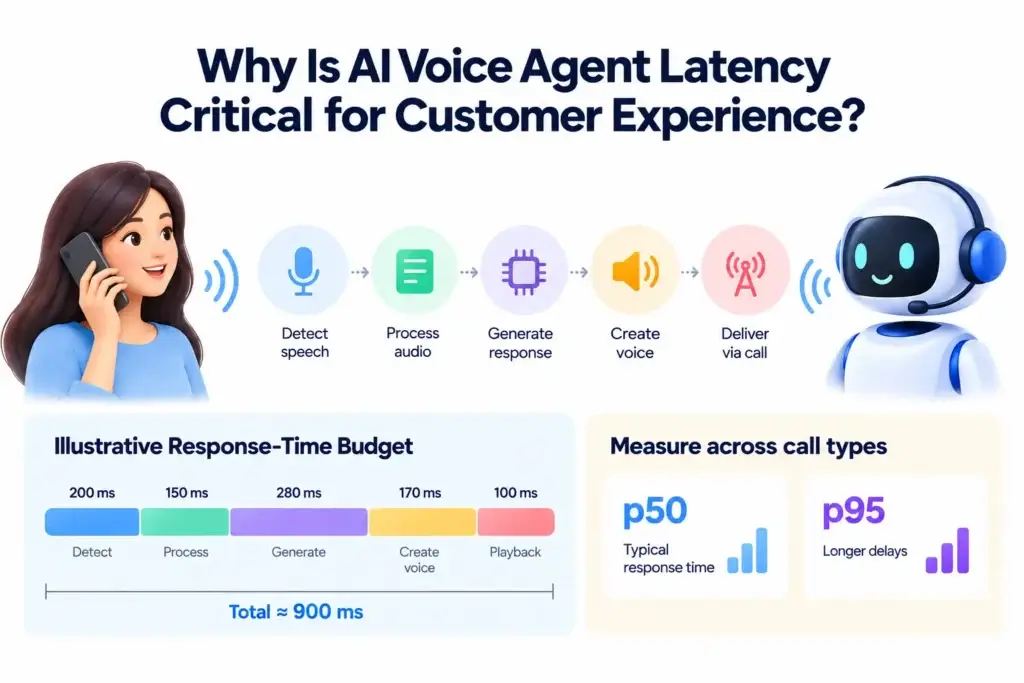
Latency is the delay between a conversational event and the system’s response.
For callers, the most noticeable delay occurs after they finish speaking and before the assistant begins responding.
If that pause becomes excessive, a caller may wonder whether the system heard the question.
They might repeat the request, begin speaking over the response, or hang up.
The problem can compound when repeated speech confuses the turn-taking system.
Understanding end-to-end response latency
A language model’s processing time represents only one part of the full experience.
The total delay can include:
- Detecting when the caller has finished speaking.
- Processing the audio or transcript.
- Generating the assistant’s next response.
- Calling external services when necessary.
- Producing speech audio.
- Delivering that audio through the telephone connection.
A simplified model is:
\[ T_{\text{response}} \approx T_{\text{endpoint}} + T_{\text{processing}} + T_{\text{generation}} + T_{\text{playback}} \]
This formula is conceptual. In a streaming system, some stages overlap.
For this reason, teams should measure the actual time from the end of the caller’s speech to the first audible response, rather than rely only on component-level estimates.
Illustrative response-time budget
Consider this hypothetical engineering example:
| Processing component | Illustrative delay |
|---|---|
| End-of-turn detection | 200 ms |
| Speech processing | 150 ms |
| Model response startup | 280 ms |
| Initial voice generation | 170 ms |
| Network and playback | 100 ms |
| Total | 900 ms |
These figures are examples for planning, not guaranteed industry benchmarks.
Actual results depend on architecture, models, network conditions, language, and whether external tool calls are required.
Why average latency is not enough
A system might respond quickly during simple tests but become slow when a caller requests account details or an API experiences congestion.
Operators should therefore track latency across different call types.
Median response time, commonly called p50, shows a typical response.
The p95 metric captures the threshold under which 95% of measured responses fall.
Monitoring both helps engineers identify cases where a minority of customers experience unusually long delays.
How Can Developers Reduce AI Voice Response Time?
Reducing latency is not simply a matter of selecting the fastest language model.
The complete pipeline needs to be examined because delays can originate in speech detection, tool calls, synthesis, or network transport.
Stream speech recognition and generation
Streaming processing allows the application to begin understanding speech while the customer is still talking.
Likewise, streaming voice generation can begin delivering audio before a complete long-form response has been created.
This can reduce perceived waiting time.
However, partial transcripts can change as the speech recognition system receives more audio.
The assistant should avoid taking irreversible actions based on unconfirmed fragments.
Improve end-of-turn detection
The system needs to recognize when the caller is finished.
If it waits too long, conversations feel slow.
If it responds prematurely, it interrupts the caller.
Voice activity detection and turn-taking controls can help balance these problems.
The appropriate configuration should be evaluated using actual calling conditions, including pauses, background noise, accents, and different languages.
Support natural interruptions
Barge-in allows customers to interrupt the assistant while it is speaking.
A caller might hear the beginning of a list of available appointment times and immediately select the first option.
The application should detect the interruption, stop or adjust playback, and process the new request.
Without this capability, the system may behave like a rigid prerecorded telephone menu.
Reduce unnecessary external requests
API calls can become a significant source of latency.
An assistant that repeatedly retrieves the same information or waits indefinitely for a failed service may create frustrating silences.
Teams should optimize service requests, establish appropriate timeouts, and use safe caching where suitable.
Account-specific or rapidly changing information should still be verified against authoritative systems when necessary.
Test the complete caller experience
Engineers should conduct real calls rather than relying entirely on simulations.
Useful scenarios include weak mobile connections, accented speech, interruptions, multiple follow-up questions, and external service failures.
The best performance target is one established from actual customer needs and measured under representative conditions.
Cascaded Voice Processing vs. Speech-to-Speech Architecture
One architectural decision is whether to process speech through separate recognition, reasoning, and voice-generation components or use a more direct real-time audio model.
Choosing between separate speech-processing components and a real-time audio architecture also involves decisions about model orchestration, infrastructure, security, and integration flexibility. Businesses planning broader automation initiatives may benefit from understanding custom AI development and integration approaches before finalizing their technical architecture.
Both options can support useful customer experiences.
The choice depends on the required control, latency, integration complexity, and billing model.
| Decision Factor | Cascaded Architecture | Speech-to-Speech Architecture |
|---|---|---|
| Processing | Separate recognition, reasoning and synthesis stages | More direct audio processing and generation |
| Latency | Depends on streaming and pipeline efficiency | Can reduce some processing transitions |
| Monitoring | Granular visibility into individual components | Depends on available model telemetry |
| Integration Control | Flexible component-level configuration | Depends on supported tools and orchestration |
| Cost Structure | Separate provider and model charges | Often tied to audio usage and realtime model pricing |
A business handling sensitive customer records may prefer greater observability and deterministic control over approved actions.
Choosing between separate speech-processing components and a real-time audio architecture also involves decisions about model orchestration, infrastructure, security, and integration flexibility. Businesses planning broader automation initiatives may benefit from understanding custom AI development and integration approaches before finalizing their technical architecture.
Another business focused on natural conversational experiences may prioritize low-latency streaming.
The right decision should be validated through representative workload testing, not architecture labels alone.
When Should AI Voice Agents Transfer Calls to Human Support?
Automation should not prevent customers from reaching a person when necessary.
A well-designed system recognizes situations where continuing the automated conversation would be unhelpful or inappropriate.
Common escalation triggers include explicit requests for human support, unresolved questions, repeated misunderstandings, sensitive complaints, failed integrations, and tasks outside authorized automation permissions.
Why transfer rules should be explicit
A system should know which issues it is allowed to resolve independently.
For instance, retrieving appointment availability might be permitted, while approving an exceptional refund could require human authorization.
These rules should be established before deployment.
Otherwise, the assistant may attempt tasks it cannot complete or delay an appropriate transfer.
Cold transfers and warm transfers
A cold transfer routes the call onward without necessarily giving the receiving representative information about the conversation.
A warm transfer aims to preserve relevant context.
That context can include the caller’s reason for contacting support, verified account references, actions already attempted, and the reason for escalation.
The receiving agent can then continue the conversation without asking the caller to repeat every detail.
Why a warm transfer is more than a summary
A summary alone does not complete a transfer.
The telephony service must connect the call to the intended destination, and the application should confirm that the handoff succeeded.
If the representative is unavailable, the caller needs a defined fallback.
Depending on the operation, that could be a callback request, another support queue, or a ticket created with the customer’s permission.
How Do Warm Call Transfers Work Technically?
A reliable warm transfer coordinates the AI application, call-control infrastructure, and human support system.
The assistant identifies that escalation is necessary and prepares the information required by the receiving team.
The telephone infrastructure handles routing and call connection.
SIP-based transfer and bridging
Many business telephony systems use Session Initiation Protocol (SIP) to manage internet-based calling.
A transfer may be implemented through supported SIP signaling, provider-specific APIs, or a conference-style bridge.
A consultation-based bridge can allow the human representative to receive the context before joining the customer.
The precise implementation depends on the telephony provider and receiving environment.
What information should be preserved?
A useful handoff record may include the following:
- Call and session identifiers.
- Verified caller identity status.
- Reason for the call.
- Relevant order, booking, or support references.
- Actions successfully completed.
- Unresolved customer request.
- Reason for escalation.
- Short contextual summary.
The system should distinguish verified facts from model-generated interpretations.
Sensitive personal information should be transferred only when appropriate and through approved, access-controlled systems.
Handling unsuccessful transfers
A transfer can fail because the receiving queue is unavailable, an agent does not answer, or a telephony connection breaks.
The voice assistant should not tell the caller the handoff was successful until the infrastructure confirms the required outcome.
Operators need explicit timeout and recovery rules.
In some cases, returning to the automated conversation may be appropriate. In others, a support ticket or callback may be the better option.
The important requirement is that callers are not abandoned between the automated and human systems.
What Determines AI Voice Agent Development Costs?
The initial investment depends on how many workflows the system must support and how difficult those workflows are to implement reliably.
An assistant answering a limited set of standard questions is different from one that verifies customers, modifies appointments, retrieves sensitive account records, and transfers complex requests to specialized teams.
Major implementation cost drivers
Conversation scope: More call types require additional dialogue design, testing, and exception handling.
Integration requirements: Connecting to a CRM, help desk, appointment calendar, or proprietary database introduces engineering work.
Language coverage: Multilingual recognition and synthesis require additional evaluation, especially in noisy calling conditions.
Telephony and transfers: Call routing, warm handoffs, queues, and failed-transfer recovery create technical complexity.
Security and privacy: Authentication, permissions, recording consent, data retention, and access controls require appropriate design and review.
Testing: Production readiness depends on validating realistic conversations, interruptions, errors, and business-system actions.
The complexity of conversational support also depends on how the assistant interacts with business systems. A voice interface may need to retrieve customer records, create support tickets, update appointments, or trigger approved workflows while maintaining appropriate permissions. Founders exploring these broader capabilities can review AI agent development for business workflow automation to understand how intelligent agents connect reasoning with controlled actions across business applications.
A meaningful project quotation should define these requirements explicitly rather than relying on a broad application label.
How Much Does It Cost to Operate an AI Voice Agent Per Month?
Once deployed, the system generates recurring expenses.
These expenses depend on call volume, duration, speech processing, model usage, telephony, infrastructure, monitoring, and support.
A simplified forecast is:
\[ \text{Monthly Variable Cost} = \text{Billable Call Minutes} \times \text{Effective Unit Rate} \]
This is appropriate only when the relevant charges can reasonably be combined into one effective per-minute rate.
Some providers bill speech processing by duration, language models by tokens, voice generation by audio or text units, and telephone services separately.
Therefore, a complete financial plan should account for the actual billing units.
Hypothetical monthly usage example
Assume a business expects 3,000 support calls each month.
If the average automated portion lasts four minutes, the estimated automated usage is 12,000 minutes.
At a hypothetical effective unit rate of $0.10 per minute, the usage calculation is:
\[ 12{,}000 \times \$0.10 = \$1{,}200 \]
This is a mathematical example, not a current market quotation.
It does not automatically include software development, maintenance, recording storage, human support, or additional telephony charges.
The actual cost depends on the selected infrastructure and its contract terms.
Why transfers change the calculation
When a call moves to a human representative, the business may incur human staffing costs and additional telephone charges.
The automated portion may also continue using some services during the transfer process, depending on the architecture.
Founders should measure how frequently calls escalate and how long both the automated and human portions last.
A high transfer rate is not automatically a failure.
For difficult or sensitive issues, transferring appropriately can be the correct outcome.
Why Cost Per Resolved Call Matters More Than Cost Per Minute
A low headline per-minute charge can be misleading if customers regularly repeat themselves or abandon unresolved conversations.
Consider two systems.
The first has a lower processing cost but frequently misunderstands requests and transfers callers without useful context.
The second costs slightly more per minute but completes common tasks accurately and provides reliable handoffs.
The second may create more business value, even if its technology bill is higher.
A more useful measurement is:
\[ \text{Cost per Resolved Call} = \frac{\text{Relevant Automation and Human Support Costs}} {\text{Verified Resolved Calls}} \]
This requires clear definitions.
A caller who disconnects after receiving an incorrect answer should not be counted as successfully served simply because the conversation ended without transfer.
Likewise, a correctly transferred call may be considered successfully routed, but it should not be treated as a resolved customer issue until resolution is confirmed.
What founders should track
Useful operational measurements include first-audio response latency, resolution rate, transfer success, repeat calls, abandonment, incorrect actions, customer satisfaction, and total attributable support cost.
Reviewing these measurements together helps teams avoid optimizing one number at the expense of the actual customer experience.
What Should Teams Test Before Launching Voice Automation?
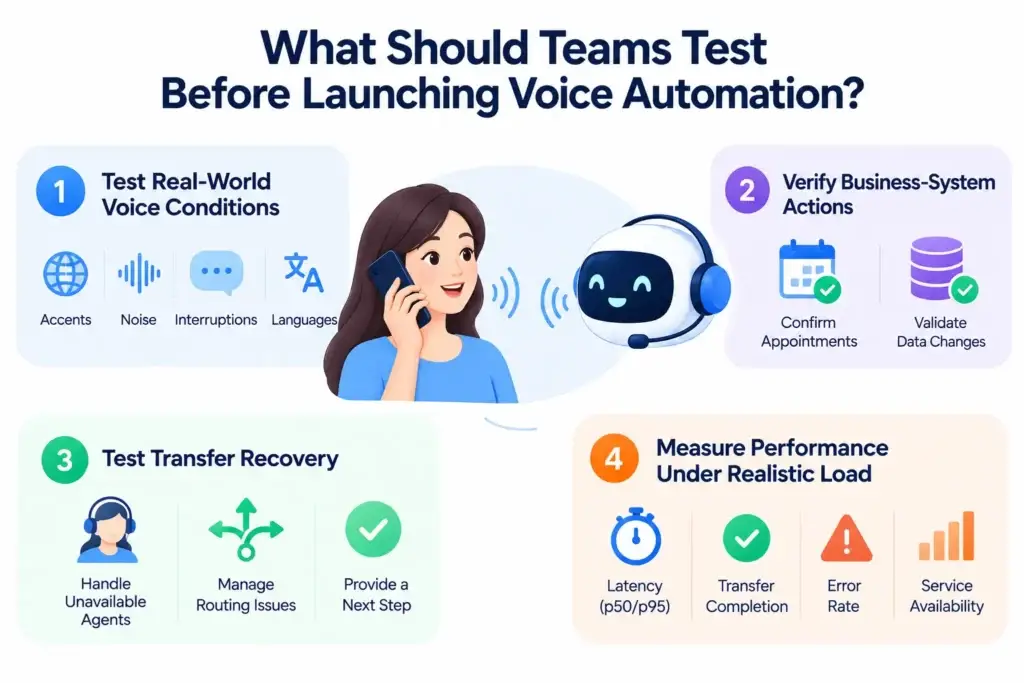
A prototype that performs well during a scripted demonstration is not necessarily ready for real customer calls.
Production testing should include normal conversations, difficult speech conditions, integration failures, and unexpected interruptions.
Test real-world voice conditions
Include callers with different accents, speaking speeds, background noise, and audio quality.
Test how the system handles pauses, interruptions, repeated questions, unclear requests, and corrections.
If several languages are supported, evaluate each language independently rather than assuming similar accuracy.
Verify business-system actions
Test both successful and failed integrations.
If the assistant attempts to create an appointment and the API times out, the caller should not receive a false confirmation.
Actions that modify customer records should have appropriate validation and permission checks.
Test transfer recovery
Simulate unavailable representatives, disconnected calls, overloaded queues, failed routing, and missing contextual data.
The caller should receive an appropriate next step rather than being left in silence.
Measure performance under realistic load
Test normal traffic and expected peak concurrency.
A system that performs well with one active call may behave differently when several calls require simultaneous speech processing or external API access.
Track p50 and p95 response latency, transfer completion, error rates, and service availability.
These measurements create a realistic understanding of operational readiness.
Founder Decision Signals
Founder Decision Signals for Generative AI Cost Control
Token Efficiency
Can you reduce unnecessary input and output tokens through shorter prompts, context management, caching, and appropriate model selection without affecting response quality?
API Cost Visibility
Can you track OpenAI and Anthropic API spending by model, feature, user activity, and request type to identify expensive workflows before costs increase?
Budget Protection
Are token limits, spending alerts, rate limits, and usage quotas configured to prevent excessive API consumption and unexpected monthly bills?
Scalable AI Economics
Can your application support growing user demand while maintaining acceptable response quality, predictable token consumption, and sustainable cost per interaction?
How Can Businesses Choose the Right Implementation Approach?
The appropriate starting point depends on the existing technology environment and the intended customer support workflow.
Some businesses already have a customer-facing application and need to connect conversational phone support to their existing systems.
How Can Businesses Choose the Right Implementation Approach?
Others are launching a new digital product and may benefit from using a ready-made platform foundation.
The distinction affects scope and timeline.
Miracuves provides voice automation implementation and integration services for organizations evaluating phone and in-app calling workflows, human escalation, CRM connectivity, and production requirements.
For eligible ready-made application platforms, Miracuves offers delivery in six working days. The customized voice-agent layer is a separate implementation, with the live service page describing a typical project timeline of 2–8 weeks, depending on the required call flows, integrations, languages, and testing.
This distinction matters when preparing a launch plan.
A business should establish its performance objectives, security requirements, escalation procedures, expected call volume, and maintenance responsibilities before choosing a development approach.
The objective is not simply to launch an automated telephone line. It is to create a reliable support operation that delivers measurable customer value.
Common Mistakes That Increase Voice Agent Latency and Costs
Measuring Only Model Processing Time
A fast model does not guarantee a fast spoken response. Teams should measure the full delay experienced by callers, including endpoint detection, integrations, speech synthesis, and playback.
Treating a Transfer Request as a Completed Handoff
A transfer instruction must be supported by the actual telephone connection and routing system. Without confirmation and recovery procedures, callers may be disconnected or sent to unavailable destinations.
Letting the Assistant Perform Unverified Actions
A conversational model should not be trusted to declare appointments booked, refunds issued, or account changes completed without confirmation from the relevant business system.
Ignoring Concurrency During Budget Planning
Monthly call volume does not reveal how many callers may need service simultaneously. Concurrency can affect provider limits, infrastructure capacity, and reliability.
Optimizing Containment at the Expense of Customers
Keeping customers within automation is not always the right outcome. A quick, appropriate human transfer may be more valuable than a long unsuccessful automated conversation.
Failing to Measure Ongoing Maintenance
Changes to business policies, connected systems, models, supported languages, and customer expectations create ongoing technical work. Maintenance should be included in the operating budget from the beginning.
Final Thoughts: Build for Better Conversations, Reliable Escalation, and Sustainable Costs
AI voice automation can make customer support more accessible, but success depends on much more than generating natural speech.
Low latency helps callers feel heard.
Reliable human transfers protect the experience when requests become complex.
Careful financial planning ensures that automation remains viable as the volume of calls increases.
These factors are connected.
A slow response can cause repeated questions and longer calls. A poorly designed transfer can increase handling time for both automation and human teams. Weak resolution measurement can hide the true cost of support.
Founders should therefore prioritize real performance testing, clear escalation policies, accurate business-system actions, and cost per successfully resolved interaction.
For organizations evaluating production implementation, Miracuves can help assess technical architecture, integration requirements, and the scope needed to bring a conversational support workflow into operation.
Before investing in automated customer support, businesses should define their expected call volumes, response-time requirements, escalation rules, and integration needs. Miracuves can help assess these requirements and identify an appropriate implementation scope. You can discuss your voice support project with the Miracuves team to clarify the technical priorities and budget considerations before development begins.
The strongest system is not the one that automates every call. It is the one that helps customers reach a reliable outcome efficiently.
FAQs
What is AI voice agent latency?
AI voice agent latency is the delay between a caller’s speech and the assistant’s response. For customer support, one useful measure is the time from the end of the caller’s speaking turn to the first audible assistant response. It includes more than language-model processing.
How can developers reduce AI voice response time?
Developers can use streaming speech processing, improve end-of-turn detection, optimize external API requests, support natural interruptions, and monitor latency during real calls. The most effective improvements depend on the specific source of delay.
What is a warm transfer in automated customer support?
A warm transfer connects a caller to a human representative while preserving useful context from the automated conversation. This may include verified identity status, the customer’s request, relevant reference numbers, and actions already attempted.
Can an AI voice assistant transfer calls automatically?
Yes, when connected to a suitable telephony and routing system. The assistant identifies when escalation is needed, while the call-control infrastructure performs the transfer. The application should verify successful connection and provide fallback behavior.
How much does it cost to build an AI voice agent for support?
Development costs depend on the number of call flows, languages, telephony requirements, CRM integrations, security controls, and testing depth. Accurate pricing requires a scoped quotation. The initial implementation budget should be kept separate from usage-based charges.
What affects the monthly cost of running an AI voice assistant?
Major factors include connected call minutes, speech processing, language-model usage, voice generation, telephony charges, concurrency, hosting, monitoring, and maintenance. Human escalation and transfer-related charges may also influence costs.
Is speech-to-speech better than a speech-to-text pipeline?
Neither approach is universally better. Speech-to-speech systems may reduce some processing steps, while cascaded architectures can provide granular monitoring and component-level configuration. The best option depends on latency, accuracy, integrations, cost, and operating requirements.
What should businesses measure after launching voice automation?
Teams should track first-audio latency, p50 and p95 performance, successful transfers, verified resolution rate, abandonment, incorrect actions, customer satisfaction, and cost per resolved call.
Miracuves is an independent software development company. We are not affiliated with, connected to, sponsored by, or endorsed by any company or product named in this article.
Terms such as “X Clone” are used descriptively. It is how the software industry refers to building a platform with functionality comparable to a known service, and how clients search for it.
The entire design and codebase of our products is built by our own team. Our products contain no code, design, graphics, or content originating from any third-party website or applications.
All third-party names and marks referenced in this article are the property of their respective owners, referenced solely to identify the services discussed.