





















Key Takeaways
- Fan Monetization Platform Trust and Safety should be built around age verification, consent, reporting, moderation, content protection, and accountable admin controls.
- Age verification should connect to restricted content access, creator onboarding, subscriptions, PPV unlocks, private messaging, and payout eligibility.
- Consent workflows help document permission for collaborative content, tagged creators, custom media, and other uploads involving multiple people.
- Structured reporting and moderation queues help operators respond to impersonation, harassment, copyright complaints, suspicious accounts, and non-consensual content.
- Content protection should combine secure media access, watermarking, download controls, ownership records, takedown workflows, and audit logs.
Safety Signals
- Creator identity checks help reduce impersonation risk and support safer publishing and payout workflows.
- Reports should be categorized and routed to the correct moderation workflow instead of disappearing into a general support inbox.
- High-risk reports may require content restrictions, evidence preservation, payout holds, escalation, and documented moderator decisions.
- Automation can help identify potential issues, while human moderation provides context for sensitive decisions.
- Role-based admin access helps ensure that staff only receive permissions required for moderation, verification, payouts, or platform operations.
Real Insights
- Trust and safety is not a separate support function; it should operate across creator, fan, payment, content, and admin workflows.
- Watermarking alone cannot protect premium media; access controls, secure storage, reporting, and takedown processes are also important.
- Creators are more likely to trust a platform when verification, consent records, content protection, reporting, and payout visibility are built into the product.
- Audit logs create accountability by recording verification decisions, moderation actions, takedowns, payout holds, and other high-risk changes.
- The strongest safety foundation is: verify users → document consent → protect content → enable reporting → moderate consistently → record actions → review and improve.
A Fan Monetization Platform does not succeed only because it has creator profiles, paid content, subscriptions, tips, paid messages, or live sessions. Those features help monetize attention, but trust and safety decide whether the platform can operate responsibly as it grows.
For founders building a Fan Monetization Platform Trust and Safety, creator platform, influencer platform, celebrity platform, video creation platform, or influencer video platform, the real product is not just the feed. It is the control system behind the feed.
That control system should answer serious operational questions:
Can the platform verify who is allowed to join?
Can creators prove they have rights and consent for the content they publish?
Can users report abuse, impersonation, copyright issues, or non-consensual uploads?
Can admins review reports quickly and apply takedowns with proper records?
Can premium content be protected from misuse, scraping, unauthorized downloads, or leaked media?
These are not optional questions for a subscription based creator platform. They directly affect creator trust, fan safety, payment approval, brand reputation, and long-term scalability.
Miracuves helps founders build ready-made and white-label creator monetization platforms with admin control, verification workflows, content moderation, reporting tools, payout visibility, and source-code ownership. The goal is not to copy another platform blindly. The goal is to build a safer, more controllable product foundation for your own creator economy business.
Why Trust and Safety Matter in a Fan Monetization Platform
Fan monetization platforms are built around direct creator-to-fan relationships. Fans pay for exclusive content, private access, premium messages, custom videos, live sessions, community interactions, or subscription tiers. Creators earn through recurring payments, PPV unlocks, tips, digital goods, paid calls, or personalized requests.
This model creates a powerful business opportunity, but it also creates risk.
A creator monetization platform may handle private media, gated content, user-generated uploads, fan messages, creator payouts, sensitive reports, payment disputes, and content ownership claims. If trust-and-safety workflows are weak, the platform can quickly face problems such as:
- Underage access
- Fake creator accounts
- Impersonation
- Non-consensual uploads
- Copyright complaints
- Unauthorized reposting
- Harassment in private messages
- Payment chargebacks
- Creator payout disputes
- Weak moderation records
- Policy confusion across regions
For founders, trust and safety should not be treated as a legal footer or support inbox. It should be designed into the platform architecture.
A safer creator platform needs clear controls across four areas: age verification, consent, reporting, and content protection.
Read more- How Do Fan Monetization Platforms Manage Premium Content, Messaging, and Paid Access?
Age Verification: The First Safety Layer
Age verification helps confirm that users or creators meet the required age threshold before accessing, publishing, monetizing, or interacting with certain platform features.
In a creator subscription platform, age verification can apply to:
| User Group | Verification Point | Why It Matters |
|---|---|---|
| Fans | Account creation, restricted content access, paid subscriptions, PPV unlocks, private messaging | Helps prevent underage access to restricted or premium experiences |
| Creators | Creator onboarding, publishing approval, payout eligibility, profile activation | Helps confirm creator eligibility before content goes live |
| Collaborators | Tagged content, co-created media, revenue split content, release forms | Helps verify that everyone appearing in content is eligible and documented |
| Staff or managers | Dashboard access, creator account management, moderation actions | Helps reduce misuse of operational permissions |
The mistake many founders make is treating age verification as a single popup. A serious subscription based creator platform needs stronger logic than “Are you 18?” checkboxes.
Age verification should be connected to the action being performed. A user may be allowed to browse public pages but blocked from paid content until verification is complete. A creator may be allowed to create a draft profile but not publish or withdraw earnings until onboarding review is approved.
That kind of staged access gives the operator more control.
Where Age Verification Should Appear in the User Journey
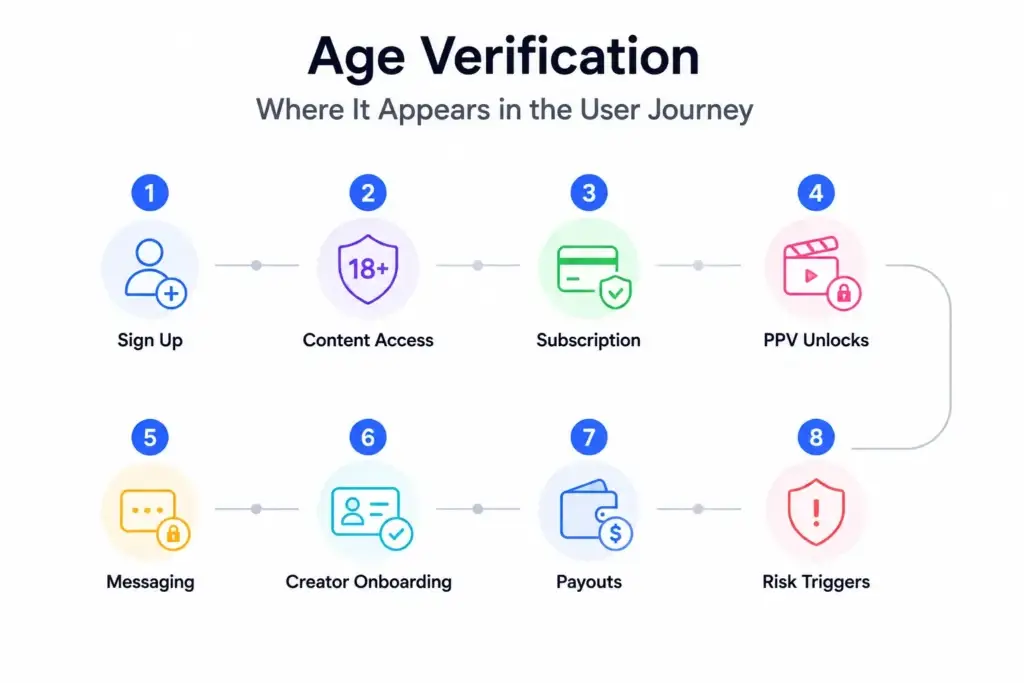
Age checks are more effective when placed at high-risk moments.
For a creator platform, those moments may include:
- Fan registration
Basic access control can begin when a user creates an account. - Restricted content access
Stronger checks may be required before viewing gated or sensitive content. - Subscription purchase
The platform can require verification before the fan subscribes to selected creators or premium tiers. - PPV unlocks
A user may need verified status before unlocking paid videos, photos, or private content. - Private messaging
Messaging can become a risk area because users may send abusive, manipulative, or restricted content. - Creator onboarding
Creators should complete identity and age checks before publishing monetized content. - Payout requests
Verification should connect to payout eligibility so earnings are not released to unverified or restricted accounts. - High-risk behavior triggers
Re-verification may be required when suspicious activity, account changes, region changes, or policy flags appear.
A ready-made platform with verification workflows can reduce the amount of ground-up development needed, but founders should still configure the verification steps based on their target market, content category, payment partners, and legal review.
Consent Workflows: Protecting Creators, Collaborators, and the Platform
Consent is one of the most important safety layers in fan monetization.
A creator may upload solo content, collaborative media, tagged content, custom videos, livestream clips, agency-managed content, or promotional material involving another person. In those cases, the platform operator needs a way to confirm that everyone involved has agreed to the upload, monetization, and distribution rules.
Consent workflows can include:
- Creator declarations during upload
- Model or collaborator release forms
- Age and identity verification for tagged collaborators
- Digital consent signatures
- Consent records attached to media
- Revenue split records for shared content
- Admin approval for sensitive or reported content
- Consent revocation handling
- Policy-based takedown review
- Audit logs for moderator decisions
A celebrity platform or influencer platform may also need consent workflows for personalized video requests, fan shoutouts, co-branded campaigns, creator collaborations, or manager-uploaded content.
Consent is not only about avoiding disputes. It also helps creators feel safer joining the platform. If creators know the platform has proper records, takedown processes, and reporting workflows, they are more likely to trust the business.
Reporting Tools: The Safety Valve of a Creator Platform
Reporting tools allow users, creators, and staff to flag content or behavior that may violate platform rules.
A weak reporting system simply sends an email to support. A stronger system connects reports to structured moderation workflows.
For a creator monetization platform, reporting categories may include:
- Underage user concern
- Impersonation
- Non-consensual content
- Copyright infringement
- Harassment or abusive messages
- Spam or bot activity
- Scam behavior
- Payment-related abuse
- Stolen creator content
- Inappropriate public profile media
- Policy-violating live session
- Suspicious creator account
- Unauthorized use of another person’s likeness
Each category should send the report into the right review path.
For example, a copyright complaint should not follow the same workflow as abusive messaging. A suspected underage user should not be handled like a normal support ticket. A non-consensual content report should be escalated with urgency, evidence preservation, and restricted access while review is pending.
The admin dashboard should help moderators see:
- Who reported the issue
- What content or profile was reported
- Which policy category applies
- Whether the content is public, private, paid, or locked
- Whether the creator or user was previously flagged
- What action was taken
- Which moderator handled the decision
- Whether an appeal is available
- Whether a payout should be paused
- Whether the case needs legal or payment-provider review
This is where trust and safety becomes operational infrastructure.
Trust and Safety Controls for Creator Platforms
| Control | Business Value | Founder Impact |
|---|---|---|
| Age verification | Controls access to restricted content, creator publishing, and payouts. | Reduces underage access risk and supports safer platform operations. |
| Creator identity checks | Helps verify that creators are real and eligible to monetize. | Improves payout trust and reduces impersonation risk. |
| Consent records | Documents permission for collaborative or tagged content. | Protects creators, collaborators, and platform operators during disputes. |
| Abuse reporting | Gives users and creators a way to flag harmful behavior or content. | Helps admins act faster before issues damage platform reputation. |
| Moderation queues | Organizes reported and flagged content for admin review. | Reduces support chaos and improves decision tracking. |
| Content protection | Protects paid media through access control, watermarking, and restrictions. | Improves creator confidence and protects monetized assets. |
| Audit logs | Records verification, moderation, payout, and takedown actions. | Creates accountability for high-risk decisions. |
Content Protection: Keeping Premium Media Safer
Content protection is not one feature. It is a group of controls that protects creator media before, during, and after access.
A fan monetization platform may include paid photos, videos, vault content, PPV drops, livestream replays, audio messages, custom video requests, and premium posts. If the platform does not protect that content, creators may lose trust quickly.
Important content protection layers include:
- Secure media storage
- Access-controlled URLs
- Subscription-based viewing rules
- PPV unlock records
- Watermarking
- Download restrictions
- Screenshot deterrents where technically feasible
- Stream protection for video content
- Expiring links
- Device/session monitoring
- Copyright reporting workflows
- Media ownership declarations
- Takedown request handling
- Admin-level content lock or removal tools
For a video creation platform or influencer video platform, content protection becomes even more important because video is harder to store, stream, moderate, and protect at scale. Premium videos need reliable upload processing, secure playback, access rules, and creator ownership controls.
Founders should not think of content protection only as anti-piracy. It is also part of creator retention. Creators want to know that the platform respects their content, protects their work, and responds when misuse happens.
Moderation Workflows: Combining Automation and Human Review
A growing creator platform cannot rely only on manual review. It also should not rely only on automation.
A practical moderation workflow usually combines:
- Automated pre-screening
- Keyword and metadata checks
- Media moderation integrations
- User reports
- Creator reports
- Manual moderator review
- Escalation paths for high-risk cases
- Takedown actions
- Account warnings
- Temporary restrictions
- Permanent account removal
- Appeal review
- Audit logs
Automation helps reduce volume. Human review helps protect context.
For example, an automated tool may flag content for review, but a trained moderator may need to decide whether the content violates platform policy, whether consent records are sufficient, whether a creator needs to provide documentation, or whether a payout should be paused.
This is especially important for platforms with private messaging, paid DMs, livestreams, and user-generated uploads. These features improve engagement, but they also increase safety workload.
Founder Decision Signals
Risk
If your platform will support gated media, PPV unlocks, paid DMs, creator payouts, or sensitive content categories, trust and safety should be planned before launch.
Creator Trust
Creators are more likely to join and stay when they see verification, consent records, payout visibility, report handling, and content protection controls.
Operational Load
Manual support inboxes break as reports increase. Structured moderation queues help teams review issues faster and keep decisions traceable.
Market Readiness
A ready-made platform can speed up launch, but the safety rules must still match the target market, payment partners, content policy, and legal review.
Trust and Safety Across Creator, Fan, and Admin Panels
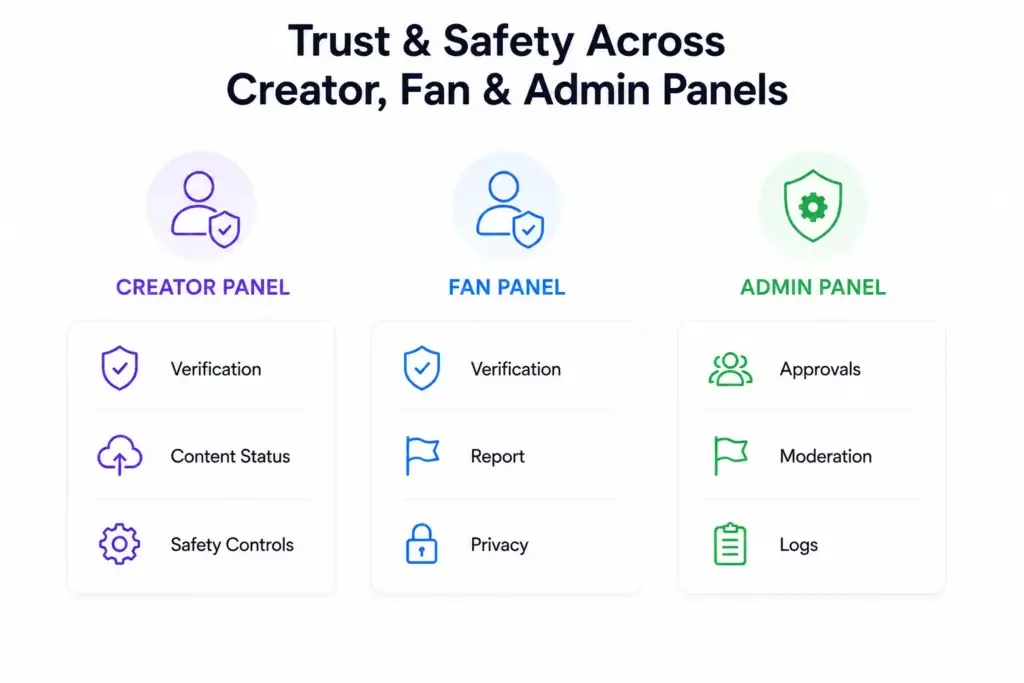
Trust and safety should not live in one backend tab. It should be visible across the full product experience.
Creator Panel
The creator dashboard should help creators manage:
- Profile verification
- Content upload status
- Consent declarations
- Collaborator tagging
- Media protection settings
- Reported content alerts
- Content takedown notifications
- Earnings affected by policy review
- Payout eligibility
- Account safety settings
- Blocked users
- Message controls
Fan Panel
The fan dashboard should include:
- Account verification status
- Report content button
- Report user button
- Subscription and PPV history
- Block or mute controls
- Privacy settings
- Safe messaging options
- Clear refund or dispute guidance
- Content access status
Admin Panel
The admin dashboard should include:
- User verification records
- Creator approval queues
- Consent record review
- Report intake
- Moderation queues
- Content takedown workflow
- Appeal management
- Payout hold controls
- Audit logs
- Role-based access control
- Activity history
- Regional policy settings
- Abuse and bot monitoring
- Payment and dispute signals
These controls help operators run the business without depending on developers for every policy decision.
For a deeper look at related dashboards, payout logic, subscriptions, creator tools, and operating modules, founders can review this creator platform features.
How Safety Controls Protect Monetization
Trust and safety is not only a compliance concern. It directly affects monetization.
A creator monetization platform earns through subscriptions, PPV media, paid messages, tips, live sessions, creator commissions, and sometimes agency-managed revenue splits. Each of these revenue streams depends on platform trust.
When safety controls are weak, monetization suffers.
Creators may leave if their content is leaked, stolen, copied, or misused. Fans may churn if they experience scams, harassment, or unsafe messaging. Payment partners may become harder to work with if reports, moderation, and age controls are unclear. Admin teams may spend more time fighting fires than growing the business.
Strong trust-and-safety workflows protect revenue by improving:
- Creator confidence
- Fan retention
- Payment stability
- Report resolution speed
- Content ownership clarity
- Payout defensibility
- Brand reputation
- Long-term platform credibility
Before expanding monetization across subscriptions, PPV, tips, private messaging, and creator payouts, founders should understand how a creator platform business model connects revenue streams, platform commissions, creator earnings, and operational control.
Read more- Fan Monetization Platform Age Verification and Geo-Blocking: Controls for Regional Operations
Ready-Made Platform vs Custom Development for Trust and Safety
Founders usually have three development paths.
| Build Route | What It Means | Best For | Trust-and-Safety Consideration |
| Basic script setup | Start with a simple content subscription script | Small tests with limited risk | May lack deeper consent, reporting, moderation, and audit workflows |
| Ready-made platform | Start with a launch-ready creator platform foundation | Founders who want faster validation | Can reduce build time if verification, admin, payouts, and moderation modules already exist |
| Custom development | Build every module around your exact operating model | Complex or highly differentiated businesses | Offers more flexibility but requires deeper planning, budget, and execution time |
| Hybrid customization | Use a ready-made platform foundation and customize safety workflows | Most founder-led creator economy launches | Balances faster launch with stronger operational control |
A ready-made platform can help founders avoid building every module from zero, but the safety design still needs business-specific planning. A celebrity platform may need strong identity verification and request approval. An influencer platform may need brand-safe moderation and campaign controls. A video creation platform may need upload moderation, live review, and media protection.
A subscription based creator platform may need stricter fan access, creator verification, payout holds, and reporting workflows.
If your platform needs age verification, consent records, report handling, moderation queues, creator payouts, and content protection, working with a creator platform development company can help you plan the right launch-ready foundation before the product goes live.
Mistakes Founders Should Avoid
Adding safety controls only after launch
Trust-and-safety workflows are harder to add after users, creators, payments, and content are already active. Plan verification, reporting, moderation, and content protection early.
Treating age verification as a checkbox
Age checks should connect to access rules, creator onboarding, restricted content, payout eligibility, and audit records. A simple confirmation screen is not enough for serious platform operations.
Ignoring consent for collaborative content
If creators upload content involving other people, the platform should support consent records, tagged collaborator review, and takedown workflows.
Letting reports disappear into support emails
Reports should create structured cases with categories, evidence, status, assigned moderators, action history, and escalation paths.
Assuming watermarking alone protects content
Watermarking helps, but content protection also needs secure storage, access rules, download limits, report handling, and takedown workflows.
Giving staff too much admin access
Role-based access control matters. A messaging operator should not automatically access payouts, verification records, or policy overrides unless the role requires it.
Trust and Safety Checklist Before Launch
Before launching a creator subscription platform, founders should review these questions:
- Are fan accounts age-gated before restricted content access?
- Are creators identity-verified before publishing or earning?
- Are collaborator consent records supported?
- Can users report content, users, messages, and creator profiles?
- Are report categories mapped to moderation workflows?
- Can admins remove, hide, restrict, or escalate reported content?
- Are moderation decisions recorded with reviewer details?
- Can creators appeal content decisions?
- Can payouts be paused during high-risk reviews?
- Are premium media files access-controlled?
- Is content protected through watermarking or download restrictions where relevant?
- Are suspicious users, bots, and repeat violators tracked?
- Are admin roles permission-based?
- Are verification, moderation, and payout actions logged?
- Are platform policies reviewed by legal experts for the target market?
This checklist is not legal advice. It helps founders prepare the product and operational questions that should be answered before launch.
How Miracuves Helps Founders Build Safer Creator Platforms
Miracuves helps founders build ready-made and white-label solutions with subscriptions, PPV content, paid messaging, creator dashboards, fan dashboards, wallets, payouts, admin controls, moderation systems, and customization support.
Related reading: If you are comparing ready-made options before launch, this creator platform features and pricing can help you understand what modules, controls, and platform decisions to review before choosing your product foundation.
Final Thoughts: Trust and Safety Is a Growth System
A creator subscription platform can launch with content tools and payment features, but it cannot scale safely without trust-and-safety operations.
Age verification helps control access. Consent workflows help protect creator rights. Reporting tools help users and creators raise concerns. Moderation queues help admins act consistently. Content protection helps defend premium media and creator confidence.
For founders, the main lesson is simple: trust and safety should not be added after monetization. It should be part of the product foundation from the beginning.
A ready-made platform can help speed up development, but the stronger decision is to shape that foundation around your market, content policy, payment needs, verification rules, and operational workflows. When safety and monetization work together, the platform becomes easier to manage, easier to trust, and easier to scale.
FAQs
What is trust and safety in a creator subscription platform?
Trust and safety refers to the systems that protect users, creators, content, payments, and platform operations. It includes age verification, creator identity checks, consent records, reporting tools, content moderation, content protection, payout review, and admin audit logs.
Why does a fan monetization platform need age verification?
A fan monetization platform may include restricted content, paid access, private messaging, and creator payouts. Age verification helps ensure that users and creators meet the platform’s age requirements before accessing or monetizing sensitive features.
What are consent workflows in a creator platform?
Consent workflows help document permission from creators, collaborators, or people appearing in content. They may include digital release forms, age checks, identity verification, tagged collaborator approval, and consent records attached to media.
How should reporting tools work in a creator monetization platform?
Reporting tools should let users and creators flag content, messages, profiles, or behavior. Reports should enter a moderation queue with categories, evidence, status, assigned reviewer, action history, escalation path, and appeal handling where appropriate.
What content protection features should a subscription based creator platform include?
A subscription based creator platform should include secure storage, access-controlled media, watermarking, download restrictions, expiring links, content unlock records, copyright reporting, takedown workflows, and admin-level content controls.
Can a ready-made platform support trust-and-safety workflows?
Yes, a ready-made platform can support trust-and-safety workflows when it includes verification modules, reporting tools, moderation queues, role-based admin access, content controls, and customization options. The final setup should match the platform’s market, content category, payment partners, and legal review.
Why is moderation important for influencer platforms?
An influencer platform may handle public profiles, paid content, sponsored campaigns, fan messages, and creator collaborations. Moderation helps protect brand safety, prevent abuse, resolve reports, and maintain trust between creators, fans, and advertisers.
How can Miracuves help with creator platform development?
Miracuves helps founders build ready-made and white-label creator platforms with subscriptions, paid content, creator dashboards, fan dashboards, wallets, payouts, admin controls, moderation workflows, reporting tools, and source-code ownership.
Miracuves is an independent software development company. We are not affiliated with, connected to, sponsored by, or endorsed by any company or product named in this article.
Terms such as “X Clone” are used descriptively. It is how the software industry refers to building a platform with functionality comparable to a known service, and how clients search for it.
The entire design and codebase of our products is built by our own team. Our products contain no code, design, graphics, or content originating from any third-party website or applications.
All third-party names and marks referenced in this article are the property of their respective owners, referenced solely to identify the services discussed.