























Key Takeaways
- Private and Public Voice Rooms should use different access, moderation, discovery, and monetization rules based on the type of conversation.
- Public rooms are better for discovery, creator reach, open events, and community growth.
- Private rooms support trust, exclusivity, VIP communities, paid sessions, and invite-only conversations.
- Access control should manage who can see, enter, speak, share, monetize, and moderate each room.
- A scalable platform should support public, private, follower-only, VIP, password-protected, and paid room models without relying on one rigid rule.
Room Access Signals
- Choose public-first when discovery, creator visibility, sharing, and broad participation are the main growth goals.
- Choose private-first when trust, paid access, exclusivity, controlled membership, or professional communities matter more.
- Public rooms usually need stronger real-time moderation because open entry increases spam and disruption risk.
- Private rooms need clearer invite, membership, sharing, and access-expiry rules to protect exclusivity.
- Hybrid platforms work best when operators can configure room visibility and permissions independently for different communities.
Real Insights
- A private room is not simply a hidden public room; it needs stronger access and trust controls.
- Public room growth depends on making participation easy without allowing speaking access to become uncontrolled.
- VIP and paid rooms should clearly define what users unlock, how long access lasts, and whether access is recurring or session-based.
- Host and moderator permissions should change based on room size, visibility, monetization model, and community risk.
- The strongest model is: use public rooms for discovery → move engaged users into follower or community rooms → offer VIP or paid access where appropriate → maintain configurable permissions and moderation throughout.
A Social Audio Platform becomes valuable when users feel they are entering the right conversation at the right time.
Some conversations should be open to everyone. Some should be invite-only. Some should be available only to followers, paid members, VIP users, verified creators, or private communities. That is why room visibility is not a small feature in a live audio product. It directly affects discovery, safety, monetization, and community quality.
Public rooms help platforms grow. They create visibility, allow new users to discover hosts, and make communities feel active. Private rooms create intimacy, trust, exclusivity, and stronger control. Both room types matter, but they should not use the same rules.
For founders building a voice-first community, the question is not simply whether to offer private or public rooms. The better question is: how should room access, moderation, and community control change based on the type of conversation?
A strong Social Audio Platform needs room permissions, host controls, listener rules, speaker approval, privacy settings, moderation workflows, reporting tools, VIP access logic, and admin visibility. Without these systems, public rooms can become noisy and private rooms can become difficult to manage.
This guide explains how startups and platform operators can structure Private and Public Voice Rooms without losing conversation quality, trust, or monetization control.
Why Room Type Matters in a Social Audio Platform
Room type shapes user behavior.
A public room invites discovery. It tells users, “Come in, listen, explore, and maybe participate.” A private room creates a different promise. It tells users, “This conversation is controlled, selective, and meant for a specific group.”
That difference changes how the platform should manage access, moderation, notifications, room ranking, discovery, monetization, and host responsibility.
| Room Type | Main Purpose | Best Used For | Core Risk |
|---|---|---|---|
| Public room | Discovery and open participation | Creator talks, community events, topical discussions, open Q&A | Noise, spam, disruption, weak conversation control |
| Private room | Controlled access and trust | VIP groups, invite-only communities, paid sessions, internal circles | Over-restriction, weak discovery, unclear access rules |
| Follower-only room | Semi-private community building | Host-led communities, creator audiences, recurring groups | Can limit new-user discovery |
| VIP room | Monetized exclusivity | Premium members, paid communities, special access | Can feel unfair if value is unclear |
| Password room | Controlled entry | Private sessions, events, small communities | Password sharing and access confusion |
A scalable Social Audio Platform should allow the platform operator to configure these models based on business needs.
Public Rooms: Built for Discovery, Growth, and Open Community
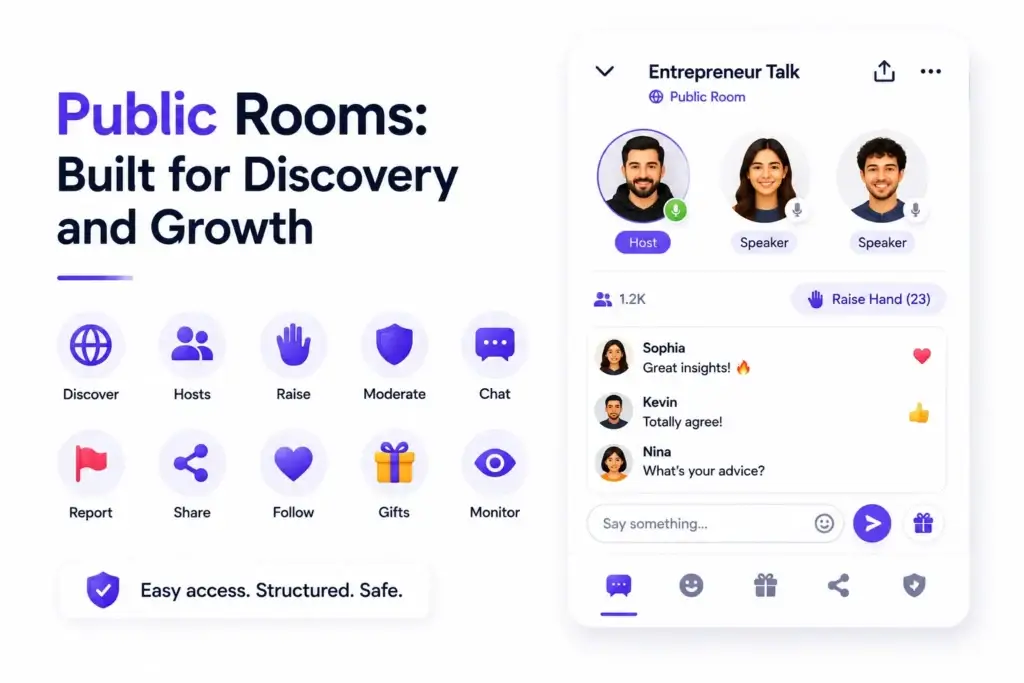
Public rooms are the growth engine of a live audio platform.
They help new users discover conversations, follow creators, listen before participating, and understand what the platform is about. Public rooms can also create social proof because users can see active conversations happening in real time.
A public room usually needs:
- Room title and topic
- Public visibility in discovery
- Host and speaker roles
- Listener entry
- Hand-raise queue
- Moderator controls
- Chat or reactions where relevant
- Report button
- Room sharing
- Follow host or speaker actions
- Gift or monetization options
- Admin monitoring
Public rooms work best when the topic is clear and the host can manage attention.
The problem is that open access increases risk. More visibility can bring more spam, off-topic behavior, low-quality speakers, or disruptive users. This is why public rooms should never rely only on the host’s judgment. The app itself should provide structure.
A public room should make participation easy, but not uncontrolled.
Private Rooms: Built for Trust, Exclusivity, and Community Control
Private rooms serve a different purpose.
They are not designed mainly for mass discovery. They are designed for controlled conversation. This makes them useful for VIP communities, creator fan circles, expert sessions, paid workshops, private networking, internal teams, closed groups, and invite-only events.
A private room workflow may include:
- Invite-only access
- Password-based access
- Follower-only entry
- VIP or paid member access
- Host approval
- Limited sharing
- Hidden room visibility
- Smaller speaker limits
- Stronger moderation rules
- Member list privacy where relevant
- Admin audit logs
Private rooms create trust because users know the conversation is not completely open.
For creators, private rooms can support premium community building. For businesses, they can support leadership sessions, paid communities, support groups, training discussions, or invite-only networking. For founders, they create a path to monetization without forcing every experience into public discovery.
But private rooms still need strong controls.
If access rules are unclear, users may feel locked out unfairly. If private room links are shared without restriction, the room may lose its exclusivity. If moderation is weak, a private room can still become unsafe.
Access Control: The Foundation of Room Quality
Access control decides who can enter, who can speak, who can invite others, and who can manage the room.
In a Social Audio Platform, access control should not be limited to a simple public/private toggle. A strong platform should support multiple permission layers.
| Access Layer | What It Controls | Example Use |
|---|---|---|
| Room visibility | Who can see the room in discovery | Public, hidden, followers-only |
| Entry permission | Who can join the room | Anyone, invite-only, VIP, password |
| Speaking permission | Who can speak | Host-approved, moderator-approved, auto-speaker |
| Sharing permission | Who can invite others | Host only, speakers, all listeners |
| Monetization permission | Who can access paid rooms | Coin users, VIP members, paid ticket holders |
| Moderation permission | Who can remove, mute, or approve users | Host, co-host, moderator, admin |
This structure gives founders more control over the community experience.
For example, a public room may allow anyone to listen but only approved users to speak. A VIP room may allow only paid members to enter but still require host approval for speakers. A private coaching room may block sharing entirely and allow only invited users.
The more flexible the access layer, the easier it becomes to create different community formats.
Host and Moderator Controls Should Change by Room Type
Hosts and moderators need different levels of control depending on room visibility.
For platforms expecting bigger live sessions, this guide on large voice room management explains how speaker queues, host permissions, moderation, and real-time room controls help protect conversation quality.
A public event may require strict speaker approval and active reporting tools. A small private room may need simpler controls but stronger access management. A VIP room may need both monetization rules and community rules.
For rooms with bigger audiences, this guide on large voice room management explains how speaker queues, host permissions, moderation, and real-time room controls help protect conversation quality.
Important host controls include:
- Start, pause, and end room
- Edit room title or topic where allowed
- Invite speakers
- Approve hand-raise requests
- Mute speaker
- Remove speaker from stage
- Remove user from room
- Assign moderator
- Disable hand raise
- Disable chat
- Pin room rules
- Control gift visibility
- Block disruptive users
Important moderator controls include:
- Review reports
- Manage speaker queue
- Remove inappropriate chat messages
- Mute disruptive speakers
- Escalate serious issues
- Support host during large rooms
- Keep conversation on topic
The founder’s goal should be to make room management easy without overwhelming hosts.
If controls are buried or confusing, hosts may not act quickly. In live audio, delayed moderation can damage the entire room.
Moderation in Public Rooms vs Private Rooms
Moderation is not the same in every room.
Public rooms usually need stronger real-time moderation because anyone may enter. Private rooms need trust-based moderation because users expect a safer and more controlled environment.
| Moderation Area | Public Room Approach | Private Room Approach |
|---|---|---|
| Speaker access | Host or moderator approval | Host approval or member-based rules |
| Reporting | Visible and easy for all users | Available but less intrusive |
| Chat moderation | Rate limits, deletion, filters | Group-specific rules and admin review |
| User removal | Fast action for disruption | Clear reason and audit record |
| Room discovery | Monitored for public quality | Controlled visibility |
| Rule display | Public room rules should be visible | Private group rules should be clear before entry |
Public rooms should prioritize speed and protection. Private rooms should prioritize trust and consistency.
A platform can support moderation workflows, reporting, and admin controls, but final community quality also depends on clear policies, active hosts, trained moderators, and consistent enforcement.
Community Control: Letting Founders Shape the Room Ecosystem
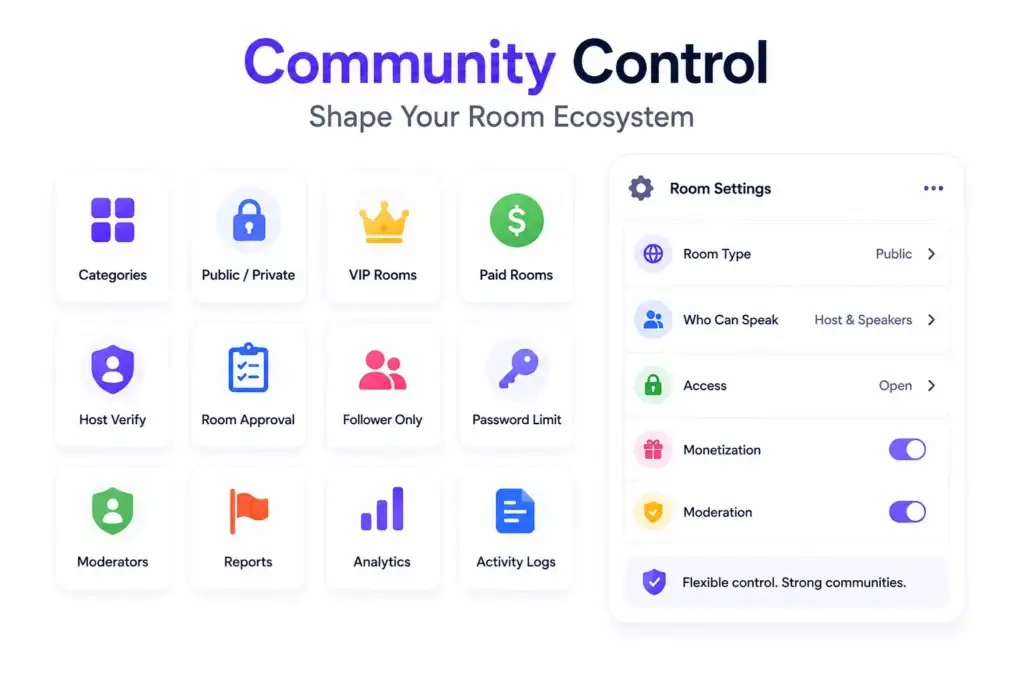
A Social Audio Platform should give the operator control over how communities form.
Some platforms want open public discovery. Others want curated communities. Some want creator-led paid rooms. Others want private interest groups, coaching spaces, fan communities, or invite-only networking.
This is why room settings should be configurable.
Community control can include:
- Room category management
- Public/private room rules
- VIP room creation permissions
- Paid room settings
- Creator eligibility rules
- Host verification
- Room approval workflows
- Follower-only room options
- Password room limits
- Report handling
- Moderator assignment
- Abuse prevention
- Admin activity logs
- Room analytics
Without these controls, every community format starts to look the same. That weakens the platform’s ability to serve different audiences.
A founder building a professional audio community may need stricter access rules. A creator entertainment platform may need gifting, VIP rooms, and follower-only sessions. A learning-focused audio platform may need scheduled private rooms and speaker approval. A social hangout app may need more casual public rooms with lightweight controls.
The product should support the business model, not force the business model into one room type.
Monetization: How Private and Public Rooms Create Different Revenue Paths
Private and public rooms can both generate revenue, but they do it differently.
Public rooms usually monetize through audience scale. Private rooms usually monetize through exclusivity and access.
| Monetization Model | Best Room Type | How It Works |
|---|---|---|
| Virtual gifts | Public and private | Listeners send gifts to hosts or speakers |
| Coin packages | Public and private | Users buy coins to spend inside rooms |
| VIP access | Private or premium rooms | Members access exclusive rooms or benefits |
| Paid room entry | Private or event-based rooms | Users pay to join a specific session |
| Creator earnings | Public and private | Hosts earn from gifts, paid access, or platform rewards |
| Sponsored rooms | Public rooms | Brands support high-visibility rooms or events |
| Premium community access | Private rooms | Users pay for closed groups or recurring access |
This is why room access and monetization should be connected.
If a user pays for VIP access, the platform must define what VIP actually unlocks. If a user buys coins to enter a private room, the app must clearly show whether access is temporary, recurring, or session-based. If public rooms include gifting, hosts need visibility into earnings and activity.
For a deeper revenue breakdown, explore the social audio app business model and how coins, gifting, VIP access, platform fees, private rooms, and creator earnings can work together.
Admin Controls Needed for Private and Public Rooms
The admin panel is where room strategy becomes manageable.
A founder cannot personally monitor every room, every report, every speaker request, and every payment issue. The operator needs a dashboard that turns live activity into controlled workflows.
Admin Controls for Private and Public Audio Rooms
| Admin Control | What It Manages | Founder Impact |
|---|---|---|
| Room visibility settings | Public, private, follower-only, VIP, and password-based rooms | Allows different community formats inside one platform |
| User and host management | Profiles, room creation rights, host status, bans, and restrictions | Protects platform quality as communities grow |
| Moderator permissions | Roles, reports, removals, mutes, speaker approvals, and escalation | Supports real-time conversation safety |
| Paid access rules | VIP rooms, coin access, paid sessions, and subscription rules | Connects room control with monetization |
| Gift and wallet controls | Coin packages, virtual gifts, creator earnings, and transaction records | Creates a clearer revenue and payout structure |
| Report review queue | User reports, room complaints, inappropriate behavior, and actions | Improves trust and operational accountability |
| Room analytics | Attendance, listening time, speaker activity, gifts, reports, and drop-off | Helps founders understand which room formats work best |
Founders can also review the live social audio platform features to understand how public rooms, private rooms, host permissions, gifting, VIP access, moderation, and operator controls work together.
Founder Decision Signals: Which Room Model Should You Prioritize?
Speed
Start with public rooms, private rooms, host controls, speaker approval, reporting, and basic admin visibility before adding advanced paid community formats.
Cost
Room access logic can increase scope when it includes VIP rules, paid entry, password rooms, invite-only communities, wallet flows, and advanced moderation.
Scalability
If your app will support creators, paid groups, fan rooms, public events, and private communities, build configurable access rules instead of hardcoding one room type.
Market Fit
Choose public-first if discovery matters most. Choose private-first if trust, exclusivity, paid access, or close-knit community behavior matters more.
Before choosing the full build scope, founders should review the social audio platform development cost factors, including room permissions, private access, VIP workflows, wallet systems, moderation tools, admin dashboards, and customization requirements.
Public-First vs Private-First Platform Strategy
Not every Social Audio Platform should grow the same way.
A public-first strategy works when the platform depends on visibility, open conversation, creator discovery, and broad audience growth. This approach is common when the app needs active rooms to attract new users.
A private-first strategy works when trust, exclusivity, or paid access is more important. This approach is useful for expert communities, creator memberships, coaching groups, professional networking, niche interest groups, or invite-only social circles.
| Strategy | Best For | Product Priority |
|---|---|---|
| Public-first | Creator discovery, open events, topic communities | Room ranking, sharing, moderation, speaker queues |
| Private-first | VIP groups, paid rooms, professional communities | Access control, invite flows, privacy, member management |
| Hybrid | Platforms serving both creators and communities | Configurable room settings and admin rules |
Most startups eventually need a hybrid model.
Public rooms bring people in. Private rooms deepen relationships. VIP or paid rooms create monetization. The platform should let the founder move users from discovery to belonging without forcing every conversation into the same room format.
Many founders explore digital entertainment solutions before deciding how to structure live rooms, creator communities, paid access, gifting, and moderation workflows.
Common Mistakes Founders Should Avoid
Treating Private Rooms as Only Hidden Public Rooms
Private rooms need stronger access rules, invite control, member clarity, and trust expectations. They are not just public rooms with lower visibility.
Launching Public Rooms Without Moderation Tools
Open rooms can grow quickly, but without reporting, mute controls, speaker approval, and admin review, the conversation can become unsafe or low quality.
Making VIP Access Confusing
If users do not understand which rooms VIP unlocks, how long access lasts, or what benefits they receive, paid access can create frustration instead of loyalty.
Using One Room Rule for Every Community
Creator fan rooms, expert sessions, public debates, private groups, and paid events need different permissions. A flexible room system gives the operator better long-term control.
How a Ready-Made Platform Helps Founders Manage Room Control Faster
Building private and public room logic from zero can become complex.
The platform needs room creation, visibility settings, password access, invite flows, follower-only rules, VIP access, paid entry, host permissions, speaker approval, moderator roles, report queues, wallet flows, notifications, analytics, and admin controls. Each module must work together while conversations are happening in real time.
Founders comparing build routes can also read this guide on a ready-made live social audio platform to understand why startups often choose launch-ready room, gifting, VIP, moderation, and admin workflows over building everything from zero.
A ready-made foundation can reduce avoidable development work and help founders focus on community positioning, creator onboarding, room programming, monetization, moderation policies, and user retention.
Miracuves helps founders build social entertainment platforms with white-label branding, admin dashboards, source-code ownership, monetization workflows, and faster deployment support. If you want a launch-ready foundation for public rooms, private rooms, host controls, gifting, VIP access, and community moderation, explore this ready-made live social audio platform from Miracuves.
You can also work with a social audio platform development partner if you need help planning room access logic, private community workflows, VIP rules, wallet systems, moderation controls, and launch execution.
Related reading: travel platform business model breakdown.
Final Thoughts: Room Access Is a Product Strategy Decision
A Social Audio Platform should not treat private and public rooms as basic toggles.
They are different community experiences.
Public rooms help users discover conversations, creators, and communities. Private rooms help users build trust, exclusivity, and deeper relationships. VIP rooms and paid rooms create monetization opportunities, but they also require clear access rules and strong admin control.
For founders, the right decision depends on the audience. A creator-led entertainment app may need public discovery and gifting. A professional community may need private rooms and member approval. A fan community may need VIP access and paid events. A hybrid platform may need all of these options working together.
The stronger product is not the one with the most room types. It is the one where access, moderation, monetization, and community control are designed around real user behavior.
Miracuves helps founders move faster with white-label, source-code-owned app foundations designed for social audio, creator engagement, monetization, moderation, and long-term product growth.
For founders comparing ready-made and custom build routes, Miracuves’ clone app development services can help turn a proven app concept into a branded, scalable, and monetization-ready product.
FAQs
What is a Social Audio Platform?
A Social Audio Platform is a voice-first community app where users join live audio rooms, listen to speakers, raise hands, participate in conversations, follow hosts, send gifts, access premium rooms, and interact in real time.
What is the difference between public and private rooms in a Social Audio Platform?
Public rooms are visible and open for discovery, while private rooms limit access through invites, passwords, VIP status, follower rules, or host approval. Public rooms help growth, while private rooms support trust and exclusivity.
When should founders use public rooms?
Founders should use public rooms when they want discovery, open participation, creator reach, topical conversations, live events, audience growth, and community visibility.
When should founders use private rooms?
Private rooms are useful for VIP communities, paid access, invite-only groups, expert sessions, coaching rooms, professional networking, fan communities, and controlled conversations.
How can a Social Audio Platform control who speaks?
The platform can control speaking through host approval, hand-raise queues, speaker roles, moderator approval, mute controls, speaker limits, and room-level permissions.
How do private rooms make money?
Private rooms can monetize through VIP access, paid entry, coin-based access, creator memberships, premium communities, private coaching sessions, and exclusive events.
What moderation tools are important for public rooms?
Important moderation tools include reporting, mute controls, speaker removal, room removal, chat moderation, moderator roles, blocked-user controls, admin review queues, and activity logs.
Can Miracuves help build a social audio platform with private and public rooms?
Yes. Miracuves helps founders build social audio platforms with public rooms, private rooms, speaker controls, gifting, VIP access, moderation workflows, admin dashboards, white-label branding, source-code ownership, and faster deployment support.
Miracuves is an independent software development company. We are not affiliated with, connected to, sponsored by, or endorsed by any company or product named in this article.
Terms such as “X Clone” are used descriptively. It is how the software industry refers to building a platform with functionality comparable to a known service, and how clients search for it.
The entire design and codebase of our products is built by our own team. Our products contain no code, design, graphics, or content originating from any third-party website or applications.
All third-party names and marks referenced in this article are the property of their respective owners, referenced solely to identify the services discussed.