


















Key Takeaways
What You’ll Learn
- Clubhouse is an audio-only social app where users join live rooms, listen, speak, or host conversations.
- Rooms are the core experience with open, social, and closed formats for different audience types.
- The app works through real-time voice interaction using speakers, listeners, hand-raise controls, and moderators.
- Clubhouse grew through FOMO and community by making live audio feel spontaneous and exclusive.
- The main lesson for founders is to build social apps around presence, simplicity, and real-time engagement.
Stats That Matter
- The article explains Clubhouse as a social audio platform for live rooms, discussions, clubs, and speaker-led conversations.
- Core user flow includes signup, profile setup, interest selection, home feed, room discovery, and live participation.
- Room types include Open, Social, and Closed to support public chats, follower-only rooms, and invite-only sessions.
- Monetization options include premium rooms, sponsored audio spots, subscription clubs, affiliate integrations, tips, and ticketed rooms.
- Clone app features include real-time audio streaming, room moderation, club discovery, push notifications, social login, AI recognition, captions, and analytics.
Real Insights
- Clubhouse worked because it removed video pressure while keeping conversations live, social, and personal.
- Its strongest growth came from exclusivity through invite-only access, celebrity rooms, and niche communities.
- Audio rooms feel more natural than feeds because users can listen quietly or join when they are ready.
- Moderation is critical in live audio because speakers, listeners, and room quality must be controlled in real time.
- For founders, build a Clubhouse-style audio app around live rooms, clubs, moderation tools, monetization, notifications, and scalable voice infrastructure.
Imagine walking past a room full of people passionately debating whether pineapple belongs on pizza, and instead of being awkward, you’re invited in to join the chat. That’s Clubhouse in a nutshell.
Back when TikTok was teaching us dances and Instagram was trying to keep up, Clubhouse burst onto the scene with something fresh: audio-only conversations. No filters, no makeup, no curated feeds. Just your voice and your vibe. Creators, startup founders, investors — even Elon Musk — jumped in. It was like Twitter, but instead of hot takes, you got hot discussions.
For entrepreneurs and digital creators trying to stand out in a noisy world, Clubhouse offered intimacy at scale. And guess what? That opened up a golden opportunity for app developers and clone creators. If you’re eyeing the next viral social app, Miracuves is already one step ahead.
What Exactly is Clubhouse?
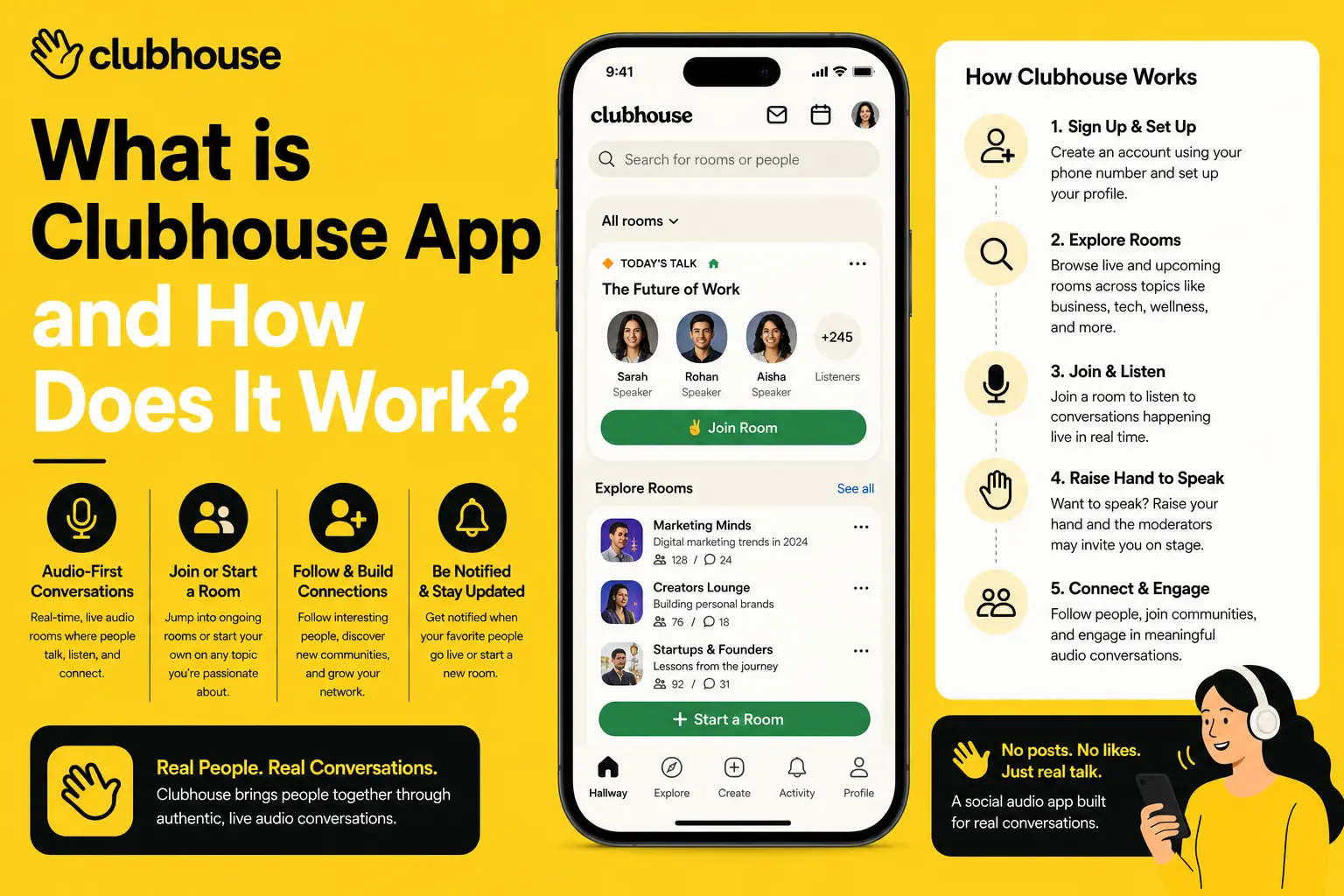
Clubhouse is a social audio platform where users can drop in on live conversations, join discussions, or start their own virtual room. Think of it like attending a never-ending conference where you can raise your hand, speak up, or just quietly listen in.
Originally launched in 2020 as an invite-only iOS app, it quickly became a cultural phenomenon. By mid-2021, it expanded to Android, opening the floodgates to the masses. Within a year, it clocked millions of downloads and became the go-to app for thought leaders, influencers, and niche communities.
Key Clubhouse Terms:
- Rooms: Where live chats happen
- Clubs: Groups centered around specific topics or interests
- Mods (Moderators): People running the room
- Listeners & Speakers: Users who can either chill quietly or join the convo
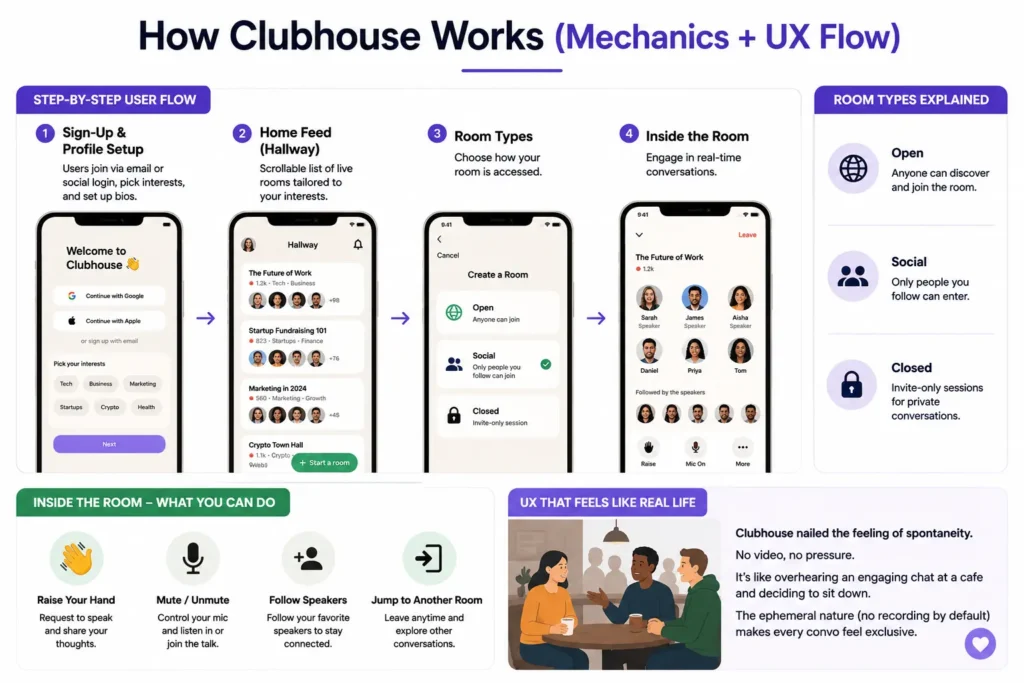
How Clubhouse Works (Mechanics + UX Flow)
Step-by-Step User Flow
- Sign-Up & Profile Setup: Users join via email or social login, pick interests, and set up bios.
- Home Feed (Hallway): Scrollable list of live rooms tailored to your interests.
- Room Types:
- Open: Anyone can join
- Social: Only people you follow can enter
- Closed: Invite-only sessions
- Inside the Room:
- Raise your hand to speak
- Mute/unmute mic
- Follow speakers or jump to another room
UX That Feels Like Real Life
Clubhouse nailed the feeling of spontaneity. No video, no pressure. It’s like overhearing an engaging chat at a cafe and deciding to sit down. The ephemeral nature (no recording by default) makes every convo feel exclusive.
Why Clubhouse Blew Up (And What It Teaches Us)
Timing is Everything
During the COVID-19 lockdown, people craved connection. Zoom fatigue was real. Enter: voice-only hangouts with zero performance anxiety.
Celebrity Effect + FOMO
When Elon Musk and Mark Zuckerberg started hosting sessions, it created insane buzz. Add invite-only access, and you’ve got the digital equivalent of an exclusive backstage pass.
Community-Led Growth
Niche communities flourished — think startup funding tips, crypto alpha groups, poetry slams, and casual gossip rooms. Clubhouse gave them a home.
Break down Clubhouse’s marketing magic — a smart mix of hype, brand positioning, and authentic conversation culture.
Monetization & Revenue Potential
While Clubhouse itself explored tipping, ticketed events, and creator grants, a clone app can unlock even more revenue streams:
- Premium Rooms: Charge entry for expert-led discussions
- Ad Spots: Sponsored rooms or interstitial audio ads
- Subscription Clubs: Recurring revenue from premium content
- Affiliate Integrations: Partner with brands, sell tools/products via live talk
Building a Clubhouse Clone with Miracuves
Want to tap into the audio-first trend? Miracuves helps you build your own Clubhouse-like app with ready-to-go features and robust backend support.
Core Features to Include
- Real-time audio streaming
- Room moderation tools
- Club creation & discovery
- Push notifications for live events
- Social login & user profile management
Advanced Add-ons
- AI speaker recognition
- Transcription and live captions
- Monetization modules
- Admin dashboard with analytics
With Miracuves, you don’t just get code. You get a scalable, monetizable, and user-friendly platform ready to launch in weeks, not months.
Why startups prefer our Clubhouse clone — cost-effective, customizable, and built for rapid growth without the risks of custom development.
Clubhouse vs Other Audio Apps
| Feature | Clubhouse | Twitter Spaces | Spotify Live | Your Clone App |
|---|---|---|---|---|
| Live Audio Rooms | Yes | Yes | Yes | Yes |
| Monetization | Limited | Some | Experimental | Fully Custom |
| Club Creation | Yes | No | No | Yes |
| Recordings | Manual | Yes | Yes | Optional |
| Branding Control | No | No | No | Full White-label |
Explore the best Clubhouse clone scripts of 2026 — compare cutting-edge features, customization options, and pricing to launch your own audio-based social platform.
Conclusion
In a world where attention spans are shorter than a goldfish’s, audio apps like Clubhouse offer depth, nuance, and presence. They’re perfect for creators looking to connect, startups aiming to engage users, and entrepreneurs building meaningful digital products.
At Miracuves, we help innovators launch high-performance app clones that are fast, scalable, and monetization-ready. Ready to turn your idea into reality? Let’s build together.
FAQs
Is Clubhouse free to use?
Yes, Clubhouse is completely free to use, though some rooms may charge entry or tips.
Can you make money on Clubhouse?
Yes, via tips, ticketed rooms, or partnerships — but it’s limited. A clone app can offer way more options.
Is video involved in Clubhouse?
Nope. It’s audio-only. That’s the beauty of it — no camera pressure.
Do Clubhouse rooms get recorded?
Not by default, but hosts can choose to record. Always check the room settings.
Can I build my own Clubhouse clone?
Absolutely. With Miracuves, you can create a customized, feature-rich audio social app.
Is Clubhouse still popular?
It has niche appeal now, but the audio trend is alive and evolving. A well-executed clone can capture that momentum.
Related Articles :-
Miracuves is an independent software development company. We are not affiliated with, connected to, sponsored by, or endorsed by any company or product named in this article.
Terms such as “X Clone” are used descriptively. It is how the software industry refers to building a platform with functionality comparable to a known service, and how clients search for it.
The entire design and codebase of our products is built by our own team. Our products contain no code, design, graphics, or content originating from any third-party website or applications.
All third-party names and marks referenced in this article are the property of their respective owners, referenced solely to identify the services discussed.