





















Key Takeaways
- Before launching a subscription-based platform, startups should define the target audience, creator or content supply, membership structure, pricing, payment flows, and core value proposition.
- The MVP should prioritize onboarding, subscription plans, recurring billing, premium content access, user accounts, notifications, analytics, and essential admin controls.
- Security, payment reliability, content permissions, creator payouts, compliance, scalability, and customer support should be planned before acquisition campaigns begin.
Pre-Launch Priority Signals
- Startups should validate pricing tiers, free versus paid access, renewal rules, trials, discounts, cancellation flows, failed-payment handling, refunds, and subscription upgrades.
- Content discovery, creator profiles, premium content gates, messaging, live access, recommendations, and member benefits should support a clear path from visitor to paying subscriber.
- Test signup completion, checkout, payment confirmation, access permissions, subscription renewal, payout calculations, notifications, moderation, and admin workflows before launch.
Founder Readiness Insights
- Founders should define acquisition channels, activation goals, subscription conversion targets, retention metrics, content cadence, support processes, and early growth experiments before going live.
- A focused launch should prove that users can discover value, complete payment, access premium benefits, return regularly, and renew before the platform expands into advanced features.
- Miracuves develops customizable subscription-based platforms with memberships, recurring payments, premium content, creator tools, messaging, live access, payouts, analytics, security, and admin controls.
Launching a subscription-based platform sounds simple from the outside. A user signs up, pays every month, and gets access to premium content, creators, services, or a private community.
But for startups, the real product is not just the subscription button.
The real product is the complete system behind recurring access. That includes user onboarding, creator or provider management, pricing rules, content protection, renewals, payment failures, refunds, moderation, privacy, payouts, analytics, admin controls, and long-term retention.
This is especially important for creator-led and premium content platforms where users pay for exclusive access, private interaction, direct messaging, live sessions, or gated media. A weak launch foundation can create problems quickly: failed payments, unclear access rules, creator payout disputes, privacy complaints, refund issues, and poor subscriber retention.
For founders exploring a faster launch route, a subscription-ready creator platform foundation can help reduce the effort of building every payment, content access, creator, subscriber, and admin workflow from zero. The stronger decision, however, is not just choosing software. It is knowing what to prioritize before going live.
1. Start With a Clear Subscription Niche Before Choosing Features

Many startups begin with a feature list. They want subscriptions, locked content, paid messages, live streaming, tips, creator profiles, wallets, analytics, and mobile apps.
Those features matter, but the niche matters first.
A subscription-based platform succeeds when users have a strong reason to pay repeatedly. That reason may be exclusive creator access, adult content, fitness coaching, expert communities, entertainment, private education, fan engagement, niche media, or premium digital products.
Before launch, founders should define:
- Who will pay every month?
- What exclusive value will they receive?
- Who will create or provide that value?
- Why would users subscribe here instead of using public social platforms?
- What niche is specific enough to build trust, but large enough to grow?
A broad platform for “all creators” is difficult to position. A focused platform for a creator category, region, language, agency model, lifestyle community, adult niche, coaching segment, or premium fan group is easier to explain, market, and monetize.
Founders should not treat niche selection as a branding task. It affects onboarding, payments, moderation, content policies, discovery, pricing, support, and platform rules.
2. Validate Creator Supply and Subscriber Demand Together
A subscription platform has two sides: the people offering value and the people paying for access.
If creators or providers do not join, subscribers have nothing to buy. If subscribers do not convert, creators lose motivation. This makes pre-launch validation more important than building a large feature set.
Startups should validate both sides before launch.
| Validation Area | What to Check | Why It Matters |
|---|---|---|
| Creator supply | Will creators, coaches, influencers, experts, or publishers join before launch? | The platform needs valuable supply before users are asked to pay. |
| Audience demand | Are fans or members already paying for similar access elsewhere? | Recurring revenue depends on willingness to pay, not just curiosity. |
| Content frequency | Can creators publish often enough to justify renewals? | Subscription churn increases when paid access feels inactive. |
| Pricing comfort | What monthly price feels realistic for the audience? | Wrong pricing can reduce conversion or weaken creator earnings. |
| Trust readiness | Can the platform verify creators, protect users, and manage disputes? | Trust issues can damage both acquisition and retention. |
A smart launch can begin with a smaller group of verified creators or providers instead of opening the platform to everyone. This gives the startup more control over quality, policies, support, and early feedback.
Once the niche and early creator supply are clear, a focused creator platform marketing strategy can help attract the first creators and paying subscribers without depending only on broad social media promotion.
3. Build the Revenue Model Before Building the Interface
Subscription revenue is important, but it is rarely the only monetization layer.
Many successful premium access platforms use multiple revenue paths. Recurring memberships create stability, while pay-per-view content, tips, paid messaging, paid calls, live sessions, bundles, platform commissions, and promotional placements can increase transaction volume.
Startups should decide which revenue streams matter at launch and which can be added later.
Before choosing the final monetization mix, founders should map the complete creator platform business model, including subscriptions, paid content, direct messaging, tips, commissions, creator payouts, and refund rules.
| Revenue Stream | Best Use Case | Founder Decision |
|---|---|---|
| Monthly subscriptions | Recurring access to creator profiles, premium content, communities, or exclusive updates. | Useful as the foundation of predictable revenue. |
| Pay-per-view unlocks | Individual premium posts, videos, media bundles, or special content drops. | Helpful when users may buy specific content without subscribing. |
| Paid messaging | Private creator-fan interaction, locked media in chat, or premium replies. | Strong for platforms where personal interaction drives spending. |
| Tips and gifts | One-time fan support during posts, live sessions, or creator milestones. | Creates low-friction spending beyond subscriptions. |
| Live sessions and calls | Paid livestreams, private sessions, coaching calls, or fan interaction events. | Useful for engagement-heavy communities. |
| Creator storefronts | Digital products, merchandise, bundles, services, or premium downloads. | Expands revenue beyond content access. |
The mistake is adding monetization features without defining the platform commission logic, payout rules, refund policy, tax documentation needs, and creator earnings dashboard. Revenue features should work as one connected system, not separate buttons scattered across the app.
For founders who want a prebuilt monetization foundation, Miracuves provides subscription, paid content, wallet, payout, and admin workflows through its white-label creator platform solution</a>, which can then be customized around the startup’s business model.
4. Prioritize Subscription Access Control From Day One
Access control is one of the most important technical layers in a subscription-based platform.
When users pay for premium access, the backend must know exactly what they can view, unlock, download, message, join, or renew. Simply hiding content in the interface is not enough. A strong system should validate access based on subscription status, payment status, creator settings, user verification, geographic restrictions, content rules, and account permissions.
A clear creator subscription platform feature set helps founders separate must-have launch workflows from advanced features that can be added after validation.
Important access-control priorities include:
- Free vs paid content visibility
- Subscription tier permissions
- Expired subscription handling
- Grace periods and failed-payment logic
- Pay-per-view purchase history
- Locked media protection
- Creator-specific pricing rules
- Refund and cancellation handling
- Role-based admin access
For adult or sensitive content categories, access control becomes even more important because the platform may need age checks, identity verification, content restrictions, blocked regions, reporting tools, and moderation queues.
This is not just a technical issue. It affects trust, revenue, creator confidence, and legal risk.
5. Plan Payments, Payouts, Wallets, and Refunds Before Launch
Payments can make or break a subscription-based platform.
Payment gateways, wallet logic, creator payouts, refund handling, moderation workflows, and custom branding all affect subscription platform development cost, so these decisions should be planned before development begins.
Startups often focus on collecting money from users, but a real subscription platform also needs to manage creator earnings, platform commissions, payout timing, failed renewals, refunds, chargebacks, tax records, payment gateway rules, and transaction history.
Before launch, founders should clarify:
- Which payment providers support the platform category?
- Will the platform use direct payments, wallets, or both?
- How will creator payouts be calculated?
- Will the platform hold commissions before payouts?
- What happens when a subscription payment fails?
- How are refunds, disputes, and chargebacks handled?
- Can admins view transaction logs and payout reports?
- Are regional payment methods needed for the target market?
A subscription business should not rely on manual spreadsheets to manage creator earnings. Even at early stage, founders need a clear ledger, payout reports, transaction status, and admin visibility.
Payment planning is also where many adult or premium creator platforms face friction. Some payment providers have stricter rules for high-risk categories, private content, adult creators, or user-generated media. Founders should confirm payment-provider suitability before launch instead of treating it as a final setup task.
6. Make Trust, Privacy, and Moderation Part of the Product Foundation
A subscription-based platform asks users to trust the brand with money, identity, content, private interaction, and account access.
That trust must be built into the platform from the beginning.
For creator and premium content businesses, moderation is not optional. Platforms need policies, reporting flows, admin review tools, creator verification, user restrictions, takedown workflows, content rules, and activity logs.
Key trust layers include:
- Creator verification workflows
- Age-check or identity workflows where required
- Consent and content ownership records where relevant
- Content moderation queues
- Abuse reporting
- Watermarking or media protection options
- Private account and visibility settings
- Role-based admin permissions
- Audit logs for sensitive actions
- Dispute and refund workflows
For sensitive creator communities, founders should also review a practical creator platform security checklist before opening the platform to creators and subscribers.
A startup should avoid promising that software alone solves every legal or compliance issue. Final compliance depends on the target jurisdiction, business model, content category, payment partners, operating policies, and legal review.
The practical goal is to launch with a compliance-ready foundation that supports the right workflows, rather than trying to repair trust gaps after users and creators are already active.
7. Design Creator and Subscriber Onboarding Separately
Creators and subscribers do not join for the same reason.
Subscribers want simple discovery, quick signup, secure payment, clear content access, and confidence that the platform is safe. Creators want easy profile setup, pricing control, content uploads, monetization tools, analytics, messaging, payout visibility, and support.
Trying to use one generic onboarding flow for both groups creates friction.
A stronger subscription platform should separate the onboarding journey.
Onboarding Priorities for Subscription Platform Startups
| User Group | Launch Priority | Business Value |
|---|---|---|
| Subscribers | Fast signup, creator discovery, subscription checkout, saved payment flow, content access. | Reduces drop-off before the first paid action. |
| Creators | Profile setup, verification, pricing, content upload, payout details, analytics. | Helps creators start earning faster and stay active. |
| Admins | User approval, creator review, payment monitoring, reports, moderation, disputes. | Gives operators control over trust, quality, and revenue. |
The best onboarding systems reduce uncertainty. A creator should know what they can sell, how they get paid, what rules apply, and how they grow. A subscriber should know what they are paying for, how billing works, how access is managed, and how to contact support.
Strong onboarding also supports creator retention and subscriber loyalty, which matters more for recurring revenue than one-time launch traffic.
8. Decide What Must Launch Now and What Can Wait
A subscription-based platform can become feature-heavy very quickly.
Startups may want mobile apps, web dashboards, livestreaming, direct messaging, wallets, pay-per-view content, referrals, creator analytics, AI tools, shop modules, multilingual support, regional restrictions, and advanced marketing automation.
Not everything needs to launch on day one.
The first launch should focus on the workflows that prove the business model:
- Can creators or providers publish valuable premium content?
- Can users subscribe or unlock paid access easily?
- Can the platform collect payments reliably?
- Can creators see earnings and request payouts?
- Can admins manage users, content, payments, and disputes?
- Can the platform enforce privacy, safety, and content rules?
Advanced modules should support traction, not distract from it. For example, AI-powered recommendations may be useful later, but they will not fix a weak creator acquisition strategy. A creator shop may expand revenue, but it should not delay the launch if subscriptions and paid content are the first revenue priority.
This is where a launch-ready foundation can help. Miracuves can help startups move faster with a ready-made subscription platform structure, while keeping room for branding, feature customization, admin control, and source-code ownership.
Founder Decision Signals
Speed
If the business needs quick market validation, prioritize prebuilt subscription, payment, creator, content, and admin workflows instead of building every module from zero.
Cost
Cost should be judged by launch scope, integrations, content depth, payment complexity, and customization needs—not just the number of screens.
Scalability
Plan for media storage, recurring payments, creator growth, traffic spikes, moderation volume, and transaction history before the platform starts growing.
Market Fit
A subscription platform should prove that users will pay repeatedly for exclusive value before expanding into advanced features.
9. Compare Ready-Made and Custom Development Based on Launch Risk
Startups usually have two development routes: build from scratch or start with a ready-made foundation.
Custom development gives more architectural freedom, but it takes more planning, budget, and technical management. Ready-made development can reduce launch time because core workflows already exist, but it still needs proper customization, branding, payment setup, and operational alignment.
| Development Route | Best For | Watch Out For |
|---|---|---|
| Ready-made platform foundation | Founders who want faster launch, proven subscription workflows, admin control, and market validation. | Confirm customization limits, source-code terms, payment compatibility, and launch scope. |
| Custom development | Startups with unique architecture, proprietary workflows, complex integrations, or long-term internal engineering teams. | Requires more time, deeper technical planning, higher coordination, and stronger product documentation. |
| Hybrid approach | Businesses that want to launch from a proven base and customize selected modules for differentiation. | Needs clear prioritization so custom work does not delay core launch validation. |
A practical startup decision is not “ready-made or custom?” The better question is: “Which route helps us validate the market without sacrificing ownership, trust, monetization, and control?”
If the startup is comparing ready-made and custom routes, choosing the right creator platform development partner becomes as important as the feature list itself.
Founders evaluating this path can also read Miracuves’ guide on ready-made creator subscription platforms vs custom development for a deeper comparison.
10. Prepare the Admin Dashboard Before Scaling Marketing
Many subscription platform problems are not visible on the frontend.
They appear in the admin layer.
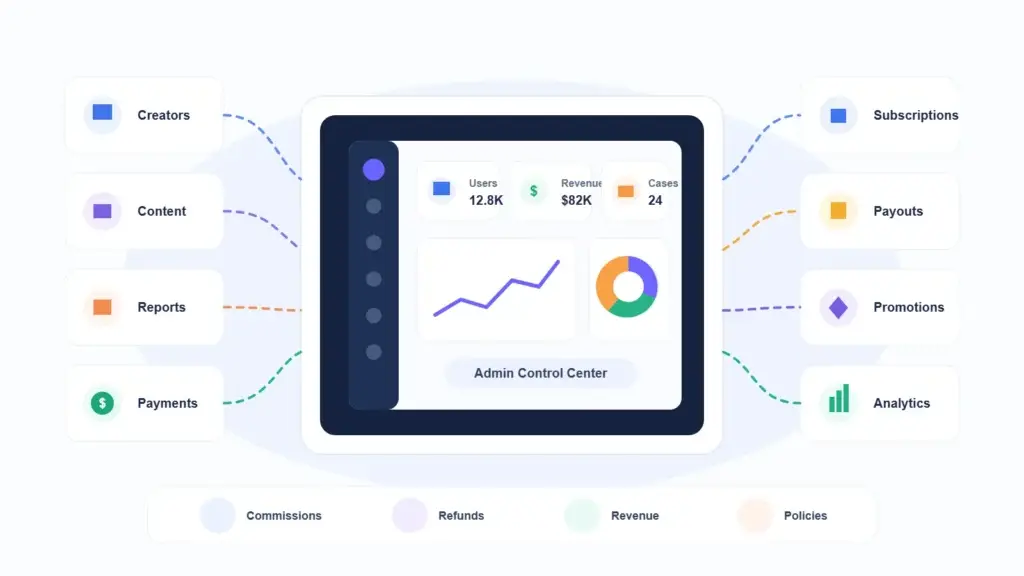
If admins cannot manage creators, subscribers, content reports, disputes, payments, payouts, commissions, refunds, and analytics, the business becomes difficult to operate even if the app looks polished.
A strong admin dashboard should help platform operators manage:
- User accounts and subscription status
- Creator applications and verification
- Content uploads and moderation queues
- Platform commissions and pricing rules
- Wallets, payments, refunds, and payout records
- Reports, complaints, and abuse cases
- Featured creators and promotional placements
- Analytics for revenue, subscribers, creators, and engagement
- Platform settings, categories, policies, and notifications
Founders should not treat the admin dashboard as a backend extra. It is the control center of the business. Without it, every small operational change becomes dependent on developers or manual work.
11. Create a Pre-Launch Checklist for Content, Policy, and Support
A subscription-based platform launches with more than software.
It needs policies, support flows, creator guidelines, payment rules, privacy expectations, refund rules, and operational documentation. This is particularly important for adult or premium content models where identity, consent, safety, content ownership, and regional restrictions may affect platform risk.
Before launch, prepare:
- Creator onboarding guidelines
- Subscriber terms and billing rules
- Content policy and restricted content rules
- Refund and cancellation policy
- Creator payout policy
- Moderation and report-handling process
- Privacy and account safety guidance
- Support response workflow
- Payment-provider documentation
- Legal review for target markets
This documentation improves trust. It also reduces confusion for creators, subscribers, support teams, and admins after launch.
Mistakes Founders Should Avoid
Building Features Before Validating the Niche
A long feature list cannot fix weak positioning. Validate the creator category, subscriber demand, pricing comfort, and launch audience before expanding the product scope.
Treating Payments as a Final Integration
Subscriptions, payouts, refunds, chargebacks, wallet history, and commission rules should be planned early because they affect the entire business model.
Ignoring Moderation and Access Control
Premium and adult content platforms need strong content rules, user reporting, verification, privacy settings, and backend access validation from day one.
Launching Without Admin Visibility
If admins cannot manage users, creators, content, payments, disputes, and analytics, the startup will struggle to operate the platform after launch.
How Miracuves Helps Startups Launch Subscription-Based Creator Platforms Faster
A subscription based platform is easier to launch when the foundation already includes the workflows founders need to validate the business.
Miracuves helps startups build white-label creator monetization platforms with branded design, source-code ownership, creator and subscriber workflows, subscription access, paid content, payments, payouts, moderation, analytics, and admin control.
For ready-made platform packages where the selected scope fits, Miracuves can support a 6-day launch timeline. This helps founders move faster without waiting months to test creator onboarding, subscriber payments, and monetization workflows.
The key advantage is not only speed. It is the ability to start from a working product foundation, customize it around your niche, and retain greater control over branding, business rules, and future growth.
Founders planning a premium creator or fan subscription business can review Miracuves’ launch-ready creator monetization solution to understand how subscription access, paid content, creator tools, payment flows, and admin workflows can fit into their launch plan.
Final Thoughts: Prioritize the Business System Before the Launch Date
Launching a subscription-based platform is not just about going live.
It is about building a business system where creators or providers can offer value, subscribers can pay confidently, content access is protected, payments are reliable, payouts are transparent, and admins have control over daily operations.
Startups should prioritize niche clarity, creator supply, subscription access, payment logic, trust workflows, moderation, onboarding, and admin visibility before investing in every advanced feature. The goal is to launch with enough strength to validate the market, learn from users, and expand without rebuilding the foundation too soon.
A ready-made platform can help reduce launch friction, but the business still needs clear strategy. With Miracuves, founders can move from planning to deployment faster while keeping room for customization, source-code ownership, monetization control, and long-term growth.
FAQs
What should startups prioritize before launching a subscription-based platform?
Startups should prioritize niche validation, creator or provider supply, subscriber demand, payment setup, subscription access control, payouts, content rules, moderation, admin dashboards, and launch support. These foundations matter more than adding every advanced feature before launch.
How do subscription-based platforms make money?
Subscription-based platforms usually make money through monthly memberships, platform commissions, pay-per-view content, paid messaging, tips, live sessions, creator storefronts, promotional placements, and transaction-based fees. The right model depends on the niche, user behavior, and creator monetization strategy.
Why is access control important for a subscription content platform?
Access control ensures that only eligible users can view premium content, messages, live sessions, downloads, or creator communities. It should be managed on the backend based on payment status, subscription tier, user role, creator settings, and platform rules.
Should a startup build a subscription platform from scratch or use a ready-made solution?
A ready-made solution is useful when the startup wants faster launch, prebuilt subscription workflows, admin control, and quicker market validation. Custom development is better when the business requires highly unique architecture, proprietary workflows, or complex integrations that cannot be handled through customization.
What features are essential for a creator subscription platform?
Essential features include creator profiles, subscriber accounts, subscription plans, locked content, pay-per-view access, paid messaging, payment gateway integration, creator payouts, admin dashboard, moderation tools, analytics, notifications, and privacy controls.
How important is moderation for premium or adult subscription platforms?
Moderation is very important because premium and adult content platforms often involve sensitive media, private interaction, identity checks, restricted content rules, and payment-provider expectations. Platforms should include reporting tools, review queues, verification workflows, audit logs, and clear content policies.
Can Miracuves help launch a subscription-based creator platform quickly?
Yes. Miracuves helps founders launch ready-made and white-label creator monetization platforms with subscription workflows, paid content, creator tools, payments, payouts, admin control, and source-code ownership. For eligible ready-made packages, Miracuves can support a 6-day launch timeline based on the selected scope.
What should founders check before choosing a subscription platform development partner?
Founders should check the working demo, source-code ownership, customization flexibility, payment architecture, creator and subscriber workflows, admin dashboard, moderation tools, deployment process, documentation, support terms, and whether the platform can match the planned business model.
Miracuves is an independent software development company. We are not affiliated with, connected to, sponsored by, or endorsed by any company or product named in this article.
Terms such as “X Clone” are used descriptively. It is how the software industry refers to building a platform with functionality comparable to a known service, and how clients search for it.
The entire design and codebase of our products is built by our own team. Our products contain no code, design, graphics, or content originating from any third-party website or applications.
All third-party names and marks referenced in this article are the property of their respective owners, referenced solely to identify the services discussed.